
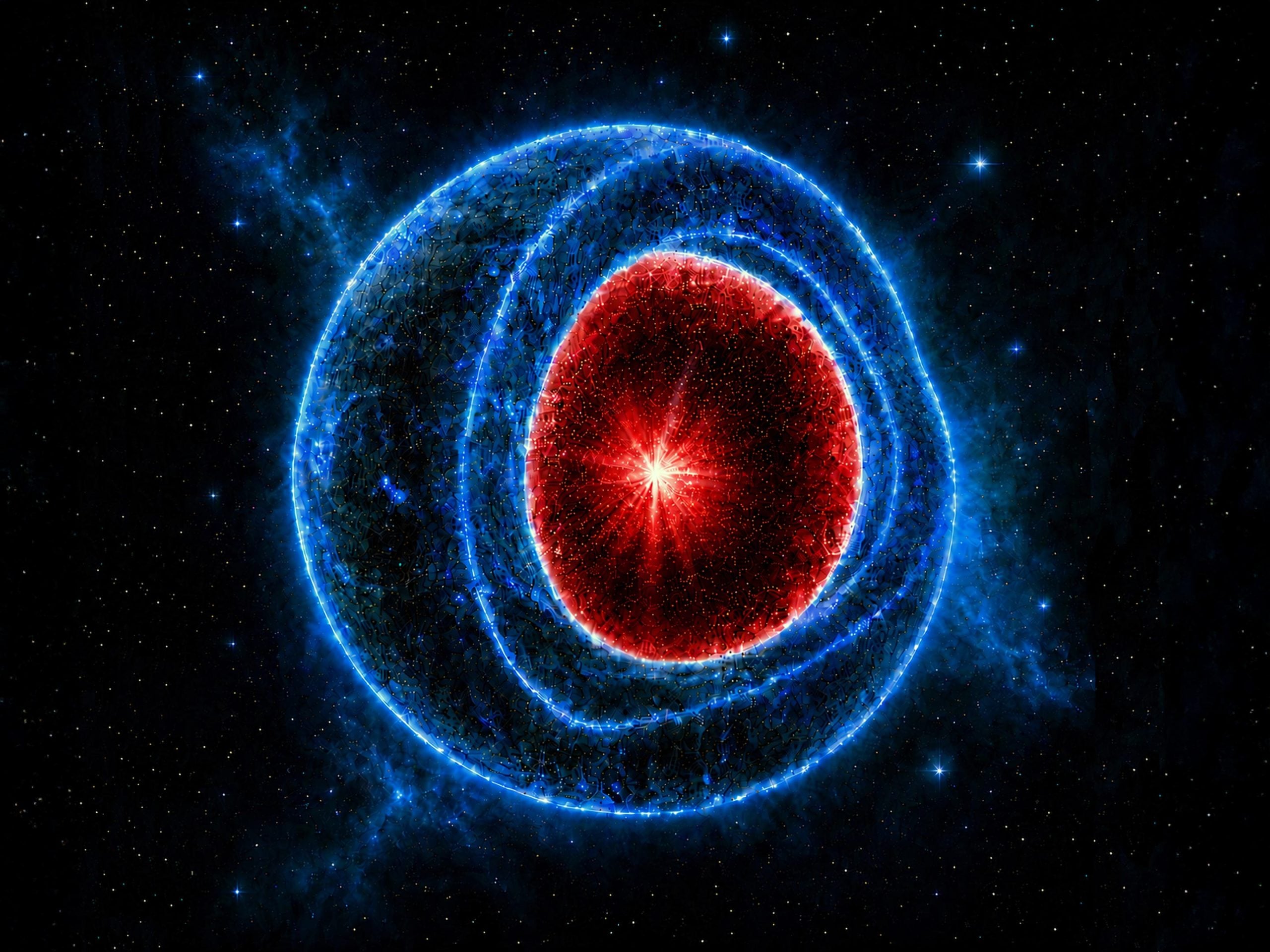
A new study suggests that the collapse of a massive star could spark the creation of a tiny expanding universe rather than a black hole. The resulting object, called a gravastar, would avoid the singularity and event horizon that make black holes so puzzling.
Massive stars produce light and heat through nuclear fusion in their cores. This process generates outward pressure that balances the inward pull of gravity. But when an extremely massive star runs out of fuel, that support disappears. Gravity takes over, causing the star to collapse inward until it reaches what physicists call a singularity, a point where matter is compressed to an extreme state.
Although black holes are widely accepted as the end result of this collapse, they raise some profound questions. How can the mass of billions of Suns be squeezed into a single point? How can spacetime become infinitely curved at the singularity? At that stage, the known laws of physics no longer provide reliable answers, making it impossible to predict what happens next. Black holes also hide everything beyond their event horizons, meaning that matter, energy, and even light can no longer be observed once they cross that boundary.
Gravastars as an Alternative to Black Holes
Because of these challenges, some scientists have explored the possibility that black holes might actually be different kinds of objects. One proposed alternative is the gravastar, short for gravitational vacuum star. These hypothetical ultra-compact objects would be nearly impossible to see because of their intense gravity.
Unlike black holes, gravastars would contain ordinary matter in their outer layers, while their interiors would be filled with dark energy. This mysterious form of energy would generate an outward pressure that counters gravitational collapse. As a result, gravastars could remain almost as massive and compact as black holes without containing either a singularity or an event horizon.
While gravastars have long attracted interest as a theoretical possibility, one major question has remained unanswered: how could they actually form?
Einstein’s Equations and a Mini Universe
Theoretical physicists Daniel Jampolski and Professor Luciano Rezzolla have now developed what they describe as the first dynamic solution to Albert Einstein’s equations of General Relativity that explains how a collapsing star could become a gravastar.
Their work suggests that, during the collapse of a massive star, a miniature universe could emerge within the collapsing matter. According to the researchers, this process would resemble the Big Bang that gave rise to our own universe. Just as dark energy is thought to drive the expansion of our universe, it would also power the growth of this newly formed mini-universe.
As the miniature universe expands, it pushes outward against the star’s inward gravitational collapse. This opposing force could stop the collapse before a black hole forms. Eventually, a balance develops between the expanding mini-universe and the collapsing stellar material. That balance creates a stable gravastar.
According to the researchers, this solution provides the first explanation for a problem scientists have debated for roughly 25 years: how gravastars might arise from the collapse of ordinary matter.
New Possibilities in Extreme Physics
Daniel Jampolski, who discovered the solution while completing his master’s thesis under the supervision of Luciano Rezzolla, explains: “The Big Bang of the emerging universe can unfold once the star has already collapsed almost to the point of becoming a black hole.”
The behavior of matter under such extreme compression remains poorly understood, leaving open the possibility that new physical effects could emerge. As Jampolski notes: “It is easier to imagine that the Big Bang occurs only at a very late stage, when matter has already been compressed to an extreme degree, thereby giving rise to new effects.”
Rezzolla, Professor of Theoretical Astrophysics at Goethe University, emphasizes that exploring alternatives does not mean dismissing black holes. He adds: “Looking for alternatives to black holes should not suggest a skepticism towards black holes, which still represent the most natural and simplest solution to the fate of gravitational collapse. However, as scientists in general, and as theoretical physicists in particular, it is essential to maintain an unbiased approach towards what we do not know and hence explore both the accepted wisdom and the more exotic interpretations. History teaches us that it is not unusual for the latter to become the former.”
Reference: “Formation of gravastars” by Daniel Jampolski and Luciano Rezzolla, 11 June 2026, Physical Review D.
DOI: 10.1103/c6lw-nx7k
Never miss a breakthrough: Join the SciTechDaily newsletter.
Follow us on Google and Google News.
3 Comments
“This ‘universe inside a dying star’ hypothesis is the closest mainstream physics has ever come to mapping the actual mechanical plumbing of cosmology. The mistake academia makes is treating the ‘Big Bang’ and a black hole collapse as two completely separate, isolated events. In reality, they are mirror images of the exact same continuous loop.The Torsion Hill Framework (V20) models a dying star not as a path to a mathematical infinity, but as a high-torque mechanical pump. The intense gravitational collapse is the definitive execution of the $1 + 1 = -1 \text{ Effect}$, drawing space-time down into a severe, localized dimensional compression nozzle (the ingestion trough).What physicists are calling a ‘bounce’ or a ‘white hole’ is simply the native safety valve of the universal engine: the Inversion Operator. Space-time cannot sustain a permanent negative deficit, so when it hits the maximum density threshold, the inversion valve flips the negative potential energy into a massive, outward positive expansion ($+3\text{D} + \text{T}$). The ‘Big Bang’ isn’t a historical anomaly from nothingness; it is the real-time restoration flash of a spatial matrix uncoiling on the other side of an inversion boundary. We aren’t seeing a paradox—we are looking at the universal pump at work.”
If fundamental particles really are unbreakable, and if the Pauli Exclusion Principle really does prevent any two identical quarks from occupying the same state, and if quantum spin really is unstoppable, and if quantum information really can’t be erased, then fundamental particles must be stored individually in a black hole, maintaining their identity and quantum information. Thus, the smbh core consists of billions of solar masses worth of individual trembling trillion degree unbreakable fundamental particles, stored nearly motionless right next to each other but unable to even touch due to the highest energy spin states and overlapping wave functions, and unable to merge due to the Pauli Exclusion Principle and skyrocketing particle kinetic energies under the Heisenberg Uncertainty Principle, a titanic standoff of gravitational confinement (density) versus matter’s quantum effects (unstoppable quantum spin and particle degeneracy pressure), resulting on n a finite core, not a singularity, with minuscule amounts of space trapped throughout the core and between each particle, a permanent state of agitation from the moment the black hole first formed. In addition to the basic standoff of gravity versus screaming matter compressed to the quantum limit, additional internal pressures and instabilities build at the rate of .782 MeV for every 3 quarks in the core, via inverse beta decay, which is reinserted into matter via electron capture at collapse or accretion, along with all of the instabilities and unpredictabilities that always accompany beta decay dynamics.
Somebody is doing drugs.