

New research confirms the Universe is expanding faster than theoretical models predict, intensifying the Hubble tension.
Using precise measurements of the Coma cluster, scientists recalibrated the cosmic distance ladder, suggesting flaws in existing cosmological models.
Expanding Universe: A Startling Discovery
The Universe appears to be expanding faster than expected — faster than theoretical models predict and beyond what our current understanding of physics can explain.
New measurements have confirmed earlier, highly debated results showing this unexpected rate of expansion. The gap between these findings and established models is known as the Hubble tension. Now, research published in Astrophysical Journal Letters offers even stronger evidence that the Universe is growing at a faster pace.
“The tension now turns into a crisis,” said Dan Scolnic, who led the research team.
Intensifying Cosmic Dilemma
Since Edwin Hubble’s 1929 discovery that the Universe is expanding, determining the precise rate of this expansion — called the Hubble constant — has been a cornerstone of cosmological research.
Scolnic, an associate professor of Physics at Duke University, explains it as trying to build the Universe’s growth chart: we know what size it had at the Big Bang, but how did it get to the size it is now? In his analogy, the Universe’s baby picture represents the distant Universe, the primordial seeds of galaxies. The Universe’s current headshot represents the local Universe, which contains the Milky Way and its neighbors. The standard model of cosmology is the growth curve connecting the two. The problem is: things don’t connect.
The Broken Model of Cosmology
“This is saying, to some respect, that our model of cosmology might be broken,” said Scolnic.
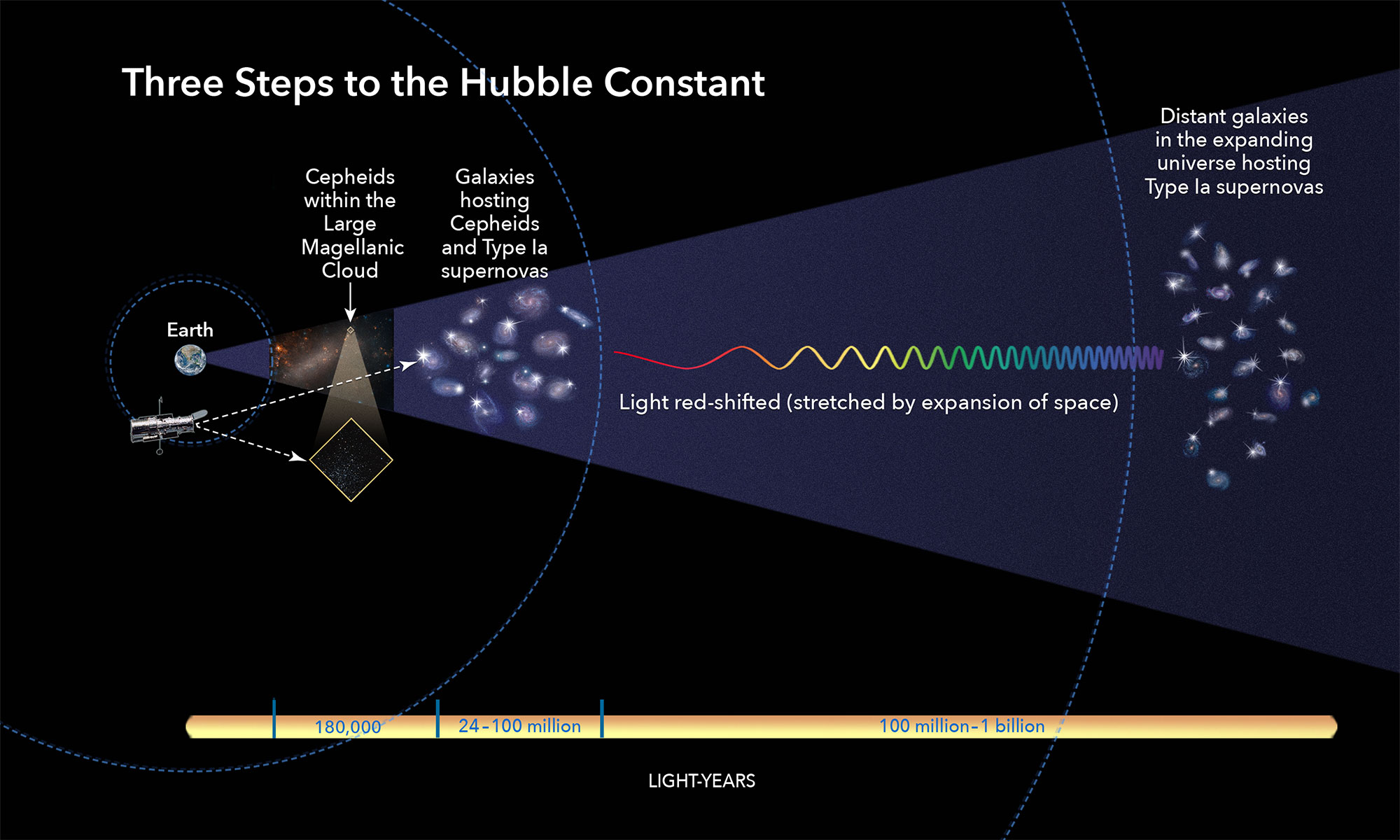
Measuring the Universe requires a cosmic ladder, which is a succession of methods used to measure the distances to celestial objects, with each method, or “rung,” relying on the previous for calibration.
The ladder used by Scolnic was created by a separate team using data from the Dark Energy Spectroscopic Instrument (DESI), which is observing more than 100,000 galaxies every night from its vantage point at the Kitt Peak National Observatory.
Scolnic recognized that this ladder could be anchored closer to Earth with a more precise distance to the Coma Cluster, one of the galaxy clusters nearest to us.

Precise Measurements Challenge Established Theories
“The DESI collaboration did the really hard part, their ladder was missing the first rung,” said Scolnic. “I knew how to get it, and I knew that that would give us one of the most precise measurements of the Hubble constant we could get, so when their paper came out, I dropped absolutely everything and worked on this non-stop.”
To get a precise distance to the Coma cluster, Scolnic and his collaborators, with funding from the Templeton foundation, used the light curves from 12 Type Ia supernovae within the cluster. Just like candles lighting a dark path, Type Ia supernovae have a predictable luminosity that correlates to their distance, making them reliable objects for distance calculations.
The team arrived at a distance of about 320 million light-years, nearly in the center of the range of distances reported across 40 years of previous studies — a reassuring sign of its accuracy.
“This measurement isn’t biased by how we think the Hubble tension story will end,” said Scolnic. “This cluster is in our backyard, it has been measured long before anyone knew how important it was going to be.”
Using this high-precision measurement as a first rung, the team calibrated the rest of the cosmic distance ladder. They arrived at a value for the Hubble constant of 76.5 kilometers per second per megaparsec, which essentially means that the local Universe is expanding 76.5 kilometers per second faster every 3.26 million light-years.

This value matches existing measurements of the expansion rate of the local Universe. However, like all of those measurements, it conflicts with measurements of the Hubble constant using predictions from the distant Universe. In other words: it matches the Universe’s expansion rate as other teams have recently measured it, but not as our current understanding of physics predicts it. The longstanding question is: is the flaw in the measurements or in the models?
Scolnic’s team’s new results adds tremendous support to the emerging picture that the root of the Hubble tension lies in the models.
“Over the last decade or so, there’s been a lot of re-analysis from the community to see if my team’s original results were correct,” said Scolnic, whose research has consistently challenged the Hubble constant predicted using the standard model of physics. “Ultimately, even though we’re swapping out so many of the pieces, we all still get a very similar number. So, for me, this is as good of a confirmation as it’s ever gotten.”
Challenging the Models of Cosmology
“We’re at a point where we’re pressing really hard against the models we’ve been using for two and a half decades, and we’re seeing that things aren’t matching up,” said Scolnic. “This may be reshaping how we think about the Universe, and it’s exciting! There are still surprises left in cosmology, and who knows what discoveries will come next?”
Reference: “The Hubble Tension in Our Own Backyard: DESI and the Nearness of the Coma Cluster” by Daniel Scolnic, Adam G. Riess, Yukei S. Murakami, Erik R. Peterson, Dillon Brout, Maria Acevedo, Bastien Carreres, David O. Jones, Khaled Said, Cullan Howlett and Gagandeep S. Anand, 15 January 2025, The Astrophysical Journal Letters.
DOI: 10.3847/2041-8213/ada0bd
Scolnic, D., Riess, A.G., Murakami, Y.S., Peterson, E.R., Brout, D., Acevedo, M., Carreres, B., Jones, D.O., Said, K., Howlett, C. and Anand, G.S., 2025. The Hubble Tension in our own Backyard: DESI and the Nearness of the Coma Cluster. The Astrophysical Journal Letters, 979, L9. DOI 10.3847/2041-8213/ada0bd
This work was conducted with funding from the Templeton Foundation, the Department of Energy, the David and Lucile Packard Foundation, the Sloan Foundation, the National Science Foundation and NASA.
Never miss a breakthrough: Join the SciTechDaily newsletter.
Follow us on Google and Google News.
17 Comments
The industry seems to be vacillating over the significance/reality of gravitational time-bending.
“Timescape” part II is probably out of the memory window by now, but it was the flavor of the month in December. The idea’s re-emergence promised to solve everything at the cost of adding a new late-phase “bump.” Not everyone with skin in the gravity game was impressed.
I suppose environmental directional dependence in flows of quantum gravity can show unexpected focus emergence during cooling. A learning-type emergence in focus, through a focus that goes past what could be expected from matter solidification and into a trihedral retro-reflectivity for flows involving cold quark triplets, an unexpected focus that verges even into organized spins of hydrogen vapor phases.
“organized spins of hydrogen vapor phases.”
Seems like a possible example of self-organizing hydrogen spin-gravity-scaffold-driven lasing here:
https://scitechdaily.com/hidden-wonders-webb-space-telescope-detects-unexplained-structures-in-heart-of-milky-way/
All the models use a flat universe as a starting point, “cosmological principle”.
Timescape says the vacuum varies, and the universe is a landscape, not a flat ocean.
I see a landscape.
“I see a landscape.”
https://scitechdaily.com/the-universes-hidden-backbone-alma-unveils-dark-matters-fine-scale-fingerprint/
I see a landscape of crossing concentric ring ripple phase peaks expressing ultra-low angular momentum of a universal quantum gravity mediator. A conserved degree of quantum freedom, which phases I suppose are relatively stationary with respect to their compact galactic cores (not shown in the frame). It’s a “Dark Matter” effect arising from intense compact core gravity, an effect that defies the “placeholder” status of DM and replaces it with a sinusoidal variation in “G” as a function of gravity carrier distance radiated.
The galactic-scale picture there is unfortunately very compact, and it could be affected by ALMAs reconstructive algorithm in the presence of systematic phase-noise-like information defining the complete frame.
It won’t be long before someone can just ask a computer in natural language to do an n-body simulation based on a sinusoidal (e.g. cosine squared) function for G, starting with the initial conditions of a dense compact core and a haze of surrounding matter.
DM as a “placeholder” can only invoke gravity that is an immediately-positioned effect of immediately-positioned matter, supposing low energy GR. The “DM” effect ripples shown, recast as non-GR quantum gravity, can also trap normal matter, making for a mix of local and remote normal matter gravitational effects. It’s covering gravitational departures from GR that do not manifest until dark matter effects appear, thousands of light years away and beyond. Cluster-scale effects and beyond are also coverable with no more than 3 different simultaneously conserved angular moments.
The focused retroreflective effect mentioned before is another conserved quantum gravity aspect that may also be seen as relevant to natural long-distance entanglements and the “DM filament” effect. Even lower angular rates for cluster scale ringlike effects. If someone runs any of these notions through an AI, it’s probably going to be clueless and nit-pick, but both can be simulated, so these ideas are very testable, though comparisons with real galaxies, for being quantum gravity ideas.
“It won’t be long before someone can just ask a computer in natural language to do an n-body simulation based on a sinusoidal (e.g. cosine squared) function for G, starting with the initial conditions of a dense compact core and a haze of surrounding matter.”
I suppose that another sinusoid multiplication factor applied to “G” would help handle any angle relative to the rotation plane, this factor being applied to the angle off the galactic rotation plane while the other sinusoidal factors favor no particular direction but operate instead by angular momentum conserving cyclic effect (wave)-lengths instead.
A rotating core should show enhanced gravitational pull effects along the galactic rotation plane, possibly significantly focused (strengthened) by the aforementioned fundamental triaxial retroreflective effect in cooling matter positioned close to the core. Gravitational pull attenuation with increasing angle off the rotation plane may also show up unexpectedly strongly due to loss of the in-plane quantum focus aspect, compared to normal “frame drag.” Core gravity focus along the poles can also be dominated by a spin-inducing aspect instead of a pulling effect.
The comment above didn’t show up this morning, so I reiterated some of the content below. Could be some sort of shadow banner artifact, I can only guess.
Another sinusoidal multiplication factor applied to “G” could handle core spin effects (“frame drag” type effects) for any angle relative to the galactic rotation plane, allowing the pull of frame drag to be strongest along the core’s rotation plane. The wave-based sinusoidal multiplier effects mentioned before, in contrast, favor no particular direction.
“Scientists find hints of the dark universe in 3D maps of the cosmos” – K. Cooper
Looks like they’re sticking to artist impressions of DM for the time being.
The latest public picture seems to be a combination of filaments and a limited number (3) of identical-sized concentric ripples (ALMA “fingerprints,” I suppose) for each of several galaxies.
noncentric ripples (ALMA “fingerprints”).
All this will prove to be nonsense when they find out that the universe isn’t expanding in the first place. They have been wrong before in their interpretations of what they perceive.
While rethinking the entirety of their understanding of the cosmos, may I suggest as a creationist, that scientists would finally think outside of the box they put themselves in. We all believe that science is all about the search for truth, but as this tension/crisis demonstrates, sometimes you have to forsake a lot of things you thought were true and start rebuilding on a solid foundation.
Everything considered herein requires Infinite Space.
What is this solid foundation? We use models that make assumptions. So our models can’t describe a determinate reality. So physical science will always be speculative. What is wrong with this? Models help to manipulate within particular model spaces. It seems that we will never be able to understand the mind of God. For a while science embraced the fundamental concept of indeterminate forces, dimensions etc. All clever models, useful to us, but models, not the “reality”. Keep on dreaming……. Can we describe the mind of God using models?
The physical world is a human construct, not something “real?”.
There is a great book that explains all this. It’s called “Genesis”. You can find copies almost everywhere
For an explanation email me at
[email protected]. How do you know it’ll be worthwhile to do that?
Scientists historically posed problems and relied on Mathematicians to solve them. This stage has been overlooked, even by Einstein who neglected to do a vital piece of maths! I have done this as I am an applied mathematician and the results cannot even be guessed at as they are so incredible. Hubble tension is explained along with the necessary adjustment to his law as it allows for speeds greater than that of light. It explains why the Universe is accelerating in its expansion and it’s NOT the ridiculous concept of dark energy!! The multiverse situation is explained and even the formation of the primordial atom that produced our Big Bang. What a pity this site won’t accept attachments as I’d be able to send the details of the missing maths and why it provides all the missing answers, including the reason for the very early galaxies observed by JWST!
The problem is that for acceptance the World’s astronomers are going to have to explain why the have ALL made such incredible errors and they won’t do that. They seem unable to accurately explain anything
Because, just like the notion of an Earth-centric universe, the math works. If all you want to do is predict where the sun, moon, and planets will be one thousand years from now, the maths in an Earth-centric universe are incredibly accurate. As for the eccentric orbits of Mercury and Venus, don’t worry… we’ll invent some placeholders until the answers reveal themselves. That’s why they won’t admit to their errors.
Could be recent signs of extraterrestrial life are creating heightened religious insecurities around here.
There is no such thing as a big bang, only a comedy of errors and historical accidents led to its popularity.
I am excited to complete my 11th paper about the foundation theory of physics during the 11th year of my hard and independent research. Please download free: (PDF) Amazing Photons and Free Space, the Fundamental Nature of Our Universe
Thank you very much for taking time to read and I believe that you will enjoy the reading because the good quality of the paper and the great efforts I have poured in. Please supply your kind advice. I appreciate your kind help very much.
Summary of findings:
A photon is the packet of energy of a single frequency electromagnetic wave per cycle and it is also a propagating dynamic elementary dipole. Free space is a polarizable superfluid medium composed of dynamic elementary dipoles with quantized energies. This framework unifies the behaviour of relatively moving particles, the characteristics of polarizable superfluid free space, their dynamic interactions, and key observable features of the cosmos. The theoretical advancements and further works aim at fostering interdisciplinary exploration and laying the groundwork for a more comprehensive and interconnective understanding of our universe’s fundamental nature.
Yours sincerely,
Wenzhong