
Groundbreaking observations reveal dark matter fluctuations below the scale of galaxies, affirming cold dark matter theories and providing new insights into the Universe’s composition.
A research team led by Professor Kaiki Taro Inoue at Kindai University (Osaka, Japan) has discovered fluctuations in dark matter distribution in the Universe on scales smaller than massive galaxies using the world’s most powerful radio interferometer, the Atacama Large Millimeter/submillimeter Array (ALMA), located in the Republic of Chile.
This is the first time that the spatial fluctuations of dark matter in the far Universe has been detected on a scale of 30,000 light-years. This result shows that cold dark matter[1] is favored even on scales smaller than massive galaxies, and is an important step toward understanding the true nature of dark matter. The article will be published in The Astrophysical Journal.
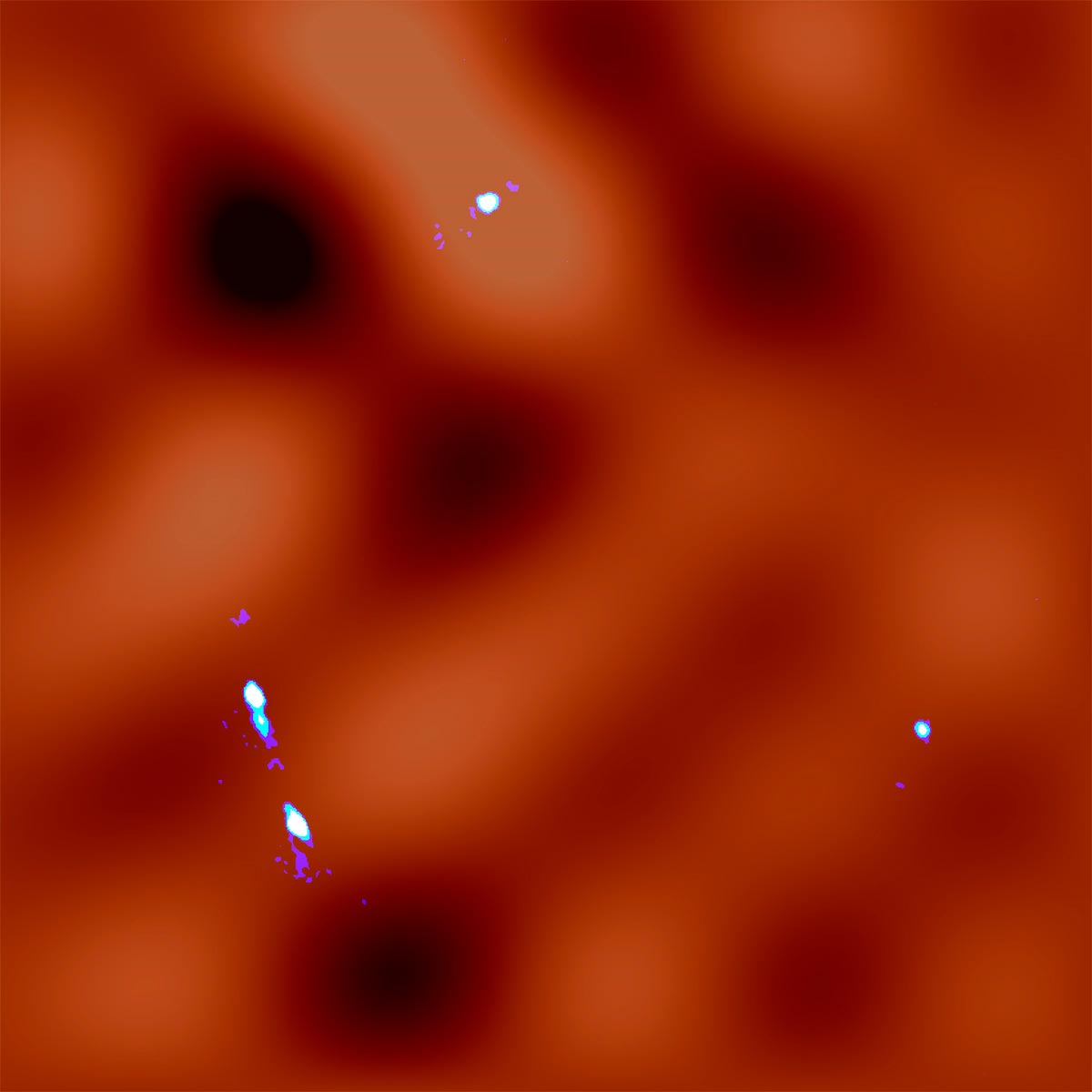
Key Points
- Observation by one of the world’s largest radio wave interferometers ALMA, which is an international project.
- The first detection of fluctuations of dark matter in the Universe on scales less than 30,000 light-years.
- An important step toward elucidating the true nature of dark matter.
ALMA Detects Small-Scale Fluctuations in Dark Matter Distribution
Dark matter, the invisible material that makes up a large fraction of the mass of the Universe, is thought to have played an important role in the formation of structures such as stars and galaxies.[2] Since dark matter is not uniformly distributed in space but is distributed in clumps, its gravity can slightly change the path of light (including radio waves) coming from distant light sources. Observations of this effect (gravitational lensing) have shown that dark matter is associated with relatively massive galaxies and clusters of galaxies, but how it is distributed on smaller scales has not been known.
The research team decided to use ALMA to observe an object at a distance of 11 billion light-years from the Earth. The object is a lensed quasar,[3] MG J0414+0534[4] (hereinafter referred to as “this quasar”).
This quasar appears to have a quadruple image due to the gravitational lensing effect of the foreground galaxy. However, the positions and shapes of these apparent images deviate from those calculated solely from the gravitational lensing effect of the foreground galaxy, indicating that the gravitational lensing effect of the distribution of dark matter on scales smaller than massive galaxies is at work.
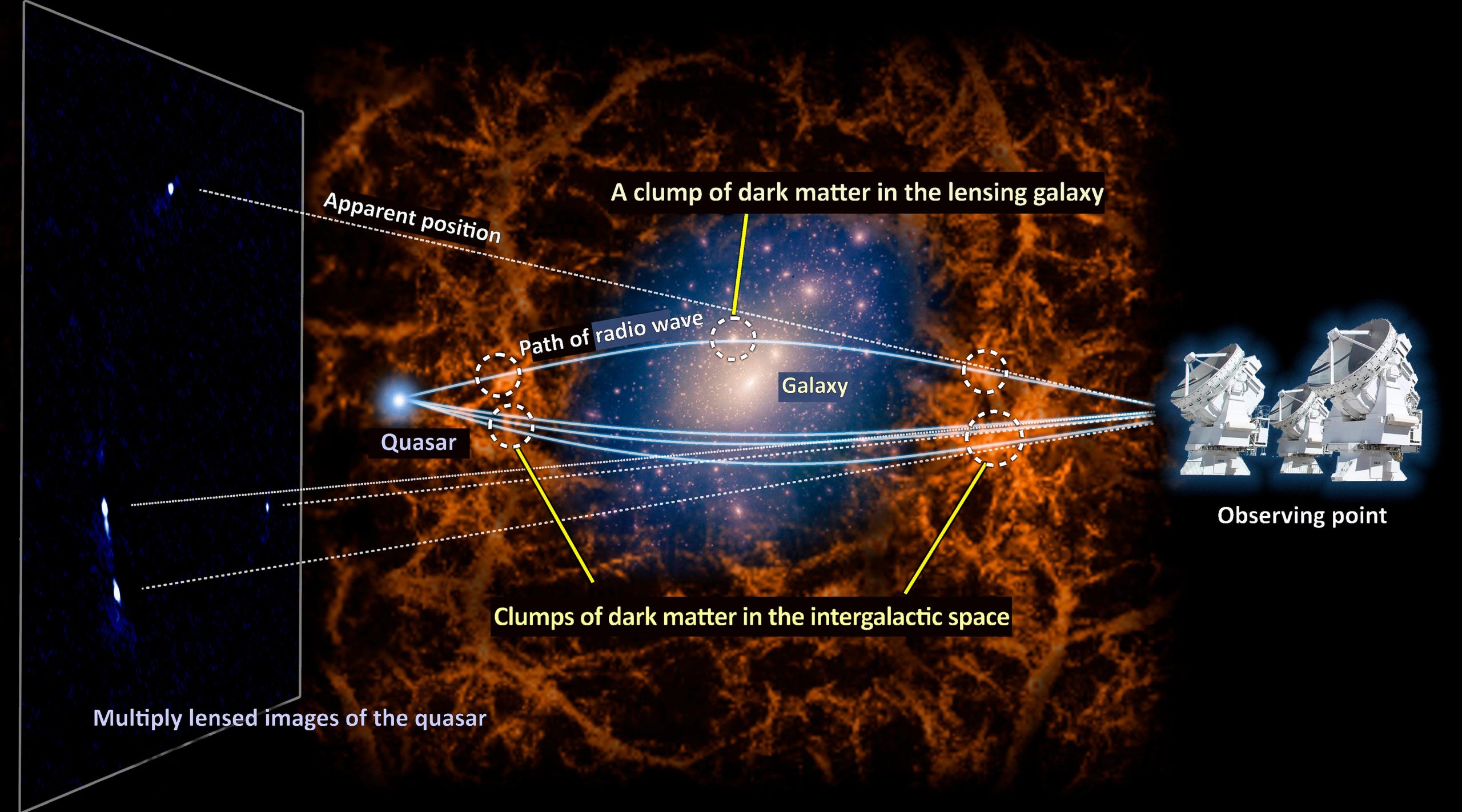
It was found that there are spatial fluctuations in the density of dark matter even at the scale of about 30,000 light-years, which is far below the cosmological scale (several tens of billions of light-years). This result is consistent with the theoretical prediction of cold dark matter, which predicts that dark matter clumps reside not only within galaxies (pale yellow color in Figure 2), but also in the intergalactic space (orange in Figure 2).
The gravitational lensing effects due to the clumps of dark matter found in this study are so small that it is extremely difficult to detect them alone. However, thanks to the gravitational lensing effect caused by the foreground galaxy and the high resolution of ALMA, we were able to detect the effects for the first time. Thus, this research is an important step to verify the theory of dark matter and to elucidate its true nature.
This research was presented in a paper “ALMA Measurement of 10 kpc-scale Lensing Power Spectra toward the Lensed Quasar MG J0414+0534” by K.T. Inoue et al. in the Astrophysical Journal.
Notes
- Cold dark matter
As the Universe expands, the density of matter decreases, and thus particles of dark matter (matter that is invisible to light) will no longer encounter other particles and will have independent motion that is different from the motion of ordinary matter. In this case, dark matter particles that move at a speed far less than the speed of light with respect to ordinary matter are called cold dark matter. Because of the low velocity, it does not have the ability to erase the large scale structures in the Universe. - The structure formation in the Universe
In the early Universe, stars and galaxies are thought to have been formed by the gravitational growth of density fluctuations of dark matter, and the aggregation of hydrogen and helium attracted to clumps of dark matter. The distribution of dark matter on scales smaller than that of massive galaxies is still unknown. - Quasar
A quasar is the central compact region of a galaxy that emits extremely bright light. The compact region and the surroundings have a large amount of dust that emits radio waves. - MG J0414+0534
MG J0414+0534 is located in the direction of the constellation Taurus as seen from the Earth. The redshift (the increase in the wavelength of light divided by the original wavelength) of this object is z=2.639. The corresponding distance is assumed to be 11 billion light-years, taking into account the uncertainty in the cosmological parameters.
Reference: “ALMA Measurement of 10 kpc Scale Lensing-power Spectra toward the Lensed Quasar MG J0414+0534” by Kaiki Taro Inoue, Takeo Minezaki, Satoki Matsushita and Kouichiro Nakanishi, 7 September 2023, The Astrophysical Journal.
DOI: 10.3847/1538-4357/aceb5f
This work was supported by Grant-in-Aids for Scientific Research from the Japan Society for the Promotion of Science (Nos. 17H02868, 19K03937), the National Astronomical Observatory of Japan ALMA Joint Scientific Research Project 2018-07A, the same ALMA J A P A N Research Fund NAOJ-ALMA-256, and Taiwan MoST 103-2112-M-001-032-MY3, 106-2112-M-001-011, 107-2119-M-001-020, 107-2119-M-001-020.
Never miss a breakthrough: Join the SciTechDaily newsletter.
Follow us on Google and Google News.
2 Comments
Nature:
Dark or invisible matter is the standard format of sub atomic particle matter that contains the ordinary particles matter in a system for a certain period of time as a typical universe in the multivers of infinite universes in the system of nature.
Energy doesn’t exist. It’s simply an unbonded particle of matter.
Matter exists inside the infinte emptiness, otherwise matter wouldn’t exist.
Emptiness is the actual realm of nature that contains everything else. Emptiness is infinite & eternal in the system of nature.
It’s only the nature that matters as an unknown inclusive entity. Everything else is known.
Resembles two crossed rib cages.
Suppose For the only known stable (ubiquitous) charged heavy particle (a hydrogen nucleus), the gravity effect divided by its charge effect (a dimensionless number approximately equal to 10 to the -36th power) is equal to the radius of said particle (approximately 10 to the -15th power in meters) when divided by the radius of some much larger ubiquitous gravity-dominated object (approximately 100K light years).
The latter length (galactic scale) can represent one or two cycles of vector field carrier (graviton) rotation depending on whether the carrier is spin-1 (a single-headed gravity effect object) or spin-2 (double-headed gravity effect object).
The suggestion here is the bright wavy orange component represents crossing concentric waves in gravity carrier rotations surrounding two galaxy cores, a core-based “dark matter peripheral effect,” a replacement for “dark matter” itself.
If a spin-2 particle basis for these waves could be visualized at the Planck scale it might resemble a black sphere carrying a wide bright stripe around the middle. In another variation, spin-2 is synthesized by superimposing oppositely rotating particles that are half dark and half light.
With these ideas I’m suggesting the bright orange waves are the result of galaxy-radiated quantized gravity carriers rotating once per every two wave-cycles of brightness, presenting identical bright faces phased together with tight particle rotation phase synchronism due to the compact galactic cores responsible.