
Falling birth rates reveal a deeper social problem: many people who want children feel blocked by economic, housing, gender, and climate pressures.
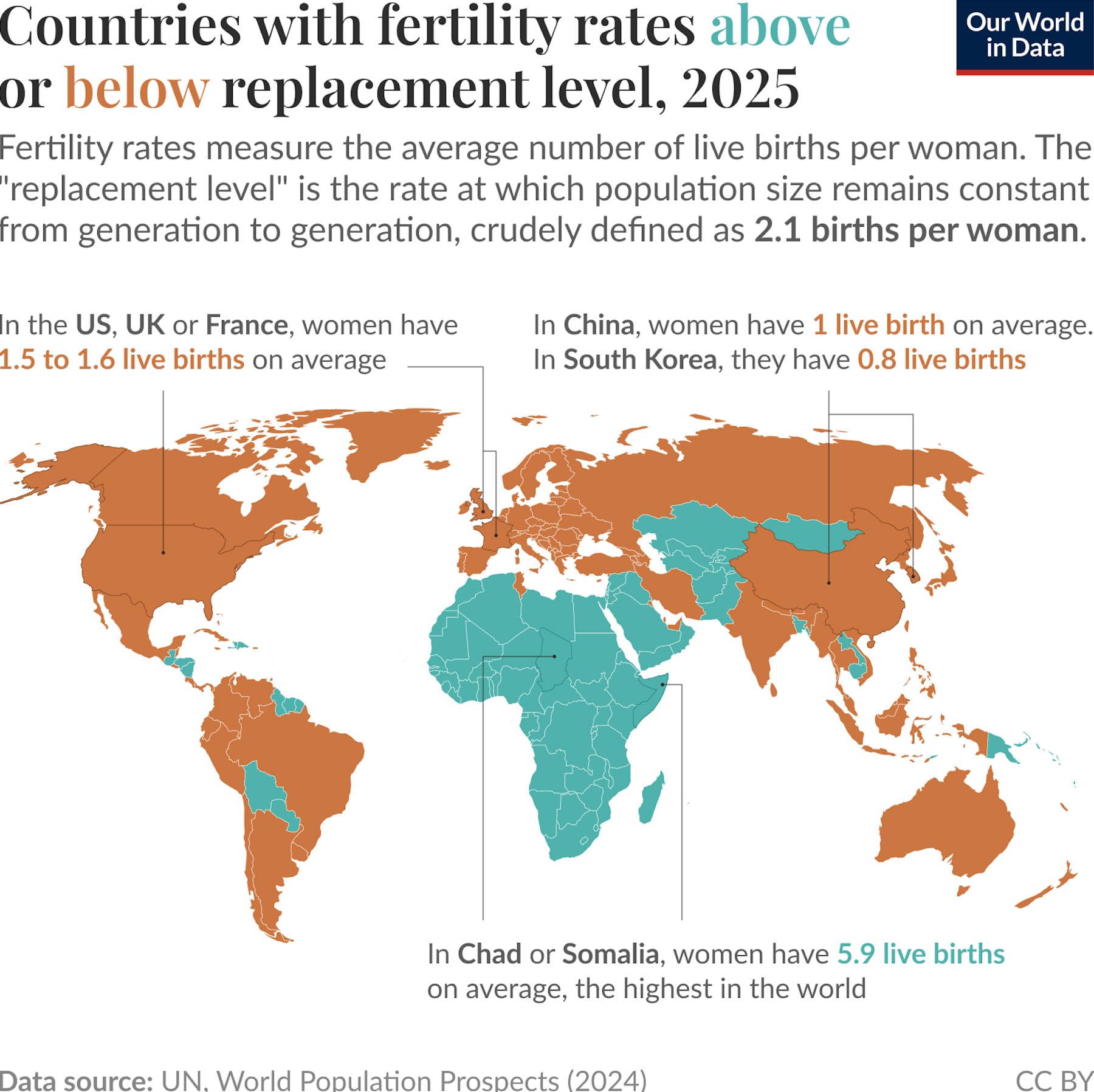
Birth rates have been falling around the world since the height of the baby boom that followed the Second World War. In many places, including Australia, they are now below replacement level. In simple terms, average populations are no longer having enough children to replace themselves over time.
Declining total fertility (or birth) rates, meaning the average number of births per woman, have drawn comments from figures ranging from Elon Musk to Italian Prime Minister Giorgia Meloni and the pope.
Since the 1960s, public debate has often focused on the dangers of overpopulation. Those concerns have not disappeared, especially in discussions linked to immigration, but attention has increasingly turned toward shrinking populations and the economic and national security challenges they may bring.
Overpopulation fears to depopulation woes
In his 1968 book The Population Bomb, Paul Ehrlich warned the 1970s would bring “people, people, people, people” and an overpopulation “cancer” resulting in famine and war. Human extinction was imminent, we were warned.
The predicted extinction of humanity from overpopulation has not happened.
Since 1950, the global total fertility rate has dropped by more than half. Across OECD countries, the average birth rate is now 1.46 births per woman, far below the 2.1 births per woman generally needed for one generation to replace the next.
World population decline is projected by the mid-2080s. China is now in its fourth year of population decline. South Korea has been declining since 2019 with its near-global record low birth rates. Germany has seen deaths outnumber births since 1972. Japan, Greece, Italy, Cuba, and Thailand are also among those in the depopulation club.
Without immigration, the United Kingdom would also see population decline, with deaths outnumbering births. Australia is about a generation away from the same fate. Immigration controls have seen depopulation in Canada.
Birth rates a solution to the aging ‘problem’
Enormous advancements since the 1950s, mostly in health and medical technologies like immunization, mean humans are living longer. We’re also having fewer children, and as a result, populations are aging.
An aging population is a mark of success and human ingenuity, but economic systems tend to view aging societies as problematic.
Workers and working-aged people are essential to maintain a healthy economy. Individual income taxpayers are the top source of federal government revenue in Australia. Too few people of working age replacing those retiring can seriously undermine economic well-being, forcing governments to do more service provision with less financial resources.
Below-replacement fertility and its implications for government bottom lines have resulted in Australian politicians calling on Australians to have more babies. “Have one for mum, one for dad, and one for the country,” Treasurer Peter Costello famously said in 2004.
In 2020, former prime minister Tony Abbott suggested the wrong kind of women were having children, calling on “middle-class” women to have more. Talking about the budget, Treasurer Jim Chalmers in 2024 said it would be “better if birth rates were higher.”
Human catastrophe of low birth rates
People are increasingly saying the choice to have children is constrained by external factors. Worldwide, around one-in-five surveyed by the United Nations said fears about the future would or have resulted in them having fewer children than they wanted.
Housing affordability, economic stability, gender inequality, and climate change present insurmountable barriers for having a much-wanted family.
The lack of choice to have children in below-replacement regions, I’d argue, is indeed a human catastrophe. How is it that we’ve allowed society to become so hostile that children are out of the question for so many who want them?
The intergenerational bargain is well and truly corrupted.
We are confronted with the tough question of who will care for us if the children are gone.
Can a human catastrophe be avoided?
The burden of having a family falls on working-aged people, especially women.
A baby bonus or one-off payment is unlikely to change people’s minds and increase the total fertility rate; such payments merely change timing. Instead, increasing total fertility rates requires a comprehensive suite of measures from a policy perspective.
Tackling the big four domains of housing, the economy, gender, and climate encompasses issues such as
- secure, affordable, and appropriate housing
- employment and income security
- accessible childcare
- social and workplace gender equality
- climate change action.
People of childbearing age aren’t being hedonistic when making family and fertility decisions. They’re not thinking about themselves, they’re actually thinking about the future world and weighing what that might look like for prospective children.
Loss of hope among people of childbearing age, including fears of being left behind, contributes to overall concerns about an insecure future.
Not only is the human catastrophe of low birth rates reflecting more widespread concerns, such as insecurity, it could also be undermining social cohesion.
Rather than an exploding bomb of overpopulation, the world faces an economic and social implosion due to a lack of substantive support necessary to help raise much-wanted children.
Surely it’s beyond time we ask people what they actually need – and give it to them.
Adapted from an article originally published in The Conversation.
Never miss a breakthrough: Join the SciTechDaily newsletter.
Follow us on Google and Google News.
29 Comments
No catastrophe – It’s nature’s way
Greed os good….to destroy everything !!!!!!
Greed is good….to destroy everything !!!!!!
World War ll was fought when there were less than 2 billion people on this planet. With all of the many and varied looming global disasters a population of more than 8 billion people is going to make everything exponentially worse.
You are so right. The fear mongers of “under” population can take comfort in the influx all the new workers of the world that don’t strike, don’t call in sick, don’t look at their phones all day , don’t ask fro raises, etc., etc.. They’re called robots. And first-world countries are using them in many areas. The big challenge is to keep the populations lower in those countries that are producing 4-5-6 and more children and sending them around the world to work. That is not making this a better world.
The only thing stopping nature is man.
I agree. This is not a catastrophe. It is a relief, a chance of survival. The problem is in redefining “economic progress” and the distribution of wealth, not in a decreasing and “aging” population.
What does climate change have to do with this?
Some people are extremely worried about climate change. People often mention it as a reason to not have kids because they don’t want them to grow up in a polluted world with lots of natural disasters happening.
Climate change fundamentally affects agriculture, water resources, and energy. It may become too hot to grow food out in sun-baked fields, limiting production. Lake levels will lower from the heat and lack of snowcap to feed them, slowing outflow rivers that are used for transport and/or energy production. It’s already happening.
If baby booms come from confidence and positive hopes for the future, birth declines come from pessimism and fear for the future.
Nothing. What does gender equality have to do with it? Nothing. An argument can be made that before we strived for sexual equality we had higher birth rates. Also before we were scared into Climatearmegeddon. What this shows me is that the publisher of scitechdaily is woke and if they are going to betray science for politics. They’re on the other side of the fence from me. Scitechdaily, Good-bye.
Lefties insert it into everything.
The only reason more people are needed is because our current economic systems are built on more people working at more jobs making more money while paying more taxes to support unlimited consumerism, ever larger government and seniors living longer and longer.
But the stark reality that no one wants to face is that economic models the world has been using up to now are going to be killed off in a future of AI driven unlimited abundance, where AI controls the manufacture and distribution of all necessities to humans and its robot workers toil tirelessly 24 x 7 for the benefit of humans, without complaint, and for no wages or benefits.
In this post-scarcity world, there will be no meaning or need for concepts like money, profit, entrepreneurship, assets, ownership or human labor. There won’t be poor people nor will there be billionaires. Housing will be free. Healthcare will be free. Food will be free. Trips around the world will be free.
EVERYTHING WILL BE FREE AND EVERYONE WILL BE EQUAL WE DON’T NEED MORE PEOPLE!
“Imagine there’s no heaven….” AI is the answer? Marxism was supposed to do all that and at least the cadres and prison guards and gut-busters and soldiers all had jobs. And when agriculture fails locally and seas rise a few more millimeters and the seaports of the world no longer guarantee food from afar, we will still have religion doing what it is supposed to do -spurring God’s anointed to take whatever the neighbours still have in the fridge. Good luck Jojo, may we meet on the Western Front, hopefully on the same side.
What a ridiculous article. A declining human population is exactly what we need. For our own species as well as all the other species on the planet. There is no catastrophe except the one we have already created and now needs fixing. We are STILL overpopulated and destroying the planet for all other species. We NEED to reduce our population size by 90% in order to live in harmony with nature and not be destroying everything.
I also find it disturbing that so many people make more humans just so there is someone there to take care of them when they are elderly. That is so selfish. I would feel horrible if my kid got stuck taking care of me and watching me suffer and die instead of being able to live their own life. I don’t understand why so many people think that is OK. I’m child-free and loving it. I will off myself if I can’t take care of myself.
Plus, think about it…do you really want someone who hates you taking care of you in your final days? How miserable would that be? Face it. Most parents mess up their kids and the kids become adults and hate their parents. Families are a mess.
More people, more problems. Stop having babies!
Then depopulate yourself and stop wasting my oxygen
Yes, and good riddance to you. Being ignorant is your problem. Maybe if you “woke-up” your mind might recover, but i doubt it. Your thoughts are the essence of fascist propaganda.
Tony Abbott’s mother was the wrong kind of woman to be having children since she unfortunately spawned that right wing loser and inflicted him on the world.
The concerns about population decline are primarily economic. We need to learn to deal with negative GDPs as the norm, not expect continuous growth, and embrace immigration instead of condemning it.
No, we do need to learn to live with population decline but, we do NOT need more immigration. Countries who continue to have more children than they can support must either get their population under control or improve their living conditions and support their own populations. No more babies being produced for export.
This is a short sighted article, and calling for more government spending to “fix” social issues only creates more and bigger problems. We are the victims of our own success; this is the natural outcome of 3 generations of relative peace and prosperity unlike anything we’ve seen before as modern humans. Its a complex landscape of social, financial, technological and psychological contributing factors that have brought us to this nexus, and in Trump human fashion we are unlikely to find a solutions unless we travel the path of struggle and strife. Hike up your breeches everyone, its going to get worse before it gets better.
My mistake, I did not mean “Trump” fashion. Yikes! I meant “true human fashion”.
Good catch, The worse was demonstrated in a series of mouse utopia experements called ‘Universe 25’ where everything was provided with no threats, within a ten foot plexiglass cube. The population climbed to below expected capacity, then stagnated and collapsed in several repeated experiments! I see many of the results observed in this experiment happening within the human population today. Homelessness, Child
Abandonment, Sex Segregation, Territorial Conflicts, etc. Google it or ask Gemini about it. ‘Universe 25’
The problem is still overpopulation. Wildlife populations are collapsing and thus all ecosystems are threatened because all it takes is for enough species to enter functional extinction to overrun the tipping point of no return. While global warming may already be past recovery, we should try to drive our population to well below 2 billion and replace our extractive economy with a sustainable one.
The economy is a figment of our imaginations, our minds, and we if we change our worldview we can flow into a better future than the one that now threatens us, all life on earth.
We are overpopulated and need to reduce our population to well below 2 billion to reach a sustainable level as we have been driving an extinction event with accelerated wildlife population declines over the past few hundred years that again accelerated at the 1970s.
Understand that human biomass is estimated at 0.06 GtC, that of our livestock at 0.1 GtC and that of all wild mammals at 0.007 GtC. That in and of itself indicates that there is no balance in nature as we are an infection killing our host and a quick glance at the Permian Era extinction provides a very clear warning of what we can expect, but sooner. It took the Permian Extinction about 60,000 +/- 48,000 years and as stated above, this is far, far faster.
So, stop the “crisis” reporting on reduced birth rates because that is precisely what we need. All we need to do is replace our extractive economy with a sustainable one based on recycling from waste back to manufacturer and reframe our economic expectations from growth to stable.
Feminism was implemented to lower the birth rates. Mission accomplished. Feminists are nasty and insufferable Man haters who continue child sacrifice to Moloch through abortion.
In a few years we will have reliable and multi talented robots for elder care and companionship. Companies in China already have 24 hour running ,robot factories working in the dark. Each year AI advances and ways they learn become easier as they take on increasingly complex tasks . We simply do not need as many humans now , GDP and productivity will not depend on humans as much . We already are seeing the early stages of major redundancies in companies taking up AI and this will grow exponentially .
Declining birth rates? What an excellent idea!
A human population crash is inevitable, surely it’s better to have it happen in a controlled manner.