
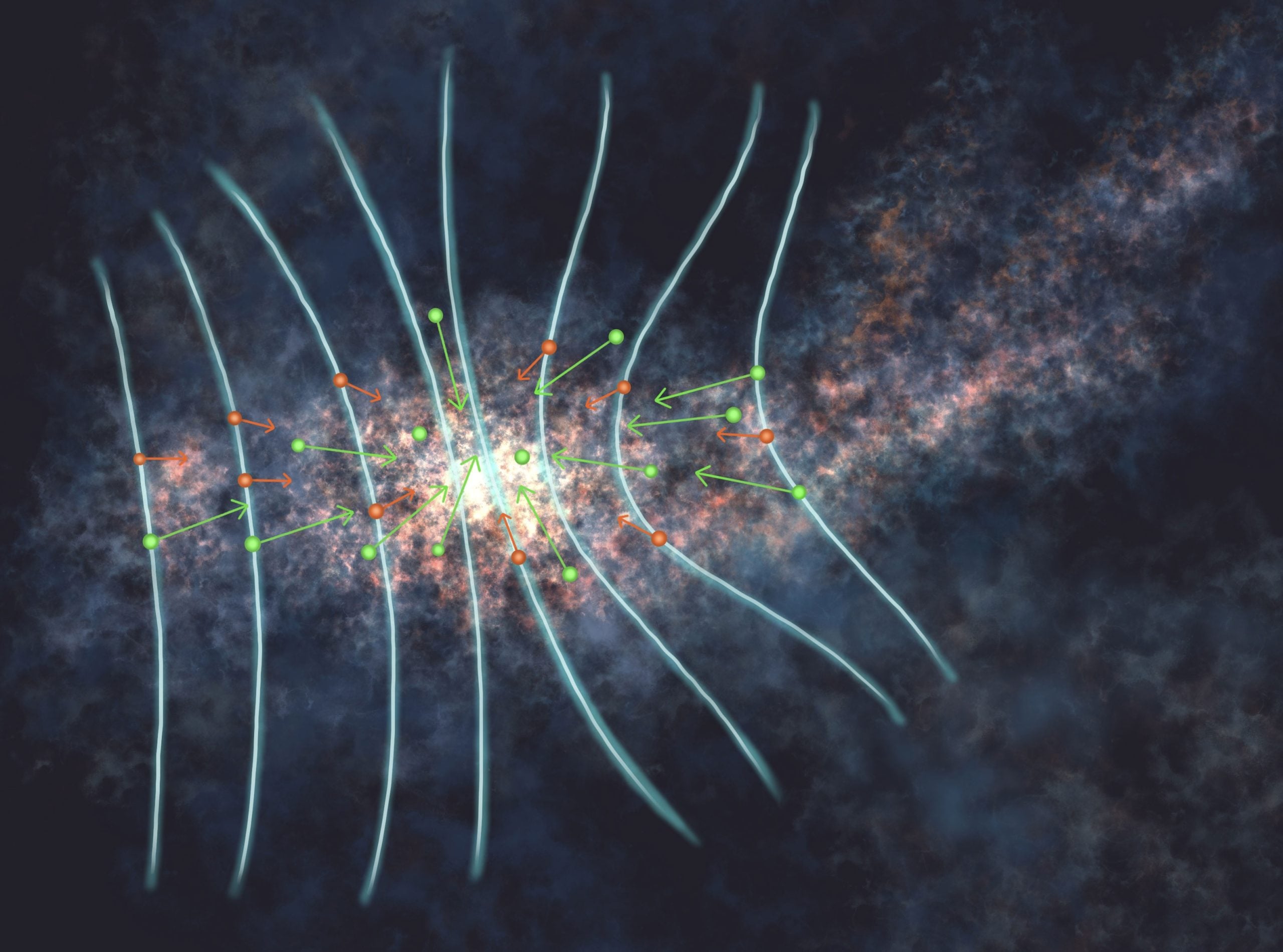
A newly observed molecular drift may reveal how magnetic fields weaken before a star is born.
A star does not begin with light. It begins in darkness, inside a frigid cloud where gravity, magnetic fields, and chemistry compete to determine whether the material will remain suspended or collapse.
Astronomers have now observed a key part of that struggle inside L1544, a dense prestellar core in the Taurus molecular cloud. Using radio observations, researchers detected evidence of ambipolar diffusion, a process that may help gravity overcome magnetic resistance and begin forming a new star.
The study, led by scientists at Kyushu University and the Max Planck Institute for Extraterrestrial Physics, was published in Astronomy & Astrophysics. According to the researchers, it is the first detection of ambipolar diffusion within a prestellar core.
Before a Star Is Born
Prestellar cores are among the earliest identifiable stages of star formation. They are compact pockets of gas and dust that have become denser than their surroundings but have not yet formed a protostar.
These objects are extremely cold, often only a few degrees above absolute zero. Under those conditions, gravity pulls material inward, while magnetic fields and internal gas motions can slow or resist collapse.
That balance is important. If magnetic support remains strong enough, a core may persist without forming a star. If the field weakens, gravity can take control and compress the material until a protostar emerges.
“Prestellar cores are fascinating stellar bodies. They are dense and cold, and a source of a lot of complex chemistry. The cold environment allows for molecules to assemble into more complex ones like precursors of prebiotic organic molecules,” explains first author Doris Arzoumanian, an Associate Professor at Kyushu University’s Institute for Advanced Study. “One of the questions we are investigating is the role of magnetic fields in star formation. Strong magnetic fields permeate prestellar cores. If that field is too strong, it can delay gravitational collapse and therefore star formation. We wanted to investigate how prestellar cores reduce the strength of their magnetic field.”
A Natural Separation Between Charged and Neutral Matter
The team studied L1544 with the Institute for Radio Astronomy in the Millimeter Range (IRAM) 30-meter (98-foot) telescope. L1544 lies in the Taurus molecular cloud, one of the closest major star-forming regions to Earth and a frequent target for studies of early stellar evolution.
Material inside a molecular cloud is not electrically uniform. Some particles are charged, while others are neutral. Charged particles, or ions, respond strongly to magnetic fields. Neutral particles do not interact with those fields directly, although collisions with ions can influence their motion.
In a sufficiently dense core, this connection can begin to weaken. Neutral particles may then slip past the ions and move inward under gravity while the ions remain more closely tied to the magnetic field. This relative motion is called ion-neutral drift, and it is the observational signature expected from ambipolar diffusion.
Detecting that drift is difficult. Many molecules normally used to trace gas motion freeze onto dust grains in such cold environments, making them much harder to observe.
The researchers therefore compared two molecules that can remain useful in dense regions of prestellar cores.
“We selected Diazenylium-d1 (N2D+), an ion, and para-monodeuterated ammonia (para-NH2D), a neutral molecule, as our tracers because they are generally located in similar high-density regions within prestellar cores,” explains second author Silvia Spezzano, group leader at the Max Planck Institute for Extraterrestrial Physics. “We therefore collected spectral data of the core and modeled the velocity of the two molecules.”
A Tiny Difference With Major Implications
The two tracers were not moving at exactly the same speed. The researchers measured a velocity difference of about 0.05 km/s (0.03 mi/s).
That gap is small by everyday standards, but in a cold, slowly evolving cloud, it can reveal a fundamental change in how matter interacts with the magnetic field.
As L1544 becomes denser, radiation has greater difficulty penetrating its interior. With less ionizing radiation reaching the core, the proportion of charged particles decreases. Collisions become less effective at forcing neutral material to follow the magnetic field, allowing that material to drift inward more freely.
The neutral gas then accelerates toward the center under gravity, while the ions continue to move more slowly with the field. The resulting difference in velocity is what the team interpreted as evidence of ambipolar diffusion.
“This process is known as ambipolar diffusion. Until now, observing this phenomenon in a prestellar core was a major challenge,” continues Arzoumanian. “As ambipolar diffusion continues, the strength of the magnetic field decreases. Eventually, gravity becomes the primary driving force in the core, resulting in its gravitational collapse into a protostar.”
Why the Result Matters
Ambipolar diffusion has long appeared in theoretical models of star formation, but directly identifying it in an actual prestellar core has been challenging. The measured drift in L1544 gives astronomers a way to test whether those models accurately describe the transition from a stable cloud to a collapsing stellar embryo.
The result also helps connect events occurring on very different scales. A velocity difference of only a few hundredths of a kilometer per second may influence whether a cloud collapses, how quickly a protostar forms, and how material is distributed around the young star.
The researchers plan to observe more prestellar cores to determine whether the same pattern appears elsewhere. Higher resolution measurements could also reveal where ion-neutral drift is strongest and how it changes across a collapsing core.
“These results were possible thanks to an interdisciplinary collaboration of expert observers and theorists in the fields of gas dynamics, astrochemistry, and dust physics,” concludes Arzoumanian. “Understanding star formation addresses a fundamental question about the origin of life in planetary systems and helps us better understand the universe as a whole.”
Reference: “Probing the ion-neutral drift velocity toward the L1544 prestellar core – Detection of ambipolar diffusion using N2D+ and para-NH2D” by Doris Arzoumanian, Silvia Spezzano, Tommaso Grassi, Paola Caselli, Yusuke Tsukamoto, Haruka Fukihara, Yoshiaki Misugi, Felipe Alves, Jaime Pineda, Sigurd Jensen, Elena Redaelli and Alexei Ivlev, 10 July 2026, Astronomy & Astrophysics.
DOI: 10.1051/0004-6361/202658871
Funding: National Institutes of Natural Sciences, German Academic Exchange Service, NINS-DAAD International Personal Exchange Program
Never miss a breakthrough: Join the SciTechDaily newsletter.
Follow us on Google and Google News.