
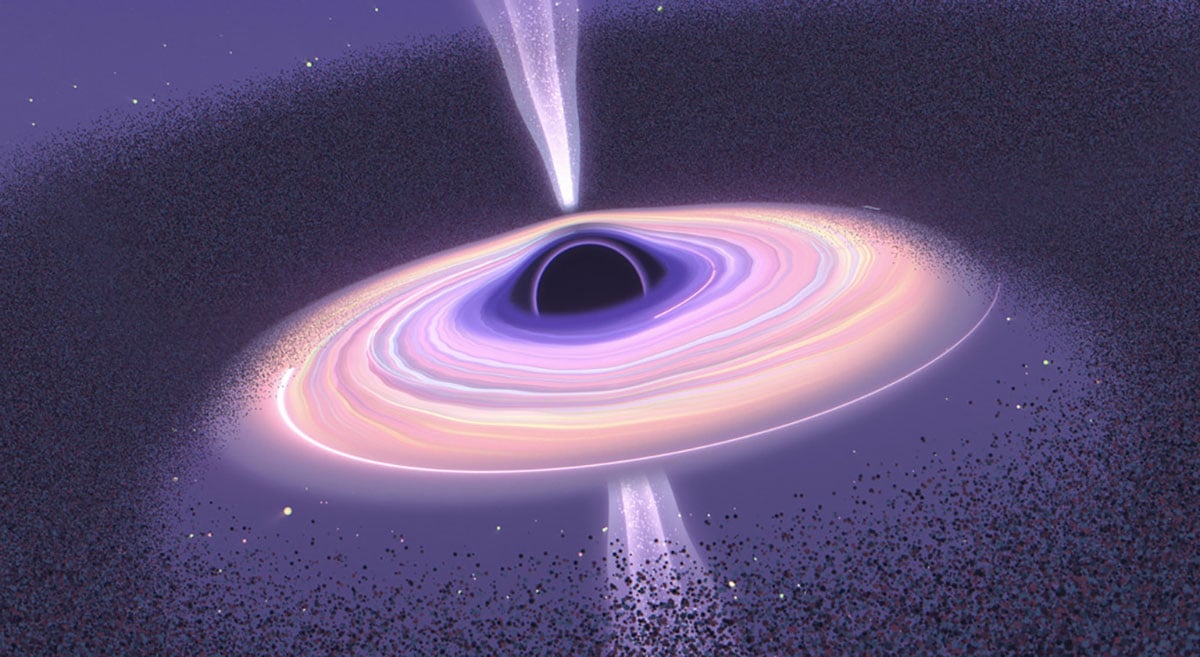
Dust patterns around quasars may help reveal supermassive black holes kicked from galactic centers.
When galaxies collide, the chaos does not stop with stars and gas. At the center of each galaxy, Supermassive Black Holes (SMBHs) can fall into a tightening gravitational dance, spiraling together until they merge into one enormous remnant. In some cases, the final black hole may not remain where it formed. It can be “kicked” away from the galactic center at extraordinary speed.
Astronomers have searched for these “recoiling” black holes for decades, but they are difficult to identify. A new paper available on arXiv, written by an international team, proposes a different way to look for them by studying the dust and gas that may stay bound to a black hole after it is launched from the center of its galaxy.
The kick comes from a consequence of Einstein’s theory of general relativity. When two merging black holes have unequal masses or spins that point in different directions, the gravitational waves they release can carry more momentum one way than another. The merged black hole is then pushed in the opposite direction. In extreme cases, that recoil can accelerate the black hole to hundreds or even thousands of kilometers per second.
Dust may reveal recoils
The new study focuses on what travels with a black hole after it is kicked away. The researchers argue that a recoiling SMBH should drag along the tightly bound inner part of its accretion disk, the hot material orbiting close to the black hole.
That inner material is connected to the Broad Line Region, where rapidly moving gas produces emission lines that can be stretched and shifted by strong Doppler effects. Using a pattern first predicted in simulations decades ago, the team investigated whether a recoiling black hole’s speed could be tied to the amount of dust still surrounding it.
If the relationship holds, dust could become a valuable clue in the search for displaced Supermassive Black Holes. Rather than looking only for a black hole that appears offset from its galaxy’s center, astronomers could also search for signs of the material it carries as it moves through space.
Signal survives a key test
The result was a modest but highly significant positive correlation between the quasar’s velocity offset (i.e., its speed) and the amount of dust it was surrounded by. But to prove their point, they ran the same analysis only using the Narrow Line Regions against each other to make sure there wasn’t a statistical fluke. Since all Narrow Line Regions were supposed to be left behind, the correlation should have vanished, which is exactly what happened.
But there was one hiccup in the study – SMBHs that appear blue-shifted (i.e., that are moving towards us) appear to be more dust-obscured than ones that are moving away. That’s the opposite of what would be expected given a pure recoil model, though the team has several potential explanations for this, including bias in how the spectral lines are fitted or some less understood physics acting on the black hole simultaneously.
Future observatories could confirm it
Since this was a statistical exercise, it’s important to note that this is only a correlation – not a causation. But it offers some tantalizing insight into what we can expect to see when next-generation gravitational wave observatories, like ESA’s LISA mission, come online.
The authors estimate that up to 50% of known quasars might have been the result of a relatively recent black hole merger. If that’s the case, those space-based observatories will have an absolute treasure-trove of data to collect. And we might eventually find a definitive way to track these vast, fast-moving cosmological titans.
Reference: “Statistical evidence for massive black hole recoils in active galactic nuclei” by Bence Bécsy, Peter Raffai, Zoltán Haiman, Andor Budai and Zsolt Frei, 6 May 2026, arXiv.
DOI: 10.48550/arXiv.2605.04781
Adapted from an article originally published in UniverseToday.
Never miss a breakthrough: Join the SciTechDaily newsletter.
Follow us on Google and Google News.
1 Comment
Supermassive black holes’ dynamics in a binary system for merger or recoil can be studied well through rotation of visible matter;while,for dark matter(/and energy), Einstein’s GR can be used in the treatment,as per the discussion carried out in this article here.So,for the text,more such example(s) needed.