
Ten years after the first detection of gravitational waves, scientists have captured the clearest signal yet — and it confirms one of Stephen Hawking’s most famous predictions.
Using the upgraded LIGO detectors, researchers observed two black holes colliding over a billion light-years away, producing space-time ripples so precise they could “hear” the black holes ring like cosmic bells.
A New Window on the Universe
On September 14, 2015, scientists detected a faint but extraordinary signal that had traveled across the cosmos for about 1.3 billion years before reaching Earth. It came from two distant black holes that had spiraled together and merged, releasing ripples in space-time known as gravitational waves. These ripples, first predicted by Albert Einstein a century earlier, were not made of light but were distortions in the very fabric of space itself. On that day, the twin instruments of the Laser Interferometer Gravitational-Wave Observatory (LIGO) recorded the first confirmed detection of gravitational waves. After six months of careful analysis and verification, the LIGO and Virgo collaborations announced the historic discovery in February 2016.
This groundbreaking observation opened an entirely new way to study the universe. Until then, astronomers had relied on light in its many forms—X-rays, visible light, radio waves—and on high-energy particles such as cosmic rays and neutrinos to explore the cosmos. For the first time, scientists could now observe cosmic events through their gravitational effects on space-time itself. The achievement, decades in the making, earned three of LIGO’s founders the 2017 Nobel Prize in Physics: MIT’s Rainer Weiss, professor of physics, emeritus (who recently passed away at age 92); Caltech’s Barry Barish; and Caltech’s Kip Thorne.
A Growing Network of Detectors
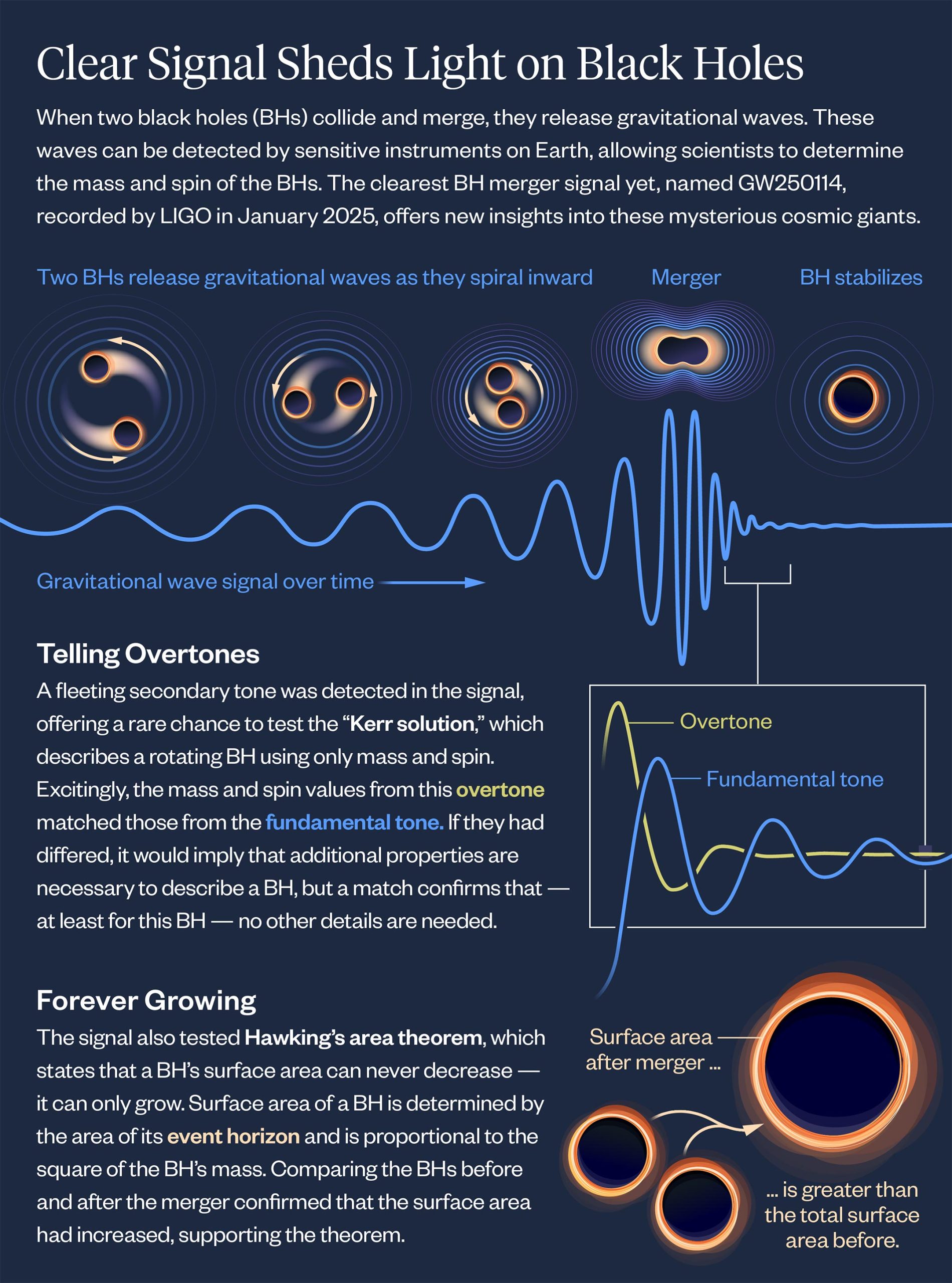
Today, LIGO’s twin observatories in Hanford, Washington, and Livingston, Louisiana, work in unison with the Virgo detector in Italy and KAGRA in Japan. Together, this global network, known as LVK (LIGO, Virgo, KAGRA), detects roughly one black hole merger every three days. So far, the collaboration has identified more than 300 mergers, with most confirmed and others still under review. During its current observing campaign, the fourth since 2015, the LVK team has already found about 230 candidate mergers, more than doubling the total from all previous runs combined.
The rapid increase in detections stems from major upgrades to the instruments, including advances in quantum precision engineering. These detectors are the most sensitive measurement devices ever built. The gravitational waves they capture cause distortions in space-time so small that LIGO and Virgo must measure changes less than one ten-thousandth the width of a proton. That is about 700 trillion times thinner than a human hair.
The Clearest Signal Yet
The improved sensitivity of the instruments is exemplified in a recent discovery of a black hole merger referred to as GW250114 (the numbers denote the date the gravitational-wave signal arrived at Earth: January 14, 2025). The event was not that different from the first-ever detection (called GW150914)—both involve colliding black holes about 1.3 billion light-years away with masses between 30 to 40 times that of our Sun. But thanks to 10 years of technological advances reducing instrumental noise, the GW250114 signal is dramatically clearer.
“We can hear it loud and clear, and that lets us test the fundamental laws of physics,” says LIGO team member Katerina Chatziioannou, Caltech assistant professor of physics and William H. Hurt Scholar, and one of the leading authors of a new study on GW250114 published in the Physical Review Letters.
Listen for the low “whoosh” rising out of the background static—that’s the sound of space-time itself rippling. Notice how much quieter the background noise is behind GW250114 compared to GW150914, an indication of how dramatically LIGO’s sensitivity has improved over the past decade. Credit: LIGO/Derek Davis (URI)
Testing Hawking’s Black Hole Area Theorem
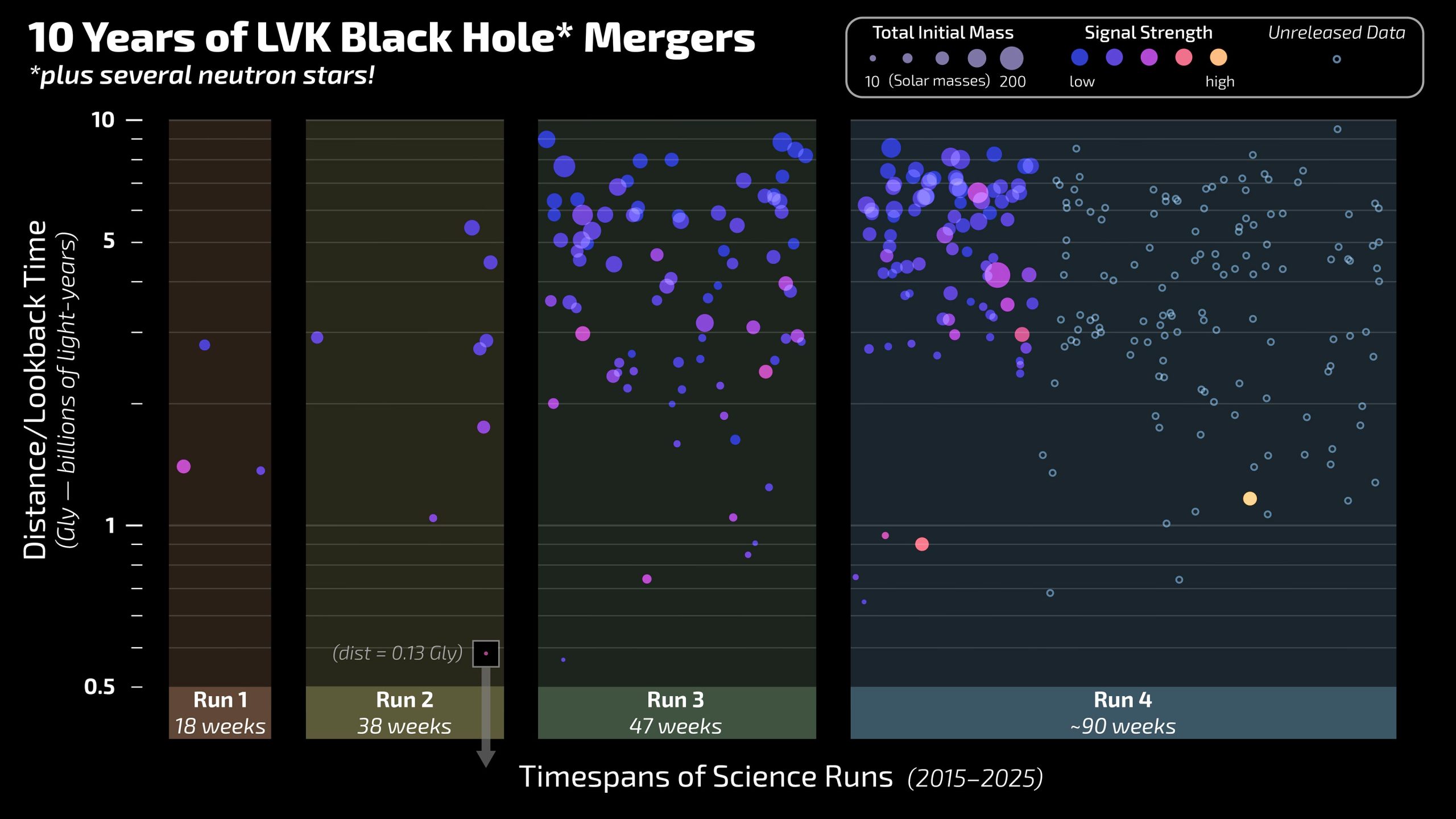
By analyzing the frequencies of gravitational waves emitted by the merger, the LVK team was able to provide the best observational evidence captured to date for what is known as the black hole area theorem, an idea put forth by Stephen Hawking in 1971 that says the total surface areas of black holes cannot decrease. When black holes merge, their masses combine, increasing the surface area. But they also lose energy in the form of gravitational waves during the phenomenon. Additionally, the merger can cause the combined black hole to increase its spin, which leads to it having a smaller area. The black hole area theorem states that, despite these competing factors, the total surface area must grow in size.
Later, Hawking and physicist Jacob Bekenstein concluded that a black hole’s area is proportional to its entropy, or degree of disorder. The findings paved the way for later groundbreaking work in the field of quantum gravity, which attempts to unite two pillars of modern physics: general relativity and quantum physics.
In essence, the detection (made just by LIGO, since Virgo was undergoing routine maintenance and KAGRA was offline during this particular observation) allowed the team to “hear” two black holes growing as they merged into one, verifying Hawking’s theorem. The initial black holes had a total surface area of 240,000 square kilometers (roughly the size of United Kingdom), while the final area was about 400,000 square kilometers (almost the size of Sweden)—a clear increase. This is the second test of the black hole area theorem; an initial test was performed in 2021 using data from the first GW150914 signal, but because that data was not as clean, the results had a confidence level of 95 percent as compared to 99.999 percent for the new data.
Kip Thorne recalls Hawking phoning him to ask whether LIGO might be able to test his theorem immediately after he learned of the 2015 gravitational-wave detection. Hawking died in 2018 and sadly did not live to see his theory observationally verified. “If Hawking were alive, he would have reveled in seeing the area of the merged black holes increase,” Thorne says.
A numerical relativity simulation of the recently observed GW250114 event, a binary black hole merger detected by LIGO on January 14, 2025. The blue and white surface shows a two- dimensional slice of the gravitational waves spiraling outward as the black holes orbit one another. Throughout this inspiral, the gravitational waves grow in magnitude, peaking as the black holes merge, and then decreasing rapidly as the newly formed remnant black hole settles.
The observed gravitational-wave signal from GW250114 is shown below in white. In comparison, the gray line shows much noisier data from LIGO’s first gravitational-wave observation, GW150914. While the amplitudes of these signals are comparable, significant improvements in detector sensitivity over the past decade have vastly reduced the amount of noise present in GW250114 relative to GW150914.
Credit: Deborah Ferguson, Derek Davis, Rob Coyne (URI) / LIGO / MAYA Collaboration. Simulation performed with NSF’s TACC Frontera supercomputer.
Hearing Black Holes Ring Like Bells
The trickiest part of this type of analysis had to do with determining the final surface area of the merged black hole. The surface areas of pre-merger black holes can be more readily gleaned as the pair spiral together, roiling space-time and producing gravitational waves. But after the black holes merge, the signal is not as clear-cut. During this so-called ringdown phase, the final black hole vibrates like a struck bell.
In the new study, the researchers were able to precisely measure the details of the ringdown phase, which allowed them to calculate the mass and spin of the black hole, and subsequently determine its surface area. More precisely, they were able, for the first time, to confidently pick out two distinct gravitational-wave modes in the ringdown phase. The modes are like characteristic sounds a bell would make when struck; they have somewhat similar frequencies but die out at different rates, which makes them hard to identify. The improved data for GW250114 enabled the team to extract the modes, demonstrating that the black hole’s ringdown occurred exactly as predicted by theoretical models.
Another study from the LVK, submitted to Physical Review Letters today, places limits on a predicted third, higher-pitch tone in the GW250114 signal, and performs some of the most stringent tests yet of general relativity’s accuracy in describing merging black holes.
“Analyzing strain data from the detectors to detect transient astrophysical signals, send out alerts to trigger follow-up observations from telescopes or publish physics results gathering information from up to hundreds of events is quite a long journey – adds Nicolas Arnaud, CNRS researcher in France and Virgo coordinator of the fourth science run – Out of the many skilled steps that such a complex framework requires, I see the humans behind all these data, in particular those who are on duty at any time, watching over our instruments. There are LVK scientists in all regions, pursuing a common goal: literally, the Sun never goes down above our collaborations!”
Pushing the Limits of Discovery
LIGO and Virgo have also unveiled neutron stars over the past decade. Like black holes, neutron stars form the explosive deaths of massive stars, but they weigh less and glow with light. Of note, in August of 2017, LIGO and Virgo witnessed an epic collision between a pair of neutron stars—a kilonova—that sent gold and other heavy elements flying into space and drew the gaze of dozens of telescopes around the world, which captured light ranging from high-energy gamma rays to low-energy radio waves. The “multi-messenger” astronomy event marked the first time that both light and gravitational waves had been captured in a single cosmic event. Today, the LVK continues to alert the astronomical community to potential neutron star collisions, who then use telescopes to search the skies for signs of another kilonova.
“The global LVK network is essential to gravitational-wave astronomy,” says Gianluca Gemme, Virgo spokesperson and director of research at INFN (Istituto Nazionale di Fisica Nucleare). “With three or more detectors operating in unison, we can pinpoint cosmic events with greater accuracy, extract richer astrophysical information, and enable rapid alerts for multi-messenger follow-up. Virgo is proud to contribute to this worldwide scientific endeavor.”
Surprising Cosmic Discoveries
Other LVK scientific discoveries include the first detection of collisions between one neutron star and one black hole; asymmetrical mergers, in which one black hole is significantly more massive than its partner neutron star; the discovery of the lightest black holes known, challenging the idea that there is a “mass gap” between neutron stars and black holes; and the most massive black hole merger seen yet with a merged mass of 225 solar masses. For reference, the previous record-holder for the most massive merger had a combined mass of 140 solar masses.
In the coming years, the scientists of LVK hope to further fine tune their machines, expanding their reach deeper and deeper into space. They also plan to use the knowledge they have gained to build another gravitational-wave detector, LIGO India. Looking farther into the future, scientists are working on a concept for even larger detectors.The European project, called Einstein Telescope, plans to build one or two huge underground interferometers with arms of more than 10 kilometers. The US one, called Cosmic Explorer, would be similar to the current LIGO but with arms 40 kilometers long. Observatories on this scale would allow scientists to hear the earliest black hole mergers in the universe and, possibly, the echo of the gravitational shakes of the very first moments of our universe.
Toward a Revolution in Cosmic Exploration
“This is an amazing time for gravitational wave research: thanks to instruments such as Virgo, LIGO, and KAGRA, we can explore a dark universe that was previously completely inaccessible,” said Massimo Carpinelli, professor at the University of Milano Bicocca and director of the European Gravitational Observatory in Cascina.
“The scientific achievements of these 10 years are triggering a real revolution in our view of the Universe. We are already preparing a new generation of detectors, such as the Einstein Telescope in Europe and Cosmic Explorer in the US, as well as the LISA space interferometer, which will take us even further into space and back in time. In the coming years, we will certainly be able to tackle these extraordinary challenges thanks to increasingly broad and solid cooperation between scientists, different countries and institutions, both at the European and global level.”
Reference: “GW250114: Testing Hawking’s Area Law and the Kerr Nature of Black Holes” by A. G. Abac, I. Abouelfettouh, F. Acernese, K. Ackley, C. Adamcewicz, S. Adhicary, D. Adhikari, N. Adhikari, R. X. Adhikari, R. X. Adhikari, V. K. Adkins, S. Afroz, A. Agapito, D. Agarwal, M. Agathos, N. Aggarwal, S. Aggarwal, O. D. Aguiar, I.-L. Ahrend, L. Aiello, A. Ain, P. Ajith, T. Akutsu, S. Al-Kershi, S. Al-Shammari, S. Albanesi, W. Ali, C. Alléné, A. Allocca, P. A. Altin, S. Alvarez-Lopez, W. Amar, O. Amarasinghe, A. Amato, F. Amicucci, C. Amra, A. Ananyeva, S. B. Anderson, W. G. Anderson, M. Andia, M. Ando, M. Andrés-Carcasona, T. Andrić, J. Anglin, S. Ansoldi, J. M. Antelis, S. Antier, M. Aoumi, E. Z. Appavuravther, S. Appert, S. K. Apple, K. Arai, A. Araya, M. C. Araya, M. Arca Sedda, J. S. Areeda, N. Aritomi, F. Armato, S. Armstrong, N. Arnaud, M. Arogeti, S. M. Aronson, G. Ashton, Y. Aso, L. Asprea, M. Assiduo, S. Assis de Souza Melo, S. M. Aston, P. Astone, F. Attadio, F. Aubin, K. AultONeal, G. Avallone, E. A. Avila, S. Babak, C. Badger, S. Bae, S. Bagnasco, L. Baiotti, R. Bajpai, T. Baka, A. M. Baker, K. A. Baker, T. Baker, G. Baldi, N. Baldicchi, M. Ball, G. Ballardin, S. W. Ballmer, S. Banagiri, B. Banerjee, D. Bankar, T. M. Baptiste, P. Baral, M. Baratti, J. C. Barayoga, B. C. Barish, D. Barker, N. Barman, P. Barneo, F. Barone, B. Barr, L. Barsotti, M. Barsuglia, D. Barta, A. M. Bartoletti, M. A. Barton, I. Bartos, A. Basalaev, …, T. Yan, K. Z. Yang, Y. Yang, Z. Yarbrough, J. Yebana, S.-W. Yeh, A. B. Yelikar, X. Yin, J. Yokoyama, T. Yokozawa, S. Yuan, H. Yuzurihara, M. Zanolin, M. Zeeshan, T. Zelenova, J.-P. Zendri, M. Zeoli, M. Zerrad, M. Zevin, L. Zhang, N. Zhang, R. Zhang, T. Zhang, C. Zhao, Yue Zhao, Yuhang Zhao, Z.-C. Zhao, Y. Zheng, H. Zhong, H. Zhou, H. O. Zhu, Z.-H. Zhu, A. B. Zimmerman, L. Zimmermann, M. E. Zucker and J. Zweizig, 10 September 2025, Physical Review Letters.
DOI: 10.1103/kw5g-d732
Never miss a breakthrough: Join the SciTechDaily newsletter.
Follow us on Google and Google News.
10 Comments
There is no ringing from black holes. Stop with the cripple worship.
We have seen the ringing twice now.
Please stop with your attack on differently abled persons, which is also irrelevant to the science that belongs to all of us.
Very imaginative. In 2012 I uploaded a first video demonstration of my new (since 2009) model of radiant-coherent-pulsing-angular-lines-of-gravity-force to YouTube, now on Odysee dot com (https://odysee.com/@charlesgshaver:d/1Gravity:8). About 9:46 AM (UTC) Mount Oso on the Japanese island of Kyushu erupted (https://www.npr.org/sections/thetwo-way/2015/09/14/440272486/watch-japanese-volcano-erupts) and at 5:51 AM (9:51 AM, UTC) LIGO allegedly detected it’s first gravity wave signal. I wrote them of their apparent error with no reply. In my model of gravity it is utterly impossible for gravity waves to travel the distances required for the reported “signals,” and now “ringing,” in accordance with the inverse-square law of attraction if they can even exist? Thirteen years and three more videos later, no so-called “scientists” have proved me wrong. Too ‘down to earth?’ Aren’t real scientists supposed to objectively, thoroughly investigate all possibilities? Furthermore, I don’t agree with Hawking (minimally, a “spacetime-er”) that such a collision/combining would necessarily “ring.” Surely, they are detecting something, probably just seismic waves.
Are you joking? As you can see from the paper they record astronomically sourced gravitational waves, not seismic events – which is the whole point of the laboratories.
The people who are laboriously working with this are called scientists because they work with science, as opposed to you. They have nothing to “prove wrong” since there isn’t anything published in peer review showing a better data analysis in the first place. And they get lots of letters from non-scientists that without evidence claim one thing or other, they don’t have time to answer that which isn’t about their science.
Hello, again, Professor Larsson. Thanks for stimulating me to sharpen my noodle. Again, obviously the LIGO sensors/scientists are detecting something. As to proving it with a “peer” reviewed paper, as I previously stated to you I have no peers; my lay gravity findings are uniquely mine. And, I have been demonstrating (not just writing of) them online for more than a decade. Surely, with all of the $Billions of US tax dollars being spent on questionable (in my opinion) gravity wave experiments, some ambitious new scientist could try to disprove my self-financed low-budget lay demonstrations. More simply put, if peer reviewed scientific papers were essential to human evolution, our early ancestors would never have started cooking with fire. Finally, for now, every time I write the corresponding author of such a paper, I offer to provide more details and personal senior lay perspectives upon reasonable request. So far, no takers.
Maybe they’re just drunk.
They didn’t ring. They blooped like two hot spheres of liquid joining as one. It formed sound vibrating through the event Horizon?! Oops that doesn’t make sense… but it does if its QGP.
This verified my theory that Black Holes are QGP spheres and are 1.5T degrees or hotter thus they appear black.
The math checks out… temperature, size, creation of supernovas, quasars etc
..
You claim “math”, yet you show none. The paper is very clear on its data analysis, most of the rest of us looks at what it has found which is made from a basis of a vacuum solution of Einstein’s equations around a central mass with an event horizon. There isn’t any observation of plasmas on that.
Spelling: “in” that.
Let the true scientists use this forum and self serving nuts shut up and go elsewhere to their own little world of fantasy