
The MIT-Led Cosmic Explorer Project Aims To Detect Gravitational Waves From the Earliest Universe
The search for space-shaking ripples in the universe just got a big boost. An MIT-led effort to build a bigger, better gravitational-wave detector will receive $9 million dollars over the next three years from the National Science Foundation. The funding infusion will support the design phase for Cosmic Explorer — a next-generation gravitational-wave observatory that is expected to pick up ripples in space-time from as far back as the early universe. To do so, the observatory’s detectors are planned to span the length of a small city.
The observatory’s conceptual design takes after the detectors of LIGO — the Laser Interferometer Gravitational-wave Observatory that is operated by MIT and Caltech. LIGO “listens” for gravitational waves by measuring the timing of two lasers that travel from the same point, down two separate tunnels, and back again. Any difference in their arrival times can be a signal that a gravitational wave passed through the L-shaped detector. LIGO includes two twin detectors, sited in different locations in the United States. A similar set of detectors, Virgo, operates in Italy, along with a third, KAGRA, in Japan.
Together, this existing network of detectors picks up ripples from gravitational-wave sources, such as merging black holes and neutron stars, every few days. Cosmic Explorer, scientists believe, should bump that rate up to a signal every few minutes. The science coming out of these detections could provide answers to some of the biggest questions in cosmology.
MIT News checked in with Cosmic Explorer’s executive director, Matthew Evans, who is a professor of physics at MIT, and co-principal investigator Salvatore Vitale, associate professor of physics at MIT, about what they hope to hear from the earliest universe.
Q: Walk us through the general idea for Cosmic Explorer — what will make it a “next-generation” detector of gravitational waves?
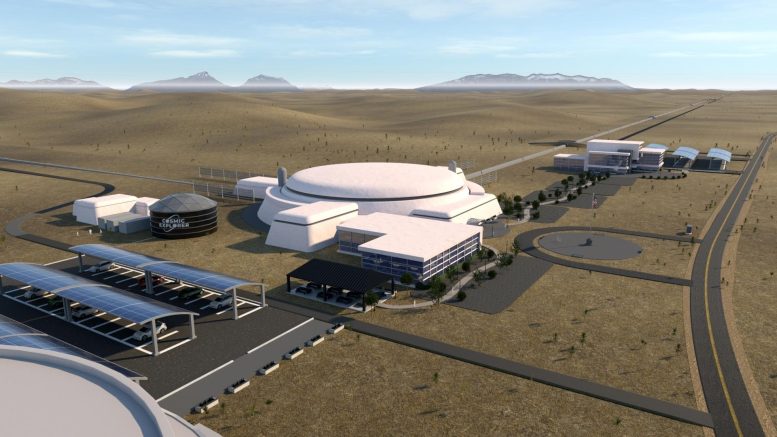
Evans: Cosmic Explorer is in some sense a giant LIGO. The LIGO detectors are four kilometers long for each arm, and Cosmic Explorer will be 40 kilometers on a side, so 10 times larger. And the signal that we get from a gravitational wave is essentially proportional to the size of our detector, and that’s why these things are so big.
Bigger is better, up to a point. At some point, you’ve matched the length of the detector to the wavelength of the incoming gravitational waves. And then, if you continue making it bigger, there are really diminishing returns in terms of scientific output. It’s also hard to find sites to build that large of a detector. When you get too big, the curvature of the Earth starts to become an issue because the detector’s laser beam has to travel in a straight line, and that’s less possible when a detector is so large that it has to curve with the Earth.
In terms of looking for possible sites, fortunately now, as opposed to in the 1980s when sites were being looked at for LIGO, there’s a lot of public data that’s available digitally. So we have already first versions of algorithmic searches that can search the U.S. for potential candidate sites. We’re looking for places which are kind of flat but also a little bowl-shaped in terms of altitude because that would avoid some excavation. And we’re looking for places that are not in the middle of cities or lakes, or in the mountains, and that aren’t too far from populated regions so that we could imagine getting scientists in and out. Our first go-around shows there are some potential candidates, especially in the western half of the U.S.
We see Cosmic Explorer as “next-generation” in the sense that it will replace existing observatories. If we were to build two Cosmic Explorer observatories in the U.S., which is our reference concept, then we would presumably shut down the two LIGO observatories. That’s probably mid-2030s, depending on how funding goes. So, it’s still a ways in the future. But we believe it would change the name of the game in terms of the science we can do.
Q: And what might that science be? What new things could you see, and what big questions could it answer?
Vitali: It will allow us to see sources that are farther away. And by sources, I mean things that we are seeing today, such as black holes and neutron stars colliding. Now, with the sensitivity of LIGO, we can see sources in our backyard, cosmologically speaking — about one-and-a-half billion years ago. That seems far away, but compared to the size of the universe, which is about 13 to 14 billion years old, that’s pretty nearby. That means we are missing important steps of the history of the universe, one of which is “Cosmic Noon,” where most of the stars in the universe were formed. That’s when the universe was around 3 billion years old. It would be great to access sources that were formed around that time, because it would teach us a lot about how black holes and neutron stars come from stars.
Going beyond that, when the universe was about a billion years old, during the Epoch of Reionization — that’s when atoms were ionized and galaxies started to form — this is still too far for us to see. Cosmic Explorer would be sensitive to the mergers of black holes and neutron stars up to those distances, and even farther than that.
We’ll also be able to see sources in a much clearer and louder way. Today, LIGO might detect something with a signal-to-noise ratio of 30, where it’s pretty loud but hard to characterize. That same signal, coming through Cosmic Explorer, would have a signal-to-noise of 3,000. So, anything that requires really sensitive measurements, like testing if Einstein’s relativity is correct, which now we can do but with large uncertainties — that would be a more precise test with Cosmic Explorer.
Finally, many measurements get better the more sources you have. We think Cosmic Explorer could detect hundreds of thousands of black hole binaries and up to a million neutron star mergers per year.
Evans: Being able to detect more sources lets you detect objects that are in the corners of parameter space, which you wouldn’t otherwise detect — like very large spins of the black hole, or very high mass ratios. If you have hundreds of thousands of sources, you can detect these oddballs.
Q: What’s next for the project going forward?
Evans: Over the next three years, we’ll be doing a full, top-down design, where we pick all the parameters of the instrument and include the infrastructure that goes around it, like the vacuum system, and we end up doing architectural designs for the buildings. And all of this needs to lead to a cost estimate that is fairly sound, both for the construction and the preliminary design. At that point we will have to have identified sites, have solid architectural and infrastructural designs done, and the design of the instrument will be at the nuts and bolts level.
The environment in which we’re doing this is one that includes other next-gen detectors in development, such as the space mission, LISA, being run by the European Space Agency, and expected to launch mid-2030s. There is also the Einstein Telescope in Europe. All these groups are colleagues rather than competitors, who we anticipate working with. In this field, you get farther by working together. It’s kind of a global effort to build these next-generation gravitational wave detectors, and it’s global science.
Never miss a breakthrough: Join the SciTechDaily newsletter.
Follow us on Google and Google News.