
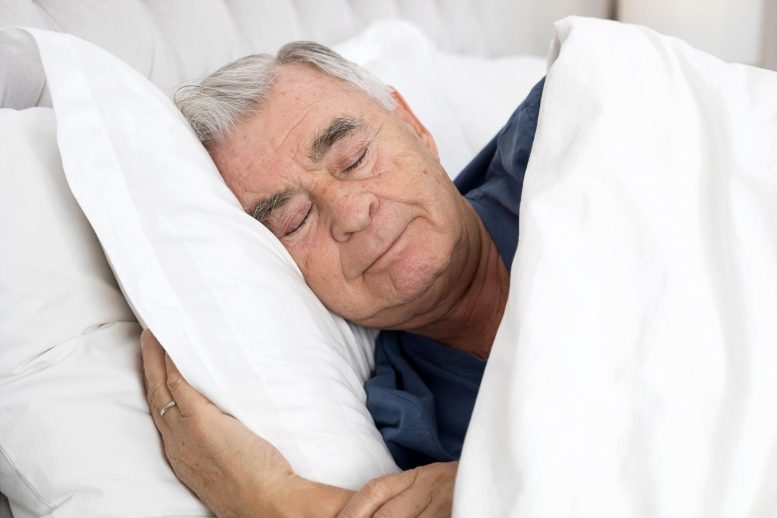
Nighttime ambient temperature plays a pivotal role in sleep quality for older adults; study underscores potential impact of climate change on sleep quality in the aging population.
New research finds that sleep can be most efficient and restful for older adults when the nighttime bedroom ambient temperature ranges between 68 to 77 °F.
The authors observed an overall trend: a 5-10 % drop in sleep efficiency as the nighttime ambient temperature increases from 77°F to 86°F. Importantly, this research also reveals substantial between-individual differences in optimal bedroom temperature.
“These results highlight the potential to enhance sleep quality in older adults by optimizing home thermal environments and emphasizing the importance of personalized temperature adjustments based on individual needs and circumstances,” said lead researcher Amir Baniassadi, PhD, Hinda and Arthur Marcus Institute for Aging Research at Hebrew SeniorLife, and Harvard Medical School.
“Additionally, the study underscores the potential impact of climate change on sleep quality in older adults, particularly those with lower socioeconomic status, and supports increasing their adaptive capacity as nighttime temperatures increase in cities across the country,” Baniassadi said.
Study Details and Findings
This longitudinal observational study examines the association between bedroom nighttime temperature and sleep quality in a sample of community-dwelling older adults. Using wearable sleep monitors and environmental sensors, researchers monitored sleep duration, efficiency, and restlessness over an extended period within participants’ homes while controlling for potential confounders and covariates. The study collected nearly 11,000 person-nights of sleep and environmental data from 50 older adults. The associations were primarily nonlinear, and substantial between-subject variations were observed.
The findings were published in the article, “Nighttime ambient temperature and sleep in community-dwelling older adults,” published in Science of The Total Environment. Authors were Amir Baniassadi; Brad Manor, PhD, Hinda and Arthur Marcus Institute for Aging Research at Hebrew SeniorLife, and Harvard Medical School; Wanting Yu, ME, Hinda and Arthur Marcus Institute for Aging Research at Hebrew SeniorLife; Thomas Travison, PhD, Hinda and Arthur Marcus Institute for Aging Research at Hebrew SeniorLife, and Harvard Medical School; and Lewis Lipsitz, MD, Hinda and Arthur Marcus Institute for Aging Research at Hebrew SeniorLife, and Harvard Medical School.
The Wider Context of Sleep in Older Adults
Older adults often experience inadequate, restless, and disrupted sleep which in turn influences many outcomes related to their health and well-being such as cognitive and physical function, mood and affect, irritability and reaction to stress, productivity, diabetes management, and risk of cardiovascular diseases. Indeed, poor sleep is disproportionately more common among older adults. Meanwhile, research on its causes has been mostly focused on physiological and behavioral factors despite evidence suggesting that the environment the person sleeps in can be as influential.
As a result, while numerous medical and behavioral interventions have been developed to improve outcomes related to sleep, the potential of environmental interventions has been largely overlooked. Within this context, the link between home ambient temperature and sleep among older adults can be a potential target for improving sleep, which motivated the researchers to conduct this study. The authors plan to continue this line of work by focusing on the potential impact of climate change on sleep in low-income older adults and developing interventions to optimize their environment.
Reference: “Nighttime ambient temperature and sleep in community-dwelling older adults” by Amir Baniassadi, Brad Manor, Wanting Yu, Thomas Travison and Lewis Lipsitz, 19 July 2023, Science of The Total Environment.
DOI: 10.1016/j.scitotenv.2023.165623
This study was supported by TMCITY foundation. Additionally, Baniassadi acknowledges support from a T32 fellowship through the U.S. National Institute on Aging (T32AG023480).
Never miss a breakthrough: Join the SciTechDaily newsletter.
Follow us on Google and Google News.