
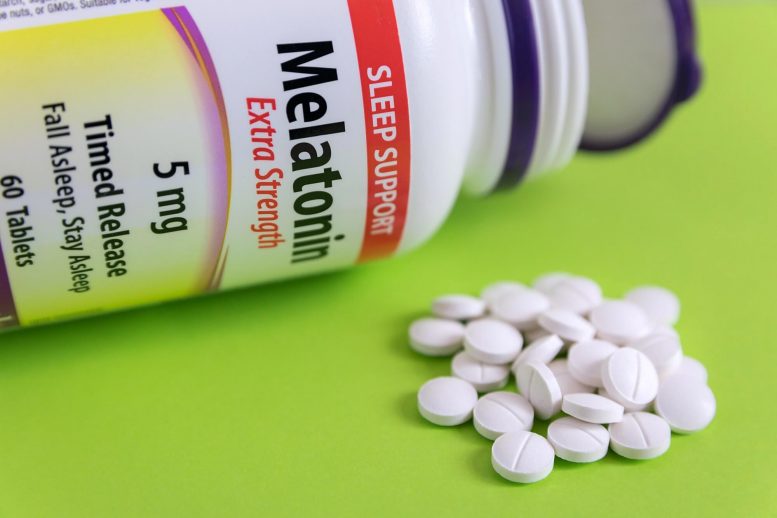
In a small study of healthy adults aged 55 and older, 5 mg of melatonin increased total sleep time compared to placebo.
Although recent research by the University of Cambridge and Fudan University found that seven hours is the ideal amount of sleep, many Americans get less than that. In fact, data from the CDC from 2014 found that 35.2% of adults in the U.S. get less than 7 hours of sleep. Clearly, many of us could use help to fall asleep faster and sleep better.
Melatonin is one of the most used supplements in the United States. Among older adults, its use has tripled in the last two decades. But there is no consensus on the right dosage of melatonin, and studies of its effects on sleep quality in older adults have had mixed results. Researchers from Brigham and Women’s Hospital conducted a study in 24 healthy, older adults to evaluate whether a high-dose or a low-dose melatonin supplement could improve sleep. The team found that the higher dose had a significant impact, increasing total sleep time compared to placebo by more than 15 minutes for nighttime sleep and by half an hour for daytime sleep. Results are published in The Journal of Pineal Research.
Melatonin is a hormone that the pineal gland in your brain produces in response to darkness. It helps with the timing of your circadian rhythms (24-hour internal clock) and with control of the sleep–wake cycle. Being exposed to light at night can block melatonin production.
Melatonin Dosage and Sleep Quality
“Sleep deficiency becomes more common as people age, and, given the drawbacks to many prescription sleep aids, many older adults report taking melatonin,” said senior author Charles Czeisler, PhD, MD, chief of the Brigham’s Division of Sleep and Circadian Disorders. “But we’ve had little evidence on the effects of melatonin on the sleep health of older adults. Our study provides new evidence and insight, and points to the importance of considering dosage and timing when it comes to the effects of supplements like melatonin, especially in older people.”
The body naturally produces the hormone melatonin, which helps regulate a person’s sleep-wake cycle with night and day. Melatonin levels peak at night. But among older people, levels of the hormone are often lower. Exogenous melatonin is sold over the counter and can be taken before bedtime as a dietary supplement, usually in the form of a pill or capsule.
To rigorously evaluate the effects of melatonin supplements, the study’s authors focused on healthy, older adults with no history of major sleep complaints. All potential participants were screened for sleep disorders. The study included 24 participants (13 women, 11 men) between the ages of 55 and 78.
During the month-long study period, participants lived in individual study rooms with no windows, clocks, or other indications of time of day. Participants followed a forced desynchrony protocol — instead of experiencing 24-hour cycles of days and nights, they were on schedules of 20-hour cycles to disentangle the effects of rest-activity from the circadian clock. This allowed the sleep to be scheduled both at night and during the day, but with a similar duration of waking before each sleep.
Polysomnography, a type of sleep study, records your brain waves, the oxygen level in your blood, heart rate and breathing, as well as eye and leg movements.
High vs. Low Dose Melatonin
Participants were randomly assigned to receive two weeks of a placebo pill and two weeks of either a low (0.3 mg) or high (5 mg) dose of melatonin 30 minutes before bedtime. Researchers used polysomnography to record brain waves, eye movement, muscle tone, and other key sleep metrics.
The team found that the low dose of melatonin did not lead to a statistically significant change in overall sleep time and that the changes that were seen were when sleep was scheduled during the biological day. Participants taking the 5 mg dose had a significant increase in total sleep time and sleep efficiency regardless of whether sleep was scheduled during the day or night.
The authors note that their study will need to be replicated in larger trials and with other doses of melatonin to determine whether a dose between 0.3 and 5mg may work as well. The study did not include participants who had a significant sleep disorder and the study’s findings may not be applicable to people who do.
“It’s exciting to see evidence that melatonin may have an impact on sleep at night for older adults because we know that so many older people have trouble sleeping,” said lead author Jeanne Duffy, MBA, PhD, of the Division of Sleep and Circadian Disorders. “But before taking a dietary supplement, it’s important for people to talk to their primary care physician and get a referral to a sleep specialist to rule out an undiagnosed sleep disorder.”
Reference: “High dose melatonin increases sleep duration during nighttime and daytime sleep episodes in older adults” by Jeanne F. Duffy, Wei Wang, Joseph M. Ronda and Charles A. Czeisler, 18 April 2022, The Journal of Pineal Research.
DOI: 10.1111/jpi.12801
Funding: This work was supported by the National Institutes of Health (grants P01 AG09975, AG06072 and AG044416), the Brigham and Women’s Hospital BRI Fund to Sustain Research Excellence, and were conducted in the Brigham and Women’s Hospital General Clinical Research Center (supported by M01 RR02635).
Disclosures: Czeisler is/was a paid consultant to Physician’s Seal, Tencent Holdings, and Teva Pharma, and is a paid consultant and holds an equity interest in With Deep and Vanda Pharmaceuticals Inc., is/was an expert witness in legal cases, including those involving Vanda Pharmaceuticals; serves as the incumbent of an endowed professorship provided to Harvard University by Cephalon, Inc., which was acquired by Teva Pharma; and receives royalties from Philips Respironics for the Actiwatch-2 and Actiwatch Spectrum devices.
Never miss a breakthrough: Join the SciTechDaily newsletter.
Follow us on Google and Google News.
17 Comments
they chose people who had no problems sleeping? Seriously?
I once looked into this with a sleep specialist. He showed me that the melatonin cycle started six hours before bed and the amounts were in micrograms. So I have been taking low doses 6 hours before bed and it is more effective than a big dose at the last minute (which puts me to sleep for a few hours, followed by insomnia for the rest. How much of the dose is absorbed is a big problem so I am using sublingual tabs (limits variability and absorbtion is higher).
Did somebody actually pay to do this study? Why would anyone pay to make a study about something already known?
OTC Melatonin has proven useless to me. Nothing prescribed has helped. When will this problem be addressed? People need sleep!!!!
Hello Admin,
How I get my article published in your website.
Waiting for your response.
I’ve always slept soundly through the night never a problem until last summer. Melatonin was suggested so I would take one at bed time with little success 2mg. Late fall of 2021 I found fast dissolving melatonin 5mg I place under my tongue about three hours before bedtime and I’ve been sleeping through the night with the exception of 2to 3 nights out of a month( nothings perfect)I also use guided meditation recordings while sleeping. I’m grateful for any studies regarding melatonin and those who participate 🙏🏻 I’m a healthy 77 year young and am thankful for melatonin. Thanks for the study and the article 🌈🌞
I take 10 mg nights I can’t sleep. Most times it helps but sometimes it don’t. U need to relaxed to let it work. Sometimes that’s a hard thing to do. But helps me most of the time
I have used it for it for well over 15 years and never leave home without it about 3 years ago. I went to 5mg from 3 and always get a wonderful nights sleep.
Perhaps, but that’s way more melatonin then is natural in the human body. And studies have shown that too much melatonin cause testicular and ovarian shrinking in lab animals. No thanks, I’ll pass on the melatonin and just drink more wine before bed.
My 83 year old father has trouble sleeping. The pills prescribed to him weren’t working so we tried 5mg of melatonin nightly, and now he usually sleeps about 9 hours a night.
Alt Title: “‘Science’ says ‘low’ dose (5mg) of melatonin helps you sleep 15 minutes longer, incase you live under a rock for 30 years”
Over the years I have been on every sleeping medication that is available. By chance, with a sound bath and 5 mg I sleep like a baby at 51 year’s.
Anybody in the military would have confirmed this without expensive surveys 😂
Does more melatonin make a person lazy too or just slow them down to sleep longer/better?
Pineal gland is also called 2nd eye and is very sensitive to light. It controls our ability to tolerate bright lights esp the ultra Violet rays and sunshine
I don’t have any insomnia but have an abnormally extreme photosensitivity issue.
I am from Pakistan and here we have intensive heat from 38 to 40-45 C for most of the months.
It is since last 15-20 yrs that going in the sun even for 10 minutes takes away all of my strength.
I feel excessively lithergic and feel unable to move from the bed for hours. Sometimes it is followed by nausea & vomiting and sometimes very very intensive lithergy which continues for 3-4 days
Doctors in Pakistan conclude that it is due to calcification of my pineal gland
I know that Melatonin tabs are it’s cure but I fear taking it due to 2 reasons.
1. To my knowledge these are not FDA approved and can be risky then
2. Any globally leading pharmaceutical like Pfizer etc has never prepared it. Why?
3. I already sleep for 7-8 hours a day. If it is increased by these tabs how will I complete my every day jobs
Please help and guide me to solve this extra photosensitivity problem
Scientist is just a fancy word for “failures who like to do dumb research on meaningless things and waste money.”
BREAKING NEWS, NEW STUDY FINDS DRINKING ANOTHER BEER AFTER ALREADY BEING DRUNK COULD RESULT IN BEING MORE DRUNK