
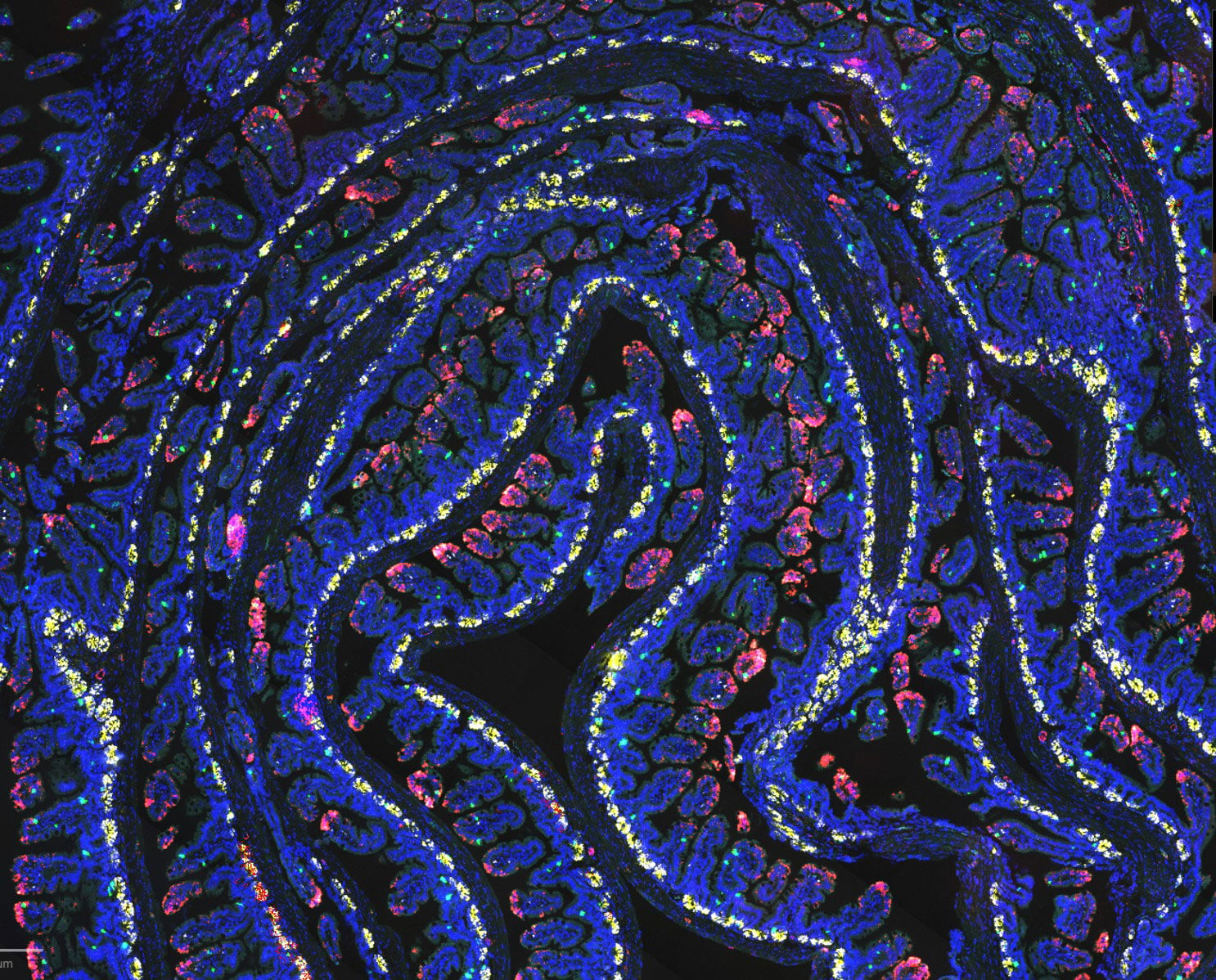
A gut bacterium appears essential to the intestinal repair benefits linked to fasting before radiation.
During radiation treatment for abdominal cancer, the therapy aimed at a tumor can also injure the delicate lining of the small intestine. That damage can lead to severe digestive problems and may restrict how much radiation a patient can safely receive.
The bacterium, Akkermansia muciniphila, or AKK, appears to work with metabolic changes caused by short-term fasting to place intestinal cells into a state that supports regeneration after radiation injury. The findings, published in Proceedings of the National Academy of Sciences, could eventually help researchers develop ways to protect healthy tissue during cancer treatment, although the work has not yet been tested in patients.
Helen Piwnica-Worms, Ph.D., professor of Experimental Radiation Oncology, and Kunal Rai, Ph.D., professor of Genomic Medicine, co-led the research.
“Fasting helps prepare intestinal cells to respond more quickly and effectively after injury, almost like training the cells with an emergency preparedness plan,” Piwnica-Worms said. “This study helps explain how that plan is organized and identifies a key bacterium involved in coordinating the response.”

Intestinal damage can limit radiation treatment
Radiation therapy is frequently used against abdominal cancers, including pancreatic, colorectal, and gynecologic cancers. The difficulty is that the small intestine contains rapidly renewing cells that are especially vulnerable to radiation.
When the intestinal lining is injured, patients can experience nausea, diarrhea, and infection. Severe damage can lead to life-threatening complications, which may restrict the amount of radiation doctors can safely deliver.
Earlier preclinical research from the Piwnica-Worms Laboratory showed that fasting before treatment improved intestinal recovery after radiation. That result raised a more difficult question: what changed inside the intestine during fasting, and how did those changes prepare the tissue to repair itself?
Fasting recruits a key gut bacterium
The researchers found that fasting for 24 hours increased the abundance of AKK in the small intestine. That shift mattered because AKK produces propionate, a small molecule created when microbes process nutrients.
Propionate worked alongside other metabolic changes caused by fasting to modify histones inside intestinal cells. Histones are proteins that package DNA, much like spools organizing long threads. Small chemical tags added to these proteins can loosen or tighten access to particular genes without changing the underlying genetic code.
In this case, the tags helped expose genes connected with tissue regeneration. A group of intestinal cells that accumulated during fasting appeared to carry these repair programs in a more accessible state, leaving them prepared to respond once injury occurred.
After radiation exposure, those cells multiplied and helped rebuild the intestinal lining. The sequence offered the researchers a possible explanation for how fasting before treatment could influence recovery afterward.
Repair requires both fasting and AKK
To determine whether AKK was simply present during the response or actually necessary for it, the researchers selectively removed the bacterium. The protective benefit associated with fasting then disappeared.

Restoring AKK by itself was not enough. The regenerative response returned only when the bacterium was reintroduced together with fasting, indicating that the microbial and metabolic changes worked as a combined system.
The results suggest that fasting alters intestinal cells before radiation arrives rather than merely helping them recover afterward. By changing gut microbes, metabolism, and access to regeneration genes, the process may allow repair to begin more rapidly once tissue is damaged.
This connection between diet, microbes, and gene activity could help researchers understand how healthy tissues organize their response to injury. It may also point toward ways to reduce treatment-related harm while preserving the cancer-fighting effects of radiation.
Future studies will need to determine whether the pathway operates similarly in patients receiving abdominal radiation. Researchers also want to investigate whether it could protect other rapidly dividing tissues, including bone marrow, from damage caused by cancer treatment.
New therapies may avoid fasting
Fasting can be physically difficult or medically inappropriate for people undergoing cancer therapy. For that reason, the researchers are interested in reproducing its protective effects without requiring patients to stop eating.
Possible approaches could include treatments based on AKK, propionate, or other metabolites involved in the repair pathway. Dietary interventions might offer another way to influence the same biological response.
“Fasting is not always practical for cancer patients, and this work supports several other potential ways to enhance recovery after treatment,” Rai said. “Whether through dietary interventions, targeted microbes or their metabolites, the goal is to help repair healthy tissue more effectively while patients receive the cancer therapies they need.”
Reference: “Fasting primes small intestinal regeneration after damage via a microbiome–metabolite–chromatin axis” by Praveen Barrodia, Ajay Kumar Saw, Sabrina L. Jeter-Jones, Chia-Chi Chang, Jiansu Shao, Emre Arslan, Anand K. Singh, Suresh Satpati, Robert R. Jenq, Kunal Rai and Helen Piwnica-Worms, 23 June 2026, Proceedings of the National Academy of Sciences.
DOI: 10.1073/pnas.2529215123
This research was supported by the National Cancer Institute (NCI) within the National Institutes of Health (NIH) and the Cancer Prevention and Research Institute of Texas (CPRIT).
Never miss a breakthrough: Join the SciTechDaily newsletter.
Follow us on Google and Google News.
2 Comments
thanks for this
Very interesting. When I was on my journey with cancer, my radiation oncologist explained nothing about the deleterious effects radiation therapy would have on my gut or any other part of my body. I researched it myself, discovered the benefits of fasting, and applied them despite my doctors’ advice to the contrary. He actually encouraged me to eat more sweet things to relieve my “stress.”
My first water fast lasted 12-days. I was not overweight when I began, and lost a significant amount of weight by the end of the fast, which stabilized afterward. From there, I continued with a one-meal-a-day regimen, incorporating probiotics through fermented foods at every meal, and I continue to do so today, five years later. Despite the continued objections of my primary healthcare physician, all my blood markers are excellent, my body composition is optimal, and I am still cancer-free. It’s helpful to read about the mechanism responsible for fasting and how it protects us; I thank you for the article.
Of course, a balanced diet is essential to our survival, but Western society tends to overindulge in good things with bad food substitutes and choices. How much food do we really need? I found the answer myself; not as much as the dietitians tell us.