
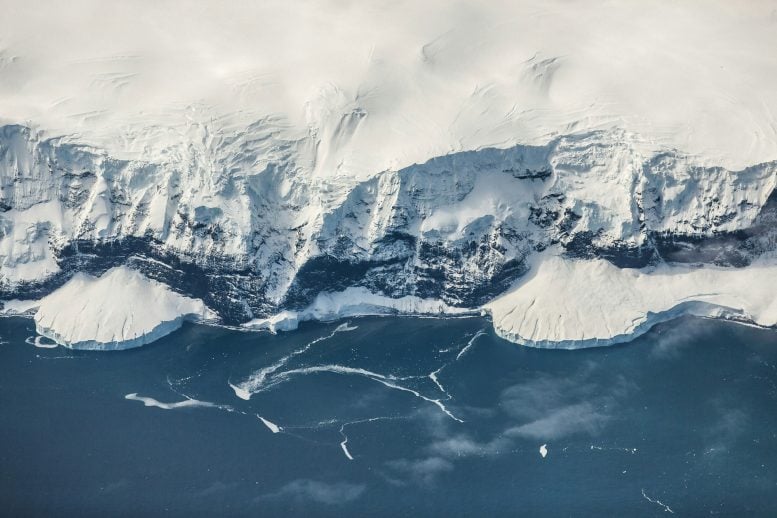
Antarctica’s first ice sheet may have begun with a geological head start hidden deep beneath the continent.
Millions of years before thick ice spread across the Northern Hemisphere, forces inside Earth lifted East Antarctica into a vast region of mountains and plateaus. The higher terrain became cold enough to preserve snow even when the planet was about 5°C (9°F) warmer than it is today.
New research published in Science suggests this slow transformation of the landscape explains how Antarctica froze roughly 34 million years ago while the Arctic remained largely free of major ice sheets.
The process began much earlier, as the ancient supercontinent Gondwana broke apart. When Antarctica and Africa started separating during the Jurassic Period, about 201 to 143 million years ago, the breakup disturbed the hot, slowly moving rock beneath Earth’s crust.
Mantle Waves Raised a Continent
Those disturbances sent waves through the mantle that gradually stripped material from the continent’s deep roots. As that heavy material sank, the surface above it rose, lifting East Antarctica over tens of millions of years.
Over time, East Antarctica developed a steep coastal escarpment, a broad elevated plateau, and the Gamburtsev Mountains. Today, those mountains are almost completely hidden beneath 1 to 3 km (0.6 to 1.9 miles) of ice.
Lead author Thomas Gernon, Professor of Earth Science at the University of Southampton, explained, “Antarctica’s land surface was gradually lifted to the point where ice could gain a permanent foothold, even while the surrounding polar oceans as well as global temperatures remained surprisingly warm.”
How Antarctica Reached the Tipping Point for Ice
Gernon and his colleagues reconstructed more than 100 million years of landscape evolution using computer simulations. Their models linked the breakup of tectonic plates with changes in the mantle, erosion at the surface, mountain growth, and the eventual arrival of permanent ice.
By about 45 million years ago, large areas of East Antarctica had risen above a crucial threshold of roughly 2 km (1.2 miles). At those elevations, temperatures were low enough for mountain glaciers to survive the summer, grow from year to year, and eventually join together.
Dr. Thea Hincks, Senior Research Fellow at the University of Southampton and co-leader of the study, said, “We found that our models can realistically capture the evolution of the two-kilometer-high coastal escarpment, elevated plateau, and inland mountains, eventually seeding the East Antarctic Ice Sheet.”
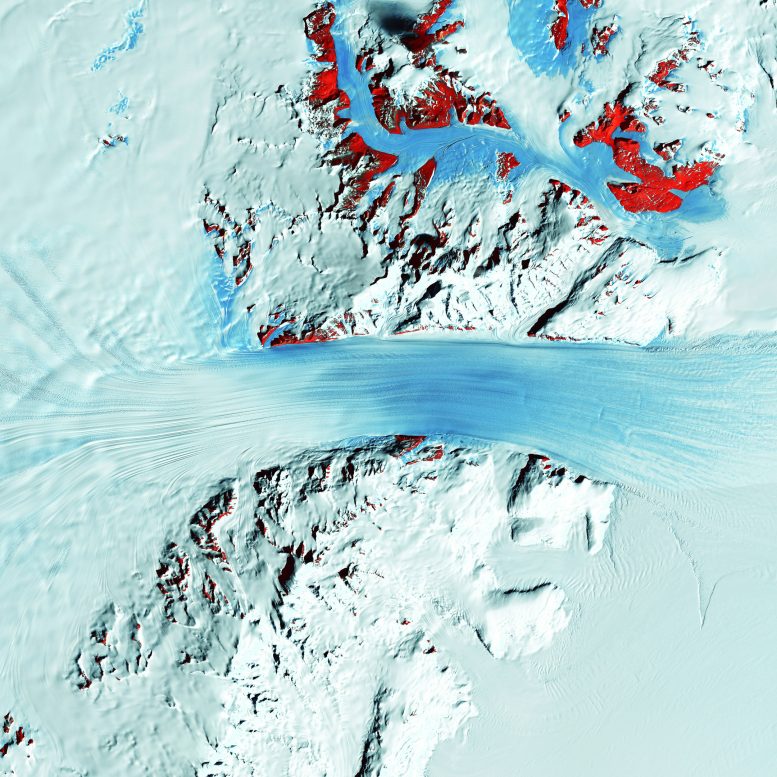
Why Antarctica Froze Before the Arctic
This elevated terrain gave Antarctica an advantage that the Arctic lacked. Although atmospheric carbon dioxide (CO₂) levels were declining, greenhouse gas reductions alone could not fully explain why one pole froze so much earlier than the other.
“If falling levels of CO2 acted alone, you would expect the poles to respond more symmetrically,” Gernon explained. “Instead, Antarctica gained a major head start because geological processes had raised land to higher elevations, making it colder.”
Mountain Height Crossed a Critical Threshold
The difference between lasting snow and summer melt can come down to a surprisingly small change in altitude.
“Topography is fundamentally important for glaciation. Air temperatures can drop by up to 1ºC for every 100 meters of altitude gained,” said Dr. Guy Paxman, Royal Society University Research Fellow at Durham University and study co-author.
Before 50 million years ago, most of the Gamburtsev Mountains stood below 1.5 km (0.9 miles). By the time Antarctica’s major glaciation began around 34 million years ago, nearly half of the range had risen above 2 km (1.2 miles).
That increase allowed snow to remain through the summer and accumulate into permanent ice caps. Glaciers then expanded down the mountains and across the plateau, eventually merging into the East Antarctic Ice Sheet.
Climate Feedbacks Locked Antarctica in Ice
Once the ice began spreading, it helped create the conditions for even more ice.
“As the ice sheet expanded, its bright surface reflected more sunlight back into space, cooling the region further,” said Dr. Philip Goodwin, a climate physicist at the University of Southampton and study co-author.
This process, known as the “ice-albedo effect,” reduced global temperatures by an estimated 1°C (1.8°F). The cooling still was not strong enough to produce comparable ice sheets in the Northern Hemisphere, where much of the Arctic land remained at lower elevations.
Cooling Feedbacks Accelerated Antarctica’s Freeze
Antarctica’s cooling also dried the atmosphere. Because cold air holds less water vapor, there was less of this heat-trapping gas available to insulate the planet. That weakened the atmosphere’s warming effect and allowed temperatures to fall further.
“Together, these feedbacks allowed the Antarctic ice sheet to spread from the mountains across the continent, eventually reaching the coast,” added Goodwin.
By comparison, the Northern Hemisphere did not develop extensive ice sheets until approximately the past five million years, nearly 30 million years after Antarctica’s transformation.
Earth’s Interior May Trigger Ice Ages
The findings suggest that the beginning of an ice age depends on more than changes in the atmosphere. Plate tectonics and activity deep inside Earth can reshape continents long before a climate threshold is crossed, determining where snow first survives and where an ice sheet can take hold.
“Our findings reveal that the Earth’s interior preconditions landscapes to glaciation, determining when and where major climate transitions like the glaciation of Antarctica become possible,” explained Gernon. “That’s incredibly important for understanding Earth’s ancient ice ages as well as future tipping points in the climate system.”
The East Antarctic Ice Sheet that emerged from those changes is now the largest on the planet. It holds enough frozen water to raise global sea levels by about 52 meters (171 feet) if it melted completely.
Reference: “Continental breakup–driven uplift instigated East Antarctic Ice Sheet formation” by Thomas M. Gernon, Thea K. Hincks, Philip Goodwin, Guy J. G. Paxman, Sascha Brune, Eelco J. Rohling, Derek Keir and Jean Braun, 2 July 2026, Science.
DOI: 10.1126/science.adz6758
The research was made possible by the support of the WoodNext Foundation, a fund of a donor-advised fund program.
Never miss a breakthrough: Join the SciTechDaily newsletter.
Follow us on Google and Google News.
1 Comment
“…, large areas of East Antarctica had risen above a crucial threshold of roughly 2 km (1.2 miles). At those elevations, temperatures were low enough for mountain glaciers to survive the summer, grow from year to year, and eventually join together.”
Assuming that the models are correct, it would seem to imply that as ice at the coasts melts, and the boundary between bedrock and glacier moves up-slope, the rate of retreat should reach zero at about 2 km elevation. That is, a linear temporal or positional extrapolation for the retreat of ice in both Greenland and Antarctica is not supported by their modeling, and strongly suggests that while the ice coverage at the lowest elevations may decrease in the future, a concern about the rapid collapse so frequently mentioned is not warranted. Furthermore, it would suggest that while alarmists are concerned about a 1.5 deg C increase in the global average temperature, these authors provide evidence that polar temperatures would have to increase more than 5 deg C to melt the highest elevation ice. Because ice melts at a fixed temperature (0 deg C), the lapse rate will inhibit retreat above 2 km until it rises above the MP.