
Close Menu
    Facebook X (Twitter) Instagram
    SciTechDaily
    • Biology
    • Chemistry
    • Earth
    • Health
    • Physics
    • Science
    • Space
    • Technology
    Facebook X (Twitter) Pinterest YouTube RSS
    SciTechDaily
    Home»Earth»Demise of Laurentide Ice Sheet Due to Sudden Shift in “Radiative Forcing”
    Earth

    Demise of Laurentide Ice Sheet Due to Sudden Shift in “Radiative Forcing”

    By Oregon State UniversityJune 23, 2015No Comments3 Mins Read
    Facebook Twitter Pinterest Telegram LinkedIn WhatsApp Email Reddit
    Share
    Facebook Twitter LinkedIn Pinterest Telegram Email Reddit
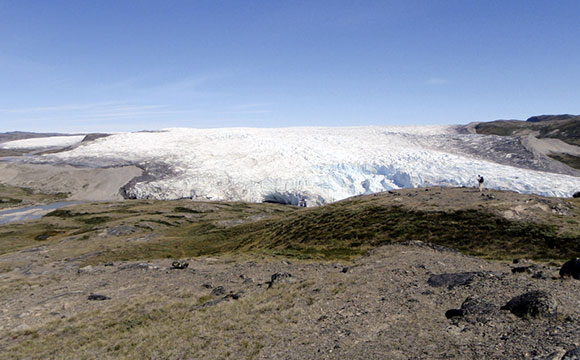
    A study of the demise of the Laurentide Ice Sheet that once covered Canada may help scientists better understand shrinking ice fields today - like this melting ice margin in Greenland.
    A study of the demise of the Laurentide Ice Sheet that once covered Canada may help scientists better understand shrinking ice fields today – like this melting ice margin in Greenland.

    Researchers at Oregon State University studied the cause of the demise of the massive Laurentide Ice Sheet during the last ice age, looking for clues as to how a warming climate may impact ice sheets on Greenland and Antarctica.

    A new study has found that the massive Laurentide ice sheet that covered Canada during the last ice age initially began shrinking through calving of icebergs, and then abruptly shifted into a new regime where melting on the continent took precedence, ultimately leading to the sheet’s demise.

    Researchers say a shift in “radiative forcing” began prior to 9,000 years ago and kicked the deglaciation into overdrive. The results are important, scientists say, because they may provide a clue to how ice sheets on Greenland and Antarctica may respond to a warming climate.

    Results of the study, which was funded by the National Science Foundation with support from the National Aeronautics and Space Administration (NASA), are being published this week in Nature Geoscience.

    David Ullman, a postdoctoral researcher at Oregon State University and lead author on the study, said there are two mechanisms through which ice sheets diminish – dynamically, from the jettisoning of icebergs at the fringes, or by a negative “surface mass balance,” which compares the amount of snow accumulation relative to melting. When more snow accumulates than melts, the surface mass balance is positive.

    When melting outpaces snow accumulation, as happened after the last glacial maximum, the surface mass balance is negative.

    “What we found was that during most of the deglaciation, the surface mass balance of the Laurentide Ice Sheet was generally positive,” Ullman said. “We know that the ice sheet was disappearing, so the cause must have been dynamic. But there was a shift before 9,000 years ago and the deck became stacked, as sunlight levels were high because of the Earth’s orbit and CO2 increased.

    “There was a switch to a new state, and the ice sheet began to melt away,” he added. “Coincidentally, when melting took off, the ice sheet began pulling back from the coast and the calving of icebergs diminished. The ice sheet got hammered by surface melt, and that’s what drove final deglaciation.”

    Ullman said the level of CO2 that helped trigger the melting of the Laurentide ice sheet was near the top of pre-industrial measurements – though much less than it is today. The solar intensity then was higher than today, he added.

    “What is most interesting is that there are big shifts in the surface mass balance that occur from only very small changes in radiative forcing,” said Ullman, who is in OSU’s College of Earth, Ocean, and Atmospheric Sciences. “It shows just how sensitive the system is to forcing, whether it might be solar radiation or greenhouse gases.”

    Scientists have examined ice cores dating back some 800,000 years and have documented numerous times when increases in summer insolation took place, but not all of them resulted in deglaciation to present-day ice volumes. The reason, they say, is that there likely is a climatic threshold at which severe surface melting is triggered.

    “It just might be that the ice sheet needed an added kick from something like elevated CO2 levels to get things going,” Ullman said.

    Never miss a breakthrough: Join the SciTechDaily newsletter.
    Follow us on Google and Google News.

    Canada Global Warming Ice Age Ice Sheet Oregon State University
    Share. Facebook Twitter Pinterest LinkedIn Email Reddit

    Related Articles

    New Data Reveals Sea Levels Rose 125 Feet After Last Ice Age

    Greenland’s Ice Sheet is Fracturing Faster Than Ever: A Warning for Rising Seas

    CryoSat-2 and ICESat-2 Reveal Alarming Speed of Greenland’s Ice Meltdown

    Earth in Crisis: Scientists Reveal Dire Climate Predictions for the Future

    Scientists Propose Bold New Solution to Climate Change

    Life on Earth Is in Danger – New Report Reveals That Earth’s Vital Signs Have Deteriorated to Levels Unprecedented in Human History

    Climate Warming and Rapid Ice Melt Linked to Volcanic Activity and Low Ocean Oxygen Events During Last Ice Age

    New Report: Earth Is “Unequivocally” in Midst of Climate Emergency

    More Damaging Than Previously Thought: Glaciers Might Not Be Able To Recover From Climate Change

    Leave A Reply Cancel Reply

    • Facebook
    • Twitter
    • Pinterest
    • YouTube

    Don't Miss a Discovery

    Subscribe for the Latest in Science & Tech!

    Trending News

    AI Could Detect Early Signs of Alzheimer’s in Under a Minute – Far Before Traditional Tests

    What if Dark Matter Has Two Forms? Bold New Hypothesis Could Explain a Cosmic Mystery

    This Metal Melts in Your Hand – and Scientists Just Discovered Something Strange

    Beef vs. Chicken: Surprising Results From New Prediabetes Study

    Alzheimer’s Breakthrough: Scientists Discover Key Protein May Prevent Toxic Protein Clumps in the Brain

    Quantum Reality Gets Stranger: Physicists Put a Lump of Metal in Two Places at Once

    Scientists May Have Found the Key to Jupiter and Saturn’s Moon Mystery

    Scientists Uncover Brain Changes That Link Pain to Depression

    Follow SciTechDaily
    • Facebook
    • Twitter
    • YouTube
    • Pinterest
    • Newsletter
    • RSS
    SciTech News
    • Biology News
    • Chemistry News
    • Earth News
    • Health News
    • Physics News
    • Science News
    • Space News
    • Technology News
    Recent Posts
    • Living With Roommates Might Be Changing Your Gut Microbiome Without You Knowing
    • Simple and Cheap Blood Test Could Detect Cancer and Other Diseases Before Symptoms Appear
    • Century-Old Cleaning Chemical Linked to 500% Increased Risk of Parkinson’s Disease
    • What if Your Memories Never Happened? Physicists Take a New Look at the Boltzmann Brain Paradox
    • Students Found an Ancient Star That Shouldn’t Be in the Milky Way
    Copyright © 1998 - 2026 SciTechDaily. All Rights Reserved.
    • Science News
    • About
    • Contact
    • Editorial Board
    • Privacy Policy
    • Terms of Use

    Type above and press Enter to search. Press Esc to cancel.