

New research reveals that post-ice age sea levels rose over a meter per century during key periods and totaled about 38 meters, informing current climate projections.
New geological data has provided a clearer understanding of how quickly and how much global sea levels rose following the last ice age, around 11,700 years ago.
This information is crucial for understanding the effects that global warming has had on melting ice caps and rising sea levels. The findings were published in the scientific journal Nature by researchers from Deltares, Utrecht University, TNO Netherlands Geological Service, Delft University of Technology, the Netherlands Institute for Sea Research (NIOZ), University of Leeds, University of Sheffield, University of Amsterdam, LIAG, and BGR.
Better understanding of sea level rise
This new knowledge about sea level rise during the early Holocene serves as a valuable reference for both scientists and policymakers. It is especially relevant today, as we are experiencing rapid melting of ice sheets due to global warming. The study offers important insights that can help guide decisions for the future.
Because of the ongoing increase in greenhouse gas emissions, climate models developed by the Intergovernmental Panel on Climate Change (IPCC) project that sea levels could rise by several meters by the year 2300. Some scenarios suggest an increase of more than one meter per century.
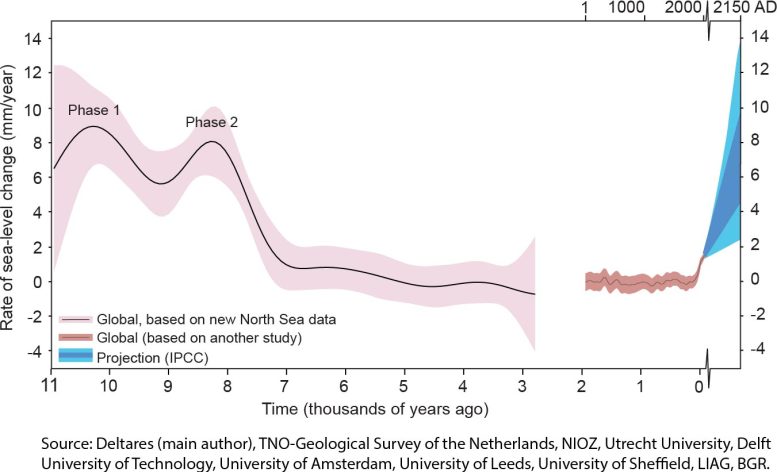
Unlike the early Holocene, however, the consequences of sea level rise today are far more serious. This is largely due to the growth of human populations and the widespread development of infrastructure, cities, and economic centers in coastal regions.
Unique dataset in the North Sea region
Global sea levels rose quickly following the last ice age. This was as a result of global warming and the melting of enormous ice caps that covered North America and Europe.
Until now, the rate and extent of sea level rise during the early Holocene were not known due to a lack of sound geological data from this period. Using a unique dataset for the North Sea region, the researchers have now been able to make highly accurate calculations for the first time.
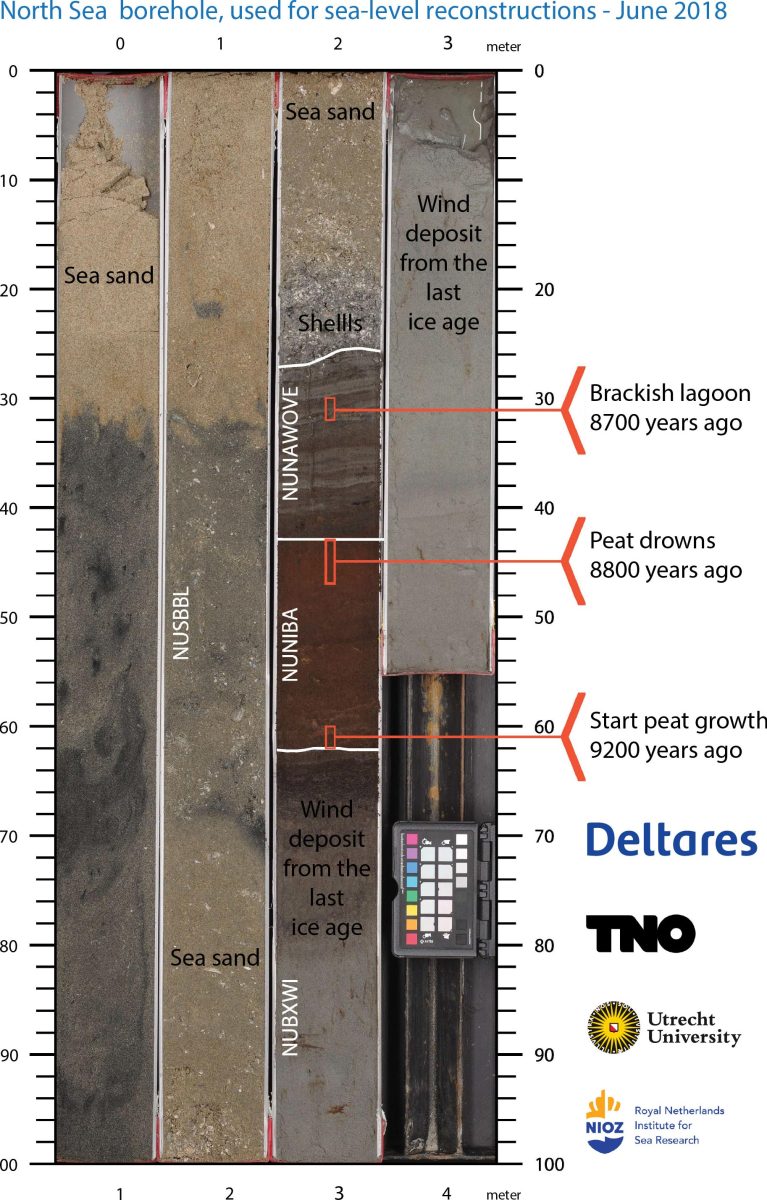
They analyzed a range of boreholes from the area in the North Sea that was once Doggerland, a land bridge between Great Britain and mainland Europe. This area flooded as the sea level rose.
By analyzing the submerged peat layers from this area, dating them, and applying modeling techniques, researchers showed that, during two phases in the early Holocene, rates of global sea level rise briefly peaked at more than a meter per century. By comparison, the current rate of sea level rise in the Netherlands is about 3 mm annually, the equivalent of 30 centimeters per century, and is expected to increase.
Furthermore, until now there has been considerable uncertainty about the total rise between 11,000 and 3,000 years ago. Estimates varied between 32 and 55 meters. The new study has eliminated that uncertainty and it shows that the total rise was around 38 meters (125 feet).
Groundbreaking research
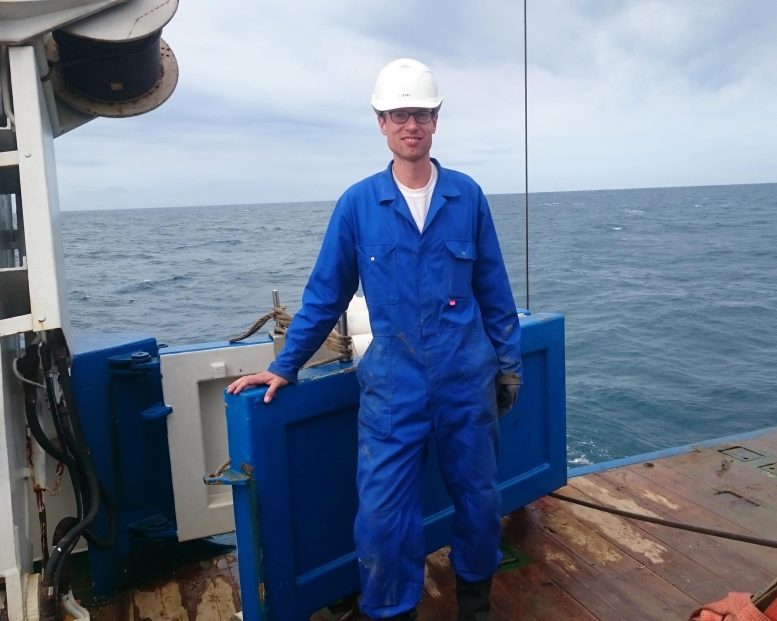
Marc Hijma, a geologist at Deltares and the lead author of the study: “With this groundbreaking research, we have taken an important step towards a better understanding of sea level rise after the last ice age. By drawing on detailed data for the North Sea region, we can now better unravel the complex interaction between ice sheets, climate, and sea level. This provides insights for both scientists and policymakers so that we can prepare better for the impacts of current climate change, for example by focusing on climate adaptation.”
Reference: “Global sea-level rise in the early Holocene revealed from North Sea peats” by Marc P. Hijma, Sarah L. Bradley, Kim M. Cohen, Wouter van der Wal, Natasha L. M. Barlow, Bas Blank, Manfred Frechen, Rick Hennekam, Sytze van Heteren, Patrick Kiden, Antonis Mavritsakis, Bart M. L. Meijninger, Gert-Jan Reichart, Lutz Reinhardt, Kenneth F. Rijsdijk, Annemiek Vink and Freek S. Busschers, 19 March 2025, Nature.
DOI: 10.1038/s41586-025-08769-7
Never miss a breakthrough: Join the SciTechDaily newsletter.
Follow us on Google and Google News.
13 Comments
Yawn. Today’s climate scare article to stoke the fear fire.
Solution: Reduce the human population and don’t build so close to the sea shore.
Yawn, another denialist SLOGAN for those allergic to science.
” Our results also show that global mean sea-level rise between 11 ka and 3 ka amounted to 37.7 m (2σ range, 29.3–42.2 m), …”
This is the way that research should be done and reported, which one seldom sees in climatology. The average and range are reported with a reasonable number of consistent significant figures and the probability range for the uncertainty (2σ) is stated explicitly. One doesn’t have to guess at what the author(s) is/are presenting. I applaud the authors for performing like real scientists, albeit I’m disappointed that the authors attention to detail wasn’t presented in the press release. Even political pollsters routinely report the margin of error. Are those with an interest in science any less capable of using the information about uncertainty than those interested in politics?
The politics of denial is the real politicization of the science.
The denial of what? If two contradictory claims are made, only one can be true. The goal of science is to try to determine which (if either) claim/hypothesis is true. Denial is a part of the Scientific Method and is the reason that peer-reviewed research is published and peers are encouraged to critique the evidence and claims. Your position suggests that you are more concerned about who makes a claim first, rather than what evidence and logic contribute to determining the truth.
Clyde Spencer wrote: The denial of what? If two contradictory claims are made, only one can be true. Clyde, All, that is not true, when two contradictory claims are made, more often than not, BOTH ARE WRONG!
There was a lot more ice to melt back then, but the world is warming much faster now.
Even one meter of sea level rise would cause huge problems for ports and harbors.
And about 20% of global agriculture is in low lying areas by estuaries, river deltas vulnerable to sea level rise and ensuing storm surges. Most crops are not salt tolerant.
—————–
“As the Earth moved out of ice ages over the past million years, the global temperature rose a total of 4 to 7 degrees Celsius over about 5,000 years.
In the past century alone, the temperature has climbed 0.7 degrees Celsius, roughly TEN TIMES FASTER than the average rate of ice-age-recovery warming.”
NASA Earth Observatory
—————————
This is from 2010. The warming since 1880 is now nearly double the 0.7C warming NASA was referring to.
Well said. You even managed to render the climate denier bully(s) mute.
Only temporally.
Is your definition of a bully one who provides scientific facts to counter unsupported claims? Perhaps you are in favor of also burning books that don’t agree with your belief?
That comment just proves my point.
You do not simply counter with ” facts”, you make snide remarks like that. You are much more careful with your comments over at MSN, I guess they don’t tolerate that behaviour over there.
“…, but the world is warming much faster now.”
Where is the evidence to support that claim? A problem with comparing modern instrumental readings and estimating temperatures from proxies or effects is that time tends to act like a low-pass filter, suppressing peaks and spreading out apparent time. Despite that issue, there was at least one study that suggested the melting of the North American ice sheet took place in a matter of a few decades, challenging your claim about the world warming much faster now.
Even one meter of sea level retreat would cause huge problems for ports and harbors!