
When Sierra Simpson was in college, she was sick for a year with recurring fevers and vomiting. Her doctors couldn’t figure out what she had. Suspecting a bacterial infection, they tried treating her with high doses of antibiotics.
“It turned out I had malaria and needed a different treatment,” Simpson said. “But by then the antibiotics had messed with my stomach and I felt more anxious than I had before.”
Antibiotics kill disease-causing bacteria, but they also destroy many of the beneficial bacteria living in our guts, a side effect that has been linked to a number of long-term health issues. That experience was the impetus for Simpson’s interest in microbiome science and the gut-brain axis — studies of the many ways that bacteria, viruses, and other microbes living in our bodies influence our physical and mental well-being.
As a now-healthy graduate student, Simpson first worked on techniques to visualize molecules in the brain. But she couldn’t shake her interest in the gut microbiome and its connections to the brain.
“So one day, Sierra just walks into my lab and asks me if I’d be interested in exploring potential connections between the gut microbiome and what my lab typically studies — drug abuse and addiction,” said Olivier George, Ph.D., associate professor of psychiatry at University of California San Diego School of Medicine. “I was reluctant at first. After all, I figured if there was something there, someone would’ve discovered it by now. But we decided to give it a try.”
In a study published April 27, 2020, in eNeuro, Simpson, George, and team discovered that the gut microbiome influences the pattern of activation in a rat’s brain during opioid addiction and withdrawal.
“Like you often have to do in science, we first hit the problem with a hammer to see how the system breaks, then backtrack from there,” Simpson said.
By that she means that in order to determine if the gut microbiome influenced drug addiction, they first needed to compare an organism with a normal gut microbiome to one without. To do that, the researchers gave some rats antibiotics that depleted 80 percent of their gut microbes. All of the rats — those with and without gut microbes — were dependent on the prescription opioid pain reliever oxycodone. Then some of the rats from each group went into withdrawal.
“To me, the most surprising thing was that the rats all seemed the same on the surface,” George said. “There weren’t any major changes in the pain-relieving effect of opioids, or symptoms of withdrawal or other behavior between the rats with and without gut microbes.”
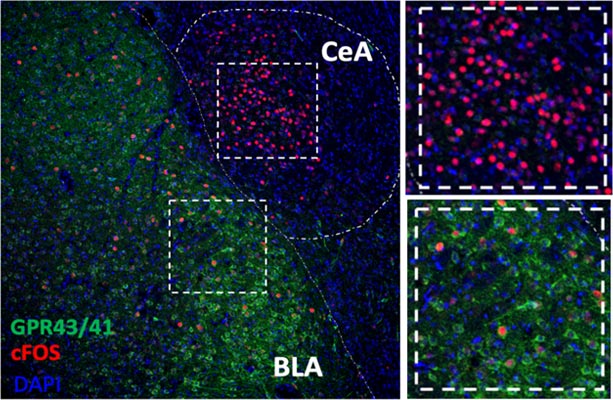
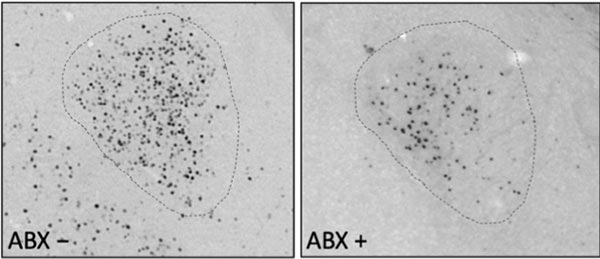
It wasn’t until the team looked at the rats’ brains that they saw a significant difference. The typical pattern of neuron recruitment to different parts of the brain during intoxication and withdrawal was disrupted in rats that had been treated with antibiotics, and thus lacked most of their gut microbes. Most notably, during intoxication, rats with depleted gut microbes had more activated neurons in the regions of the brain that regulate stress and pain (periaqueductal gray, locus coeruleus) and regions involved in opioid intoxication and withdrawal (central amygdala, basolateral amygdala). During withdrawal, microbe-depleted rats had fewer activated neurons in the central amygdala, as compared to rats with normal gut microbiomes.
“It was many months of counting black dots,” Simpson said. “But in the end, it became clear that, at least in rats, gut microbes alter the way the brain responds to drugs.”
That shift could affect behavior, she explained, because a decrease in neurons recruited in the central amygdala could result in fewer withdrawal symptoms, which can in turn lead to a higher risk of drug abuse.
Now, George’s team is expanding their studies to include rats that self-administer oxycodone and outbred rats that are more genetically diverse. They are also looking for microbial or chemical signatures in the rats that could indicate which are more susceptible to addiction, with and without gut microbes.
In addition, the researchers are mining human microbiome data, which include users of opioids and antibiotics, to see if they follow trends similar to those they observed in rats.
“Not only does this study suggest gut microbes may play a role in drug addiction, if we find similar effects in humans, it may change the way we think about co-prescribing antibiotics and pain killers, for example when a person undergoes surgery,” George said. “The way a person’s gut microbes are affected could make them more or less sensitive to opioids. The key now will be looking for biomarkers so we can predict how a person might respond before we treat them.”
As for Simpson, she earned her Ph.D. just a week and a half ago, after successfully defending her thesis virtually — presenting her research findings to her advisory committee, family, and friends while sheltering in place during the COVID-19 pandemic. Next, Simpson will turn her attention to a startup company she is launching to further advance and commercialize her research findings.
Reference: “Depletion of the Microbiome Alters the Recruitment of Neuronal Ensembles of Oxycodone Intoxication and Withdrawal” by Sierra Simpson, Adam Kimbrough [Ph.D.], Brent Boomhower, Rio McLellan, Marcella Hughes, Kokila Shankar, Giordano de Guglielmo [Ph.D.] and Olivier George [Ph.D.], 27 April 2020, eNeuro.
DOI: 10.1523/ENEURO.0312-19.2020
Additional co-authors of this study include: Kokila Shankar, UC San Diego and Scripps Research; Adam Kimbrough, Brent Boomhower, Rio McLellan, Marcella Hughes, and Giordano de Guglielmo, UC San Diego.
Never miss a breakthrough: Join the SciTechDaily newsletter.
Follow us on Google and Google News.
1 Comment
Oh !! This is a really great article. Thank you for providing these details. I’m sad I didn’t even know about this.