
Close Menu
    Facebook X (Twitter) Instagram
    SciTechDaily
    • Biology
    • Chemistry
    • Earth
    • Health
    • Physics
    • Science
    • Space
    • Technology
    Facebook X (Twitter) Pinterest YouTube RSS
    SciTechDaily
    Home»Earth»NASA Reveals the Black Sea’s Stunning Annual Turquoise Transformation
    Earth

    NASA Reveals the Black Sea’s Stunning Annual Turquoise Transformation

    By Kathryn Hansen, NASA Earth ObservatoryJuly 18, 2026No Comments4 Mins Read
    Facebook Twitter Pinterest Telegram LinkedIn WhatsApp Email Reddit
    Share
    Facebook Twitter LinkedIn Pinterest Telegram Email Reddit
    Turquoise Black Sea From Space Annotated
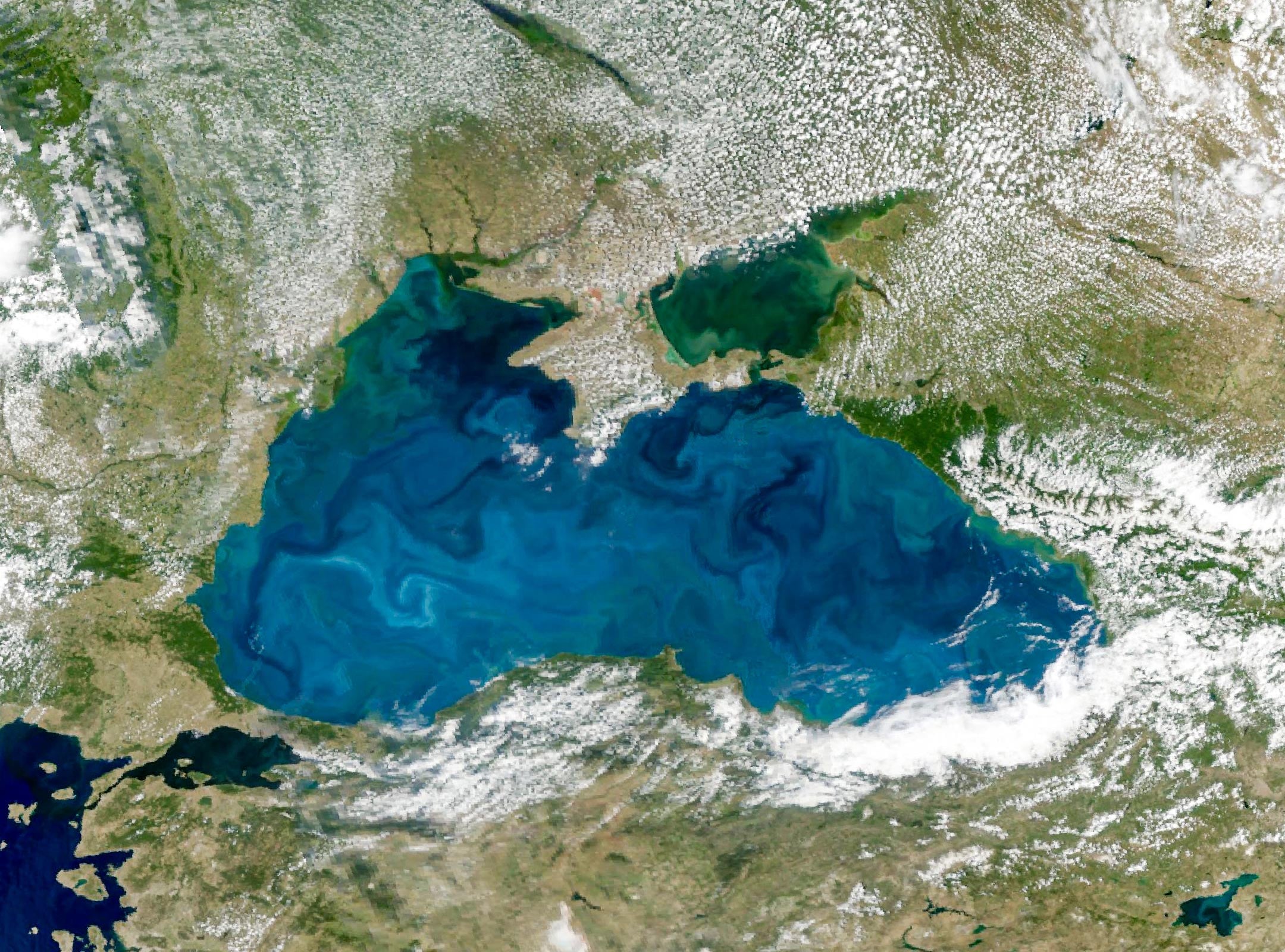
    NASA’s PACE satellite captured the Black Sea glowing turquoise on June 22, 2026, as a massive bloom of microscopic coccolithophores spread across its surface.

    NASA captured the Black Sea’s annual turquoise transformation as massive blooms of microscopic plankton turned the water into a dazzling spectacle visible from orbit.

    The Black Sea lies between Europe and Asia and reaches the Mediterranean Sea through a series of connected waterways. Although its waters are often dark, the sea can undergo a dramatic color change during spring and summer, when broad swirls of turquoise spread across its surface.

    NASA’s PACE (Plankton, Aerosol, Cloud, ocean Ecosystem) satellite observed this seasonal transformation on June 22, 2026. Its OCI (Ocean Color Instrument) captured the image above, revealing bright blue and turquoise patterns stretching across the Black Sea.

    NASA PACE Spacecraft In Orbit
    NASA’s PACE (Plankton, Aerosol, Cloud, ocean Ecosystem) spacecraft in orbit over Earth. Credit: NASA GSFC

    Tiny Plankton Turn the Black Sea Turquoise

    The striking color was likely produced by coccolithophores, microscopic phytoplankton coated in small plates of calcium carbonate. When these organisms gather in enormous numbers, their reflective coverings can give the water a cloudy, milky blue appearance.

    Coccolithophores are especially common in the Black Sea during late spring and early summer. At other points in the year, diatoms—a type of microscopic algae with silica shells—may become more abundant. Unlike coccolithophores, diatoms generally make the water appear darker rather than brighter.

    A Colorful Bloom Reaches the Bosphorus

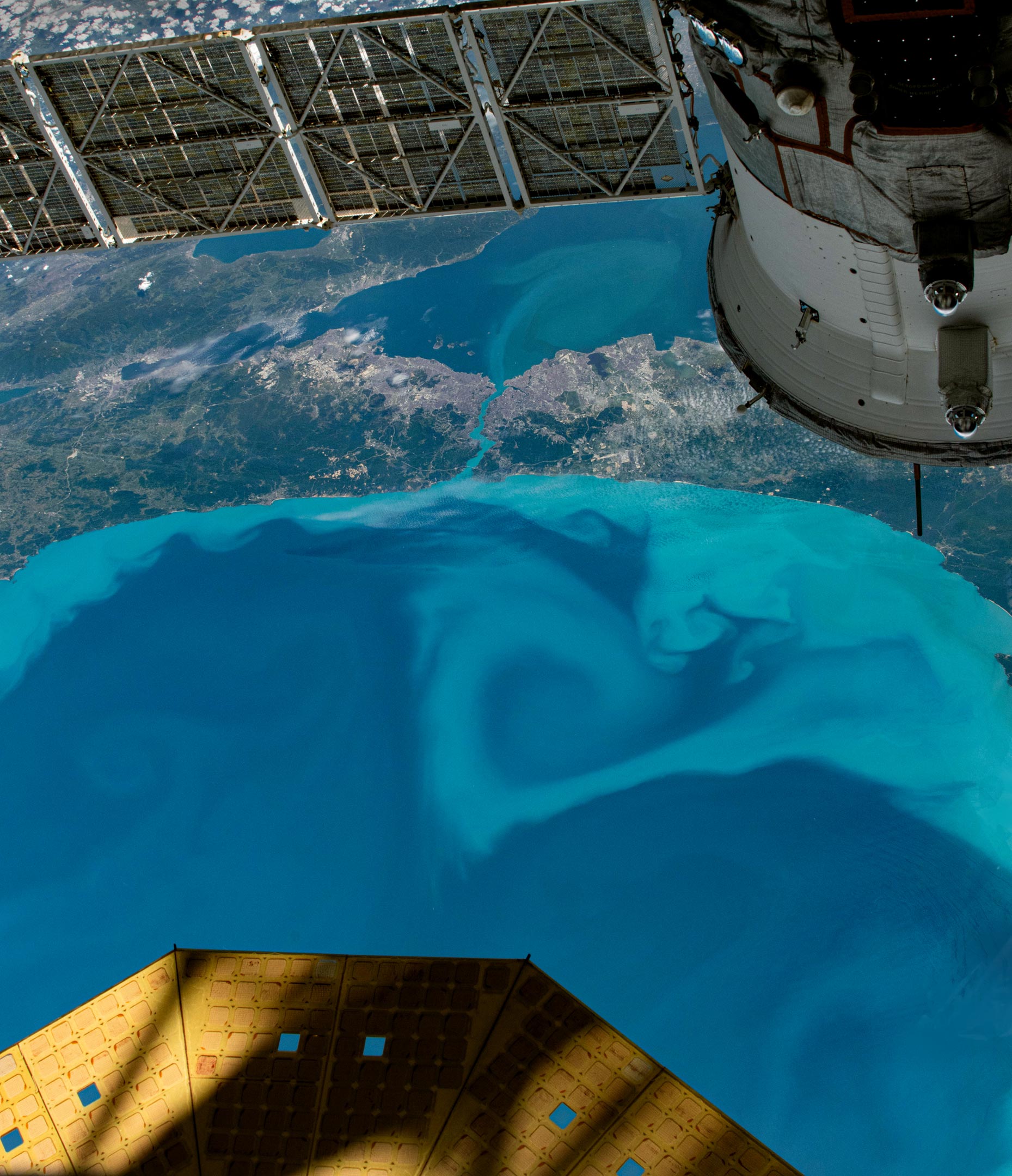
    The turquoise waters were also visible in the Bosphorus, the narrow channel that passes through Istanbul and links the Black Sea with the Sea of Marmara.

    On May 27, 2026, roughly one month before the PACE satellite observation, an astronaut aboard the International Space Station photographed the colorful strait below. The image shows blooming phytoplankton following the movement of currents on both sides of the waterway. (Note that north is oriented toward the bottom of the frame.)
    Turquoise Black Sea From ISS Annotated
    An astronaut aboard the International Space Station photographed turquoise phytoplankton blooms flowing through the Bosphorus on May 27, 2026, revealing currents on both sides of the strait.

    A Massive Bloom Visible From Space

    A single coccolithophore is far too small to see without magnification. During a major bloom, however, the organisms can multiply in such vast numbers that their collective presence becomes visible from orbit.

    Satellite and astronaut observations allow scientists to follow how these blooms form, spread, and change over time. This type of remote sensing is particularly valuable in areas where researchers cannot easily collect samples directly from the water.

    Black Sea Blooms and the Carbon Cycle

    These blooms do more than create a spectacular view from space. Coccolithophores also participate in the ocean’s carbon cycle by absorbing carbon while they grow.

    After the organisms die, some of that carbon can sink with their remains toward the seafloor. Once deposited there, it may stay out of the atmosphere for long periods of time.

    NASA Earth Observatory image by Michala Garrison, using PACE data from NASA EOSDIS LANCE and GIBS/Worldview and the NASA Ocean Biology Distributed Active Archive Center OB.DAAC. Astronaut photograph ISS074-E-619520 was acquired on May 27, 2026, with a Nikon Z9 digital camera using a focal length of 50 millimeters. The photograph was supplied by the ISS Crew Earth Observations Facility and the Earth Science and Remote Sensing Unit at NASA Johnson Space Center.

    A member of the Expedition 74 crew captured the image. It was cropped and adjusted to improve contrast, and lens artifacts were removed. Through the ISS National Lab, the International Space Station Program helps astronauts photograph parts of Earth that are especially valuable to researchers and the public. The program also makes those images freely available online.

    Never miss a breakthrough: Join the SciTechDaily newsletter.
    Follow us on Google and Google News.

    Geography NASA NASA Earth Observatory NASA PACE Phytoplankton
    Share. Facebook Twitter Pinterest LinkedIn Email Reddit

    Related Articles

    Frozen on Top, Blooming Below: Microscopic Life Awakens in Lake Erie

    Green Menace: Toxic Algae and Environmental Neglect at California’s Clear Lake

    Biological Brilliance: Filaments of Phytoplankton in Australia

    Twists of Nature: Spectacular Swirls in the Sky and Sea Around Norway’s Remote Bear Island

    Red Tide off Rio – “It Is Very Worrying”

    Spied by Satellite: Phytoplankton Factory in the Argentine Sea

    Sea Ice in Denmark Strait – Drifted More Than 1,000 Km (600 Miles) From the Arctic Ocean

    Meandering Mississippi River: Photo Taken by Astronaut on Space Station Shows Divergence From State Boundaries

    Incredible Rare Peek at Patagonia in Winter

    Leave A Reply Cancel Reply

    • Facebook
    • Twitter
    • Pinterest
    • YouTube

    Don't Miss a Discovery

    Subscribe for the Latest in Science & Tech!

    Trending News

    New Study Suggests Vitamin C Could Help Prevent Cancer

    The Surprising Chocolate Trick That Could Boost Your Gym Performance

    Common Mouth Bacteria May Trigger Dangerous Calcium Buildup in the Heart

    Natural Supplement May Boost Cancer-Fighting Immunity

    Could Dark Matter Be Hiding in a Hidden Fifth Dimension?

    The Hidden Tradeoff Behind Today’s Most Powerful Weight-Loss Drugs

    Atlantic Ocean Slowdown Could Supercharge California Storms

    A Deadly Ebola-Like Virus Is Spreading. Are We Ready?

    Follow SciTechDaily
    • Facebook
    • Twitter
    • YouTube
    • Pinterest
    • Newsletter
    • RSS
    SciTech News
    • Biology News
    • Chemistry News
    • Earth News
    • Health News
    • Physics News
    • Science News
    • Space News
    • Technology News
    Recent Posts
    • World’s First Superconducting Quantum Heat Engine Could Transform Quantum Computing
    • Scientists Turned a 200-Year-Old Light Trick Into a Modern Breakthrough
    • Physicists Just Turned a Black Hole Energy Theory Into Reality
    • NASA Reveals the Black Sea’s Stunning Annual Turquoise Transformation
    • First Close-Up Images Reveal Shackleton’s Lost Ship on the Ocean Floor
    Copyright © 1998 - 2026 SciTechDaily. All Rights Reserved.
    • Science News
    • About
    • Contact
    • Editorial Board
    • Privacy Policy
    • Terms of Use

    Type above and press Enter to search. Press Esc to cancel.