
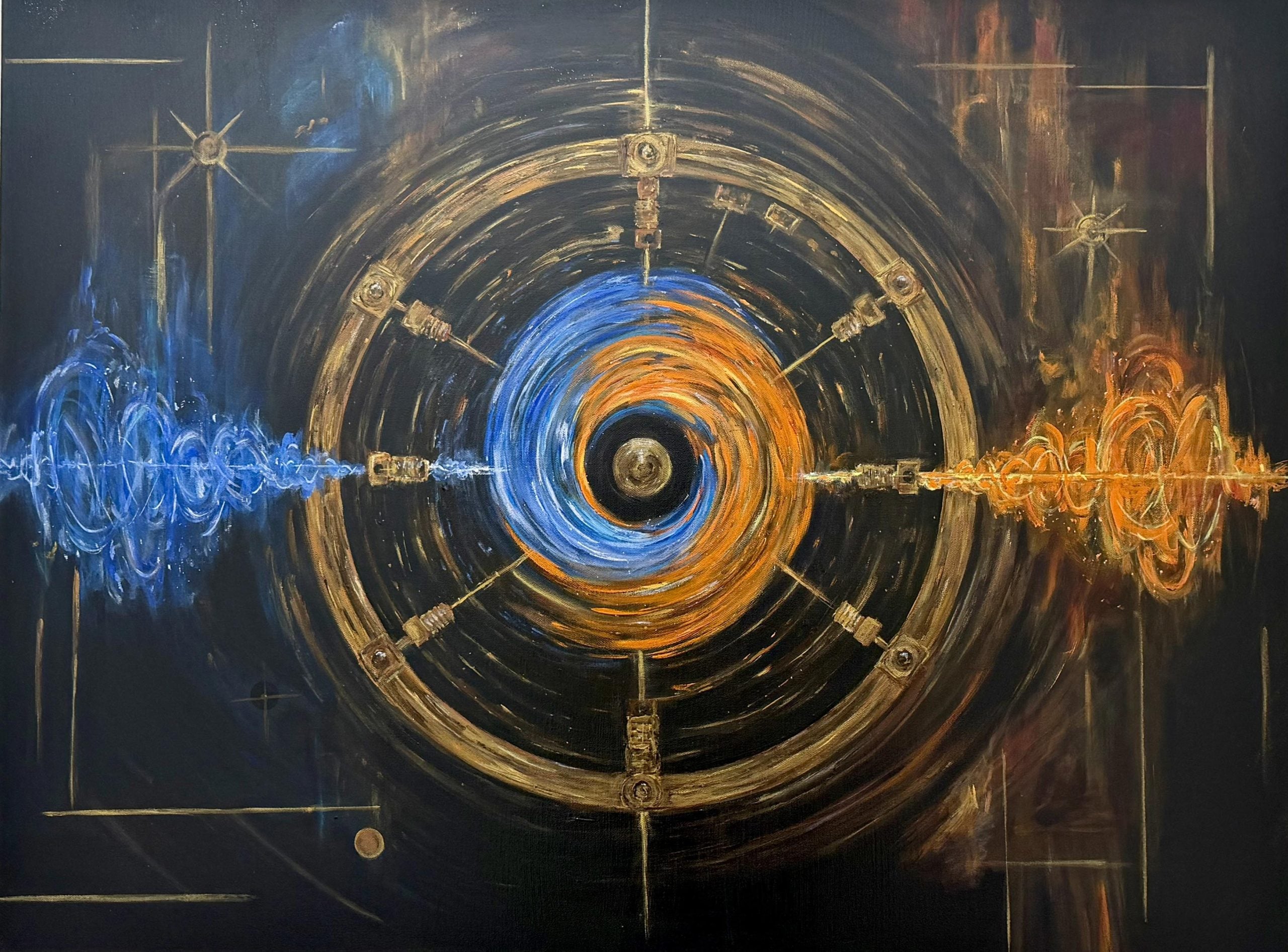
Scientists have recreated a famous black hole phenomenon in the lab using synthetic rotation, bringing a 50-year-old theory closer to real-world technology.
More than 50 years ago, physicist Sir Roger Penrose proposed a remarkable way that energy might be taken from a rapidly spinning black hole. In his theoretical scenario, a particle would enter the black hole’s ergosphere, a region where the rotation of the black hole drags the surrounding fabric of space along with it. The particle could then split into two pieces. One would plunge into the black hole, while the other would escape with more energy than the original particle carried.
Physicist Yakov Zel’dovich later extended this general idea to waves. He predicted that when a wave interacts with an object rotating fast enough, the wave could draw energy from that rotation and emerge stronger than before.
Simulating Extreme Rotation Without Moving Parts
Researchers at the Advanced Science Research Center at the CUNY Graduate Center (CUNY ASRC) have now demonstrated a new method for producing this type of wave amplification. Their results were published in Nature.
Instead of physically spinning an object at extreme speed, the researchers developed a radio frequency device whose properties change across space and time in a way that imitates rotation. This engineered system produces synthetic ultrafast rotation, allowing scientists to simulate rotational speeds far beyond the limits of mechanical machinery.
The approach helps overcome a major obstacle that has long prevented researchers from experimentally investigating the behavior of waves interacting with extremely fast rotation.
“Our approach facilitates a new method of wave–matter interaction in which waves with selected rotational properties extract energy from synthetic time-engineered rotation, producing a form of broadband selective amplification,” said principal investigator Andrea Alù, Distinguished Professor and Einstein Professor of Physics at the CUNY Graduate Center and founding director of the CUNY ASRC’s Photonics Initiative.
“This successful experiment moves ideas about extreme rotational dynamics from theory to practice and creates a versatile experimental platform for exploring a broad range of phenomena at the intersection of astrophysics, wave physics, and quantum science,” said lead author Hadiseh Nasari, a postdoctoral researcher with the CUNY ASRC’s Photonics Initiative. “The work has implications for advances in fundamental science and in communications, optics and photonics.”
Making a Stationary Device Appear to Spin
The researchers focused on a central question. Could electromagnetic waves sent into a stationary device behave as though they were interacting with something rotating at an ultrafast speed? More importantly, could those waves extract energy from that synthetic motion?
To test the concept, the team constructed a ring-shaped network of electronic resonators. The properties of the resonators were changed rapidly in a precisely timed sequence, creating a pattern that traveled around the ring.
Nothing in the device physically rotated. However, the traveling pattern caused the electromagnetic waves to experience the system as though it were spinning at an enormous speed.
“Waves with the appropriate rotational characteristics extracted energy from the system and became amplified, reproducing the essential physics of the Penrose–Zel’dovich process,” said co-lead author Hady Moussa, a former PhD student with the CUNY ASRC Photonics Initiative. “Our approach relies on engineered metamaterials that are designed to control how waves propagate.”
Metamaterials are specially designed structures that can guide and manipulate waves in ways that ordinary materials cannot. In this experiment, they allowed the researchers to reproduce the essential behavior predicted by Penrose and Zel’dovich without requiring an actual black hole or a mechanically spinning object.
A New Laboratory for Extreme Physics
Synthetic rotation can imitate apparent motion faster than the speed of light without requiring matter or information to physically travel at that speed. This gives scientists a controlled way to explore extreme regimes that would otherwise be difficult or impossible to reproduce in a laboratory.
The achievement creates a new experimental platform for investigating phenomena connected to astrophysics, wave behavior, and quantum science. It could also lead to potential applications in wireless communications, classical optics, and quantum optics.
Future research will need to determine how the findings can be incorporated into practical technologies. The same principles could also be extended to photonic and quantum systems, potentially creating new methods for controlling light, processing information, and studying wave phenomena inspired by some of the universe’s most extreme environments.
Reference: “Observation of Floquet rotational super-radiance” by Hadiseh Nasari, Hady Moussa, Yoshiaki Kasahara, Arno Thielens and Andrea Alù, 8 July 2026, Nature.
DOI: 10.1038/s41586-026-10725-y
The research was supported by the U.S. Department of Defense, the U.S. National Science Foundation, and the Simons Foundation.
Never miss a breakthrough: Join the SciTechDaily newsletter.
Follow us on Google and Google News.
3 Comments
Nothing in the device physically rotated. However, the traveling pattern caused the electromagnetic waves to experience the system as though it were spinning at an enormous speed.
VERY GOOD.
Please ask researchers to think deeply:
How do you understand topological spin?
These themes reflect a deep-seated institutional resistance to questioning the ontological premises that underlie all of contemporary fundamental physics—premises that have never been empirically verified.
—— Excerpted from https://zhuanlan.zhihu.com/p/2062808500313626237.
это напоминает сюжет давно прочитанного фантастического рассказа. Ученый совет лишил человечество Велосипеда. В реальности доказав что движение велосипеда мимо толпы. Равно движению толпы мимо велосипеда. Велосипедист упал. А ученые не возвысились. Ошибка заключена в первопричине. Или несвоевременное расслабление со стороны матера, или вектор напряжения отца не туда. Все что под простыней пространства-времени это игры закрытого клуба. Это не в тыру вы попали.
Thank you for browsing and commenting.
Mainstream physics has long confused the concepts of space and spacetime. It needs to be clarified that it is not the public who lift the sheets and see the dirtiness and ugliness of mainstream physics. The following Picture shows mainstream physics lifting the sheets and performing naked in front of the public. Some people and publications in mainstream physics no longer understand what is dirty, ugly, and shameful, and honesty has long been out of reach for them.
Picture: https://pic2.zhimg.com/v2-4127b0b58fe8b88feb27c189fb705029_1440w.jpg?source=172ae18b.
—— Excerpted from https://zhuanlan.zhihu.com/p/2062808500313626237 and https://scitechdaily.com/microscope-spacecrafts-most-precise-test-of-key-component-of-the-theory-of-general-relativity/#comment-721618.