
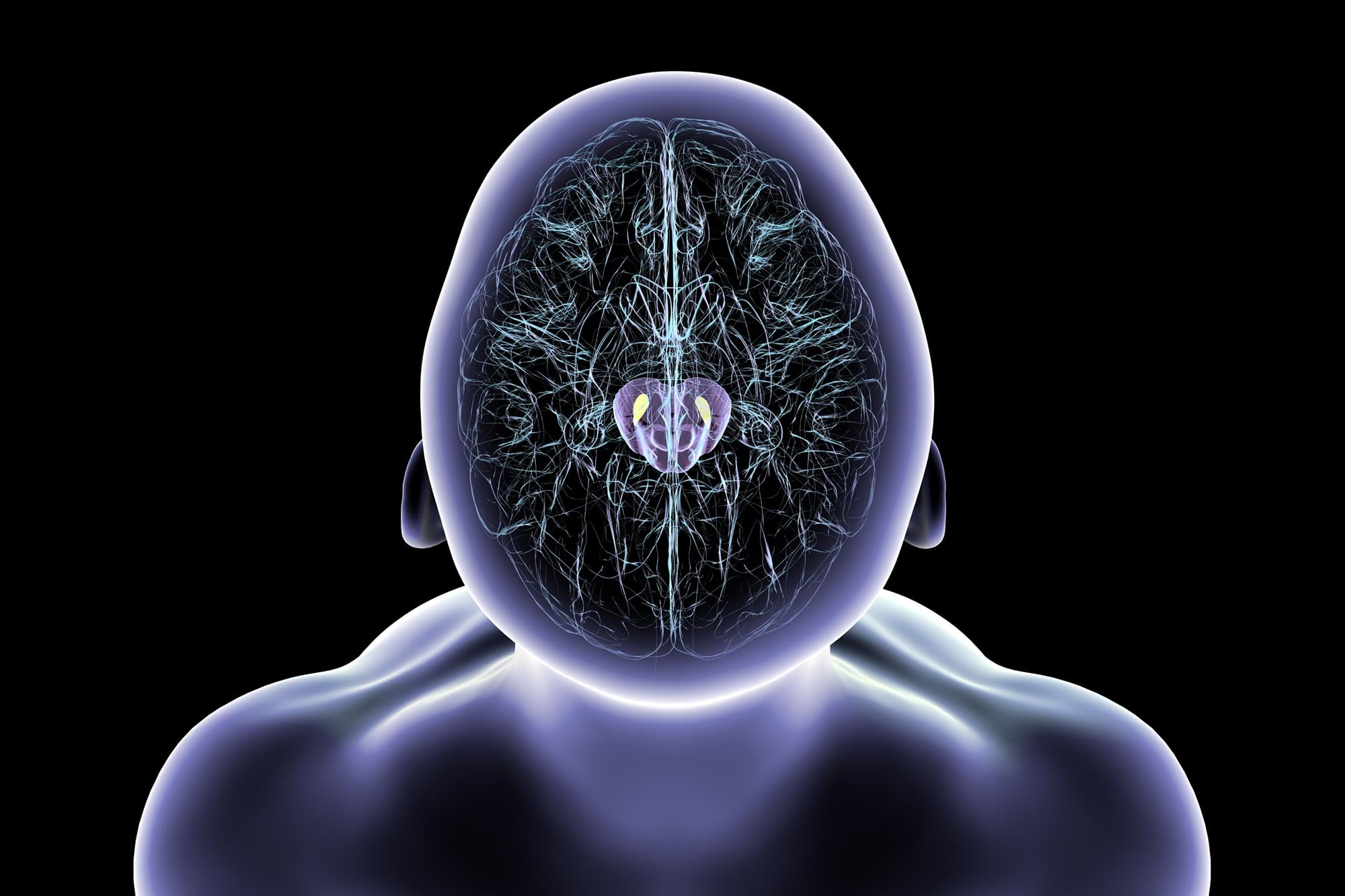
Researchers have developed a magnetic method for influencing deep-brain circuits without permanently implanted electrodes.
A magnetic field may offer a new way to reach circuits buried deep within the brain without permanently implanting electrodes. An international research team injected magnetic nanoplatelets into a targeted brain region and used them to improve movement problems in mice with Parkinson’s-like symptoms.
The approach is less invasive than conventional deep brain stimulation, which relies on surgically implanted electrodes and is used for some people with Parkinson’s disease. Researchers from Friedrich-Alexander-Universität Erlangen-Nürnberg (FAU), RWTH Aachen, Maastricht University (the Netherlands), and KU Leuven (Belgium) reported the findings in Advanced Science.
Parkinson’s disease gradually destroys brain cells that produce dopamine, a chemical messenger essential for controlling movement. As dopamine levels fall, motor circuits begin to malfunction, causing tremors and other movement difficulties.
Some patients receive a brain pacemaker, a small device placed beneath the collarbone that sends electrical signals to the subthalamic nucleus (STN for short), a region deep inside the brain. Stimulating this area can alter abnormal neural activity and reduce movement symptoms.
“The procedure is relatively complex, however, and not always successful,” explains Prof. Dr. Danijela Gregurec from the Department of Chemistry and Pharmacy at FAU. “This puts many Parkinson’s patients off, and not all patients are suitable candidates for one of these pacemakers.”

The magnetic technique could eventually provide a less invasive option because it reaches deep brain regions without requiring electrodes to remain permanently implanted.
Mechanical forces activate deep brain circuits
“We use magnetic nanoparticles that we implant in the brain,” Gregurec explains. “They have a special shape and a magnetic structure. They were developed in order to transform magnetic fields into tiny mechanical forces.”
Unlike standard deep brain stimulation, the technique does not send electricity directly into the brain. “The traditional method establishes an electrical connection to the brain,” she says. “In contrast, we use the neurons’ natural mechanosensors to influence regions deep within the brain.”
When a magnetic field surrounds the brain, the particles respond by producing very small mechanical forces. These forces gently deform nearby cell membranes, much as pressing a finger against an inflated balloon changes its shape. That pressure opens mechanosensitive channels and allows electrically charged ions to enter the nerve cells.
Magnetic stimulation improves movement in mice
The researchers tested the method in animal models with damage to the same nerve cells affected in people with Parkinson’s disease. This produced similar movement problems.
“Together with our partners from Maastricht, we injected magnetic nanoparticles developed here at FAU into the animals’ subthalamic nucleus,” Gregurec explains. “That is the very region in the brain that is also an important target for conventional deep brain stimulation in Parkinson’s disease.”
Using high-precision stereotactic procedures, the researchers placed the particles directly into the intended brain region. Accurate positioning was essential because the treatment needed to reach the correct motor circuit.
After the mice were exposed to a magnetic field, their movement deficits improved significantly. “The effect is roughly equivalent to what we would have expected after implanting a brain pacemaker,” says Gregurec.
Safety results support further development
The magnetic particles remained in the animals’ brains for several months without producing signs of inflammation, suggesting that they were well tolerated during the test period.
Gregurec’s group is now exploring ways to avoid injecting the particles directly into the brain. One possibility would be to administer them through the bloodstream and design them to cross the blood-brain barrier.
The researchers are also investigating compact wearable devices capable of generating the necessary magnetic fields. A headband that patients could place on themselves is one possible design, although the approach is still several years away from potential clinical use.
“Nevertheless, we are convinced that the new method has enormous potential,” Gregurec states. “It is not only considerably simpler and cheaper than a conventional brain pacemaker, it is probably also more flexible. Adjusting the parameters of the magnetic field would allow us to control the nanoparticles more accurately.”
The technique could also serve as a research tool for examining how tiny mechanical forces alter brain activity.
Reference: “Remote Magnetomechanical Neuromodulation Uncovers Therapeutic Mechanisms for Alleviating Parkinsonian Symptoms in Freely Moving Mice” by Anouk Wolters, Lorenzo Signorelli, Christian Herff, Sophia Gimple, Renzo Riemens, Gunter Kenis, Kim Rijkers, Hamed Shabani, Jyh-Jang Sun, Yasin Temel, Hans Clusmann, Danijela Gregurec and Sarah-Anna Hescham, 3 April 2026, Advanced Science.
DOI: 10.1002/advs.75097
Never miss a breakthrough: Join the SciTechDaily newsletter.
Follow us on Google and Google News.