
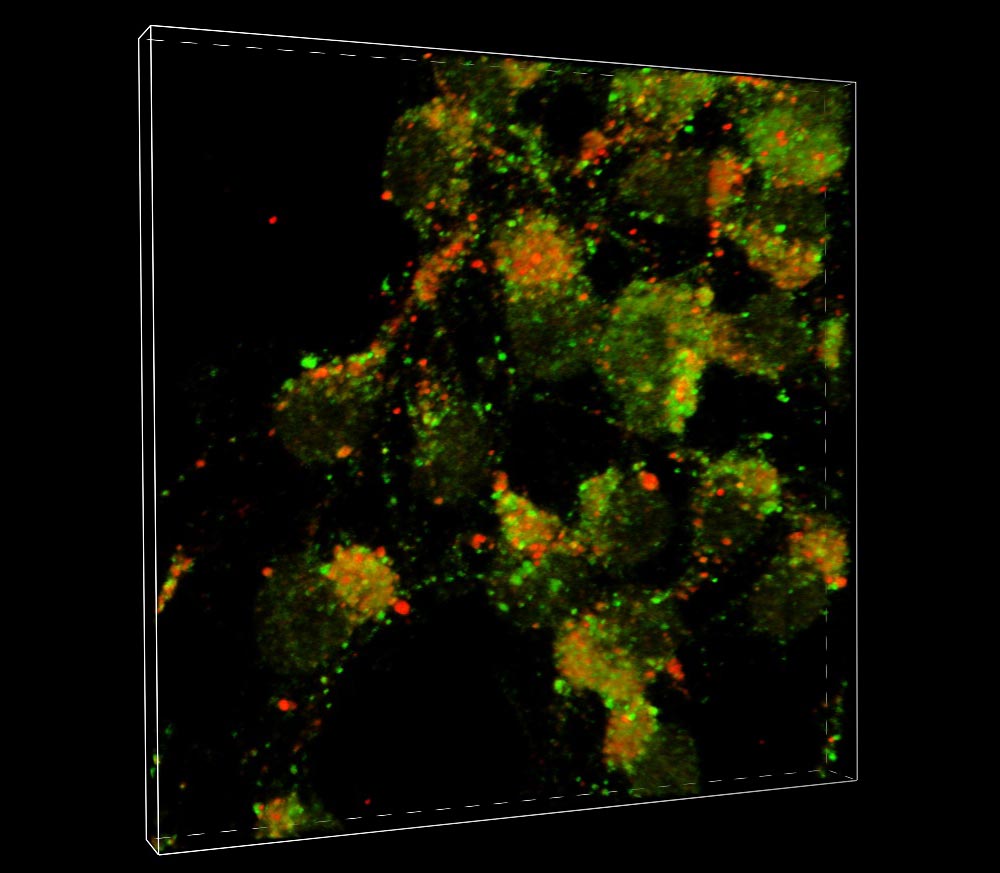
Study shows how blocking cellular housekeeping system leads to buildup and spread of abnormal protein aggregates in the brain.
Parkinson’s disease may be driven in part by cell stress-related biochemical events that disrupt a key cellular cleanup system, leading to the spread of harmful protein aggregates in the brain, according to a new study from scientists at Scripps Research.
The discovery, published in The Journal of Neuroscience in February 2022, offers a clear and testable hypothesis about the progression of Parkinson’s disease, and may lead to treatments capable of significantly slowing or even stopping it.
“We think our findings about this apparent disease-driving process are important for developing compounds that can specifically inhibit the process of disease spread in the brain,” says study senior author Stuart Lipton, MD, PhD, Step Family Endowed Chair, founding co-director of the Neurodegeneration New Medicines Center, and professor in the Department of Molecular Medicine at Scripps Research.
Parkinson’s disease affects roughly one million people in the United States. Its precise trigger is unknown, but it entails the deaths of neurons in a characteristic sequence through key brain regions. The killing of one small set of dopamine-producing neurons in the midbrain leads to the classic Parkinsonian tremor and other movement impairments. Harm to other brain regions results in various other disease signs including dementia in late stages of Parkinson’s. A closely related syndrome in which dementia occurs early in the disease course is called Lewy Body Dementia (LBD), and affects about 1.4 million people in the U.S.
Nitric Oxide and Protein Aggregates
In both diseases, affected neurons contain abnormal protein aggregations, known as Lewy bodies, whose predominant ingredient is a protein called alpha-synuclein. Prior studies have shown that alpha-synuclein aggregates can spread from neuron to neuron in Parkinson’s and LBD, apparently transmitting the disease process through the brain. But precisely how alpha-synuclein aggregates build up and spread in this way has been unclear.
One clue, uncovered by Lipton’s lab and others in prior research, is that the Parkinson’s/LBD disease process generates highly reactive nitrogen-containing molecules including nitric oxide. In principle, these reactive nitrogen molecules could disrupt important cellular systems, including “housekeeping” systems that normally keep protein aggregates under control.
In the new study, the Scripps Research team demonstrated the validity of this idea by showing that a type of nitrogen-molecule reaction called S-nitrosylation can affect an important cellular protein called p62, triggering the buildup and spread of alpha-synuclein aggregates.
p62 Protein and Its Role in Autophagy
The p62 protein normally assists in autophagy, a waste-management system that helps cells get rid of potentially harmful protein aggregates. The researchers found evidence that in cell and animal models of Parkinson’s, p62 is S-nitrosylated at abnormally high levels in affected neurons. This alteration of p62 inhibits autophagy, causing a buildup of alpha-synuclein aggregates. The buildup of aggregates, in turn, leads to the secretion of the aggregates by affected neurons, and some of these aggregates are taken up by nearby neurons.
“The process we observed seems very similar to what is seen in Parkinson’s and LBD brains,” says study first author Chang-Ki Oh, PhD, a staff scientist in the Lipton laboratory.
The researchers also tested postmortem brains of LBD patients, and again found that levels of S-nitrosylated p62 were abnormally high in affected brain areas—supporting the idea that this process occurs in humans.
Lipton and Oh say that S-nitrosylation of proteins becomes more likely in many situations of cellular stress, including the presence of protein aggregates. Thus, this chemical modification of p62 could be a key factor in a self-reinforcing process that not only stresses brain cells beyond their limits, but also spreads the source of stress to other brain cells.
Potential Drug Targets for Parkinson’s and LBD
The team is now working to develop drug-like compounds that specifically inhibit the S-nitrosylation of p62. Although it would take years to develop such compounds as potential commercial drugs, they could, in principle, slow the Parkinson’s/LBD disease process or prevent its further spread in the brain after it begins, Lipton says.
Reference: “S-Nitrosylation of p62 Inhibits Autophagic Flux to Promote α-Synuclein Secretion and Spread in Parkinson’s Disease and Lewy Body Dementia” by Chang-ki Oh, Nima Dolatabadi, Piotr Cieplak, Maria T. Diaz-Meco, Jorge Moscat, John P. Nolan, Tomohiro Nakamura and Stuart A. Lipton, 15 February 2022, The Journal of Neuroscience.
DOI: 10.1523/JNEUROSCI.1508-21.2022
The study was co-authored by Chang-Ki Oh, Nima Dolatabadi, Tomohiro Nakamura, and Stuart Lipton, of Scripps Research; Piotr Cieplak, Maria Diaz-Meco and Jorge Moscat of Sanford Burnham Prebys Medical Discovery Institute; and John Nolan of the Scintillon Institute in San Diego.
The study was supported in part by the National Institutes of Health (R01 NS086890, R35 AG071734, DP1 DA041722, R01 DA048882, RF1 AG057409, R01 AG056259, R01 AG061845, R61 NS122098, RF1 NS123298), the Brain & Behavior Research Foundation, and the Michael J. Fox Foundation.
Never miss a breakthrough: Join the SciTechDaily newsletter.
Follow us on Google and Google News.