

A peptide known to prevent the protein error that gives rise to Parkinson’s disease has been optimized by scientists, making it a strong candidate for future development into a cure.
A molecule that shows promise in preventing Parkinson’s disease has been refined by scientists at the University of Bath. It has the potential to be developed into a drug to treat the incurable neurodegenerative disease.
Professor Jody Mason, who led the research from the Department of Biology and Biochemistry, said: “A lot of work still needs to happen, but this molecule has the potential to be a precursor to a drug. Today there are only medicines to treat the symptoms of Parkinson’s – we hope to develop a drug that can return people to good health even before symptoms develop.”
Parkinson’s disease is characterized by a specific protein in human cells ‘misfolding’, where it becomes aggregated and malfunctions. The protein – alpha-synuclein (αS) – is abundant in all human brains. After misfolding, it accumulates in large masses, known as Lewy bodies. These masses consist of αS aggregates that are toxic to dopamine-producing brain cells, causing them to die. It is this drop in dopamine signaling that triggers the symptoms of Parkinson’s, as the signals transmitting from the brain to the body become noisy, leading to the distinctive tremors seen in sufferers.
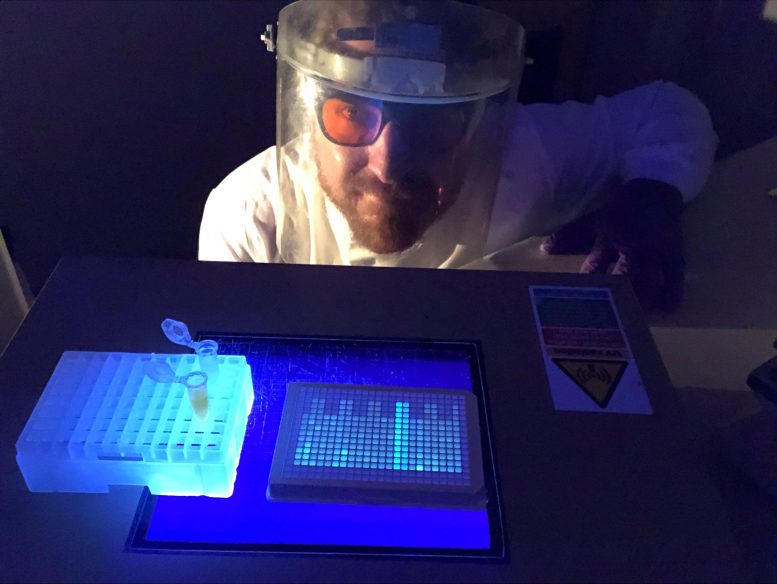
Peptide-Based Approach to Prevent Protein Misfolding
Previous efforts to target and ‘detoxify’ αS-induced neurodegeneration have seen scientists analyze a vast library of peptides (short chains of amino acids – the building blocks of proteins) to find the best candidate for preventing αS misfolding. Of the 209,952 peptides screened in earlier work by scientists at Bath, peptide 4554W showed the most promise, inhibiting αS from aggregating into toxic disease forms in lab experiments, both in solutions and on live cells.
In their latest work, this same group of scientists tweaked peptide 4554W to optimize its function. The new version of the molecule – 4654W(N6A) – contains two modifications to the parental amino-acid sequence and has proven to be significantly more effective than its predecessor at reducing αS misfolding, aggregation, and toxicity. However, even if the modified molecule continues to prove successful in lab experiments, a cure for the disease is still many years away.

Dr. Richard Meade, the lead author of the study, said: “Previous attempts to inhibit alpha-synuclein aggregation with small molecule drugs have been unfruitful as they are too small to inhibit such large protein interactions. This is why peptides are a good option – they are big enough to prevent the protein from aggregating but small enough to be used as a drug. The effectiveness of the 4654W(N6A) peptide on alpha-synuclein aggregation and cell survival in cultures is very exciting, as it highlights that we now know where to target on the alpha-synuclein protein to suppress its toxicity. Not only will this research lead to the development of new treatments to prevent the disease, but it is also uncovering fundamental mechanisms of the disease itself, furthering our understanding of why the protein misfolds in the first place.”
Professor Mason added: “Next, we’ll be working on how we can take this peptide to the clinic. We need to find ways to modify it further so it is more drug-like and can cross biological membranes and get into the cells of the brain. This may mean moving away from naturally occurring amino acids towards molecules that are made in the lab.”
Broader Implications for Other Neurodegenerative Diseases
This research also has implications for Alzheimer’s disease, Type 2 diabetes, and other serious human diseases where symptoms are triggered by protein misfolding.
Dr. Rosa Sancho, head of research at Alzheimer’s Research UK, said: “Finding ways to stop alpha-synuclein from becoming toxic and damaging brain cells could highlight a new pathway for future drugs to stop devastating diseases like Parkinson’s and dementia with Lewy bodies.
“We’re pleased to have supported this important work to develop a molecule that can stop alpha-synuclein from misfolding. The molecule has been tested in cells in the laboratory and will need further development and testing before it can be made into a treatment. This process will take a number of years, but it is a promising discovery that could pave the way for a new drug in future.
“Currently there are no disease-modifying treatments available for Parkinson’s disease or dementia with Lewy bodies, which is why continued investment in research is so important for all those living with these diseases.”
Reference: “A Downsized and Optimised Intracellular Library-Derived Peptide Prevents Alpha-Synuclein Primary Nucleation and Toxicity Without Impacting Upon Lipid Binding” by Richard M.Meade, Kathryn J.C. Watt, Robert J. Williams and Jody M. Mason, 22 October 2021, Journal of Molecular Biology.
DOI: 10.1016/j.jmb.2021.167323
This research was funded by BRACE, Alzheimer’s Research UK, Engineering and Physical Sciences Research Council.
Never miss a breakthrough: Join the SciTechDaily newsletter.
Follow us on Google and Google News.