
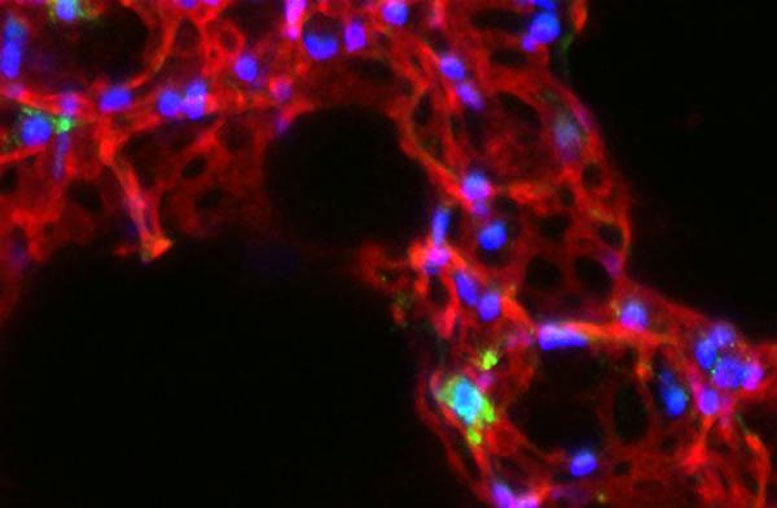
Asthma is a chronic inflammatory disease driven by the interplay of genetics, environmental factors, and a diverse cast of immune cells. In their latest study, researchers at La Jolla Institute for Allergy and Immunology (LJI) identified a subset of T cells, whose frequency serves as an early childhood immune signature that predicts the risk of developing asthma later on.
“We found what I would consider very strong biomarkers for those children who are most likely to develop asthma as they get older,” says senior author Mitchell Kronenberg, Ph.D., president and chief scientific officer of La Jolla Institute. “Children who, at the age of one, had a higher frequency of so-called MAIT cells appear to be less likely to develop asthma by the age of seven.”
Consistent with the “hygiene hypothesis,” which holds that increased microbial exposure in the first years of life is protective for asthma, the team’s findings also indicate that the presence of house dust components that stimulate the innate immune system decreases asthma risk. “We are not advocating for dirt and we don’t know enough about the microbiome to know which aspects are beneficial,” says Kronenberg, “but as we learn more it is feasible that one day the protective components could even be taken in pill form.”
The study, published in this week’s online edition of the Journal of Immunology, was part of the larger Urban Environment and Childhood Asthma (URECA) study funded by the National Institutes of Health. Initiated in 2005, the study follows 560 families from four disadvantaged urban areas who are at high risk for asthma to uncover potential risk factors that contribute to increased asthma rates in children growing up in impoverished neighborhoods.
Postdoctoral researcher and co-first author Shilpi Chandra, Ph.D., and her colleagues were particularly interested in MAIT cells (short for mucosal-associated invariant T cells) and their brethren, invariant natural killer T (iNKT) cells. Both cell types are an integral part of the innate immune response, which reacts almost immediately to foreign invaders.
Unlike conventional T cells, which belong to the adaptive arm of the immune response and take a few days before they are fully trained on a single, specific protein fragment or peptide antigen, MAIT and iNKT cells recognize molecular components common to many microbes.
The team analyzed the frequency of different types of immune cells in blood collected from 110 one-year-old study participants, the presence of immune-stimulatory components in the subjects’ house dust, and asked whether any of the factors correlated with an increase in asthma at age seven.
“We found certain immune signatures such as having more MAITs that are protective,” says Chandra. “In humans, MAIT cells are unique in that they are borne to make gamma interferon, which could help skew the immune system toward an asthma-protective Th1 immune response.”
And while the absolute numbers of iNKT cells had no bearing on asthma risk, the iNKT cell antigenic content in house dust from subjects’ houses did. “iNKT activity reflects a home environment with increased microbe exposure and therefore protection from asthma,” says Shilpi.
Reference: “Development of Asthma in Inner-City Children: Possible Roles of MAIT Cells and Variation in the Home Environment” by Shilpi Chandra, Gerhard Wingender, Jason A. Greenbaum , Archana Khurana, Amin M. Gholami, Anusha-Preethi Ganesan, Michael Rosenbach, Katy Jaffee, James E. Gern, Robert Wood, George O’Connor, Megan Sandel, Meyer Kattan, Leonard Bacharier, Alkis Togias, Anthony A. Horner and Mitchell Kronenberg, 5 February 2018, Journal of Immunology.
DOI: 10.4049/jimmunol.1701525
Never miss a breakthrough: Join the SciTechDaily newsletter.
Follow us on Google and Google News.