
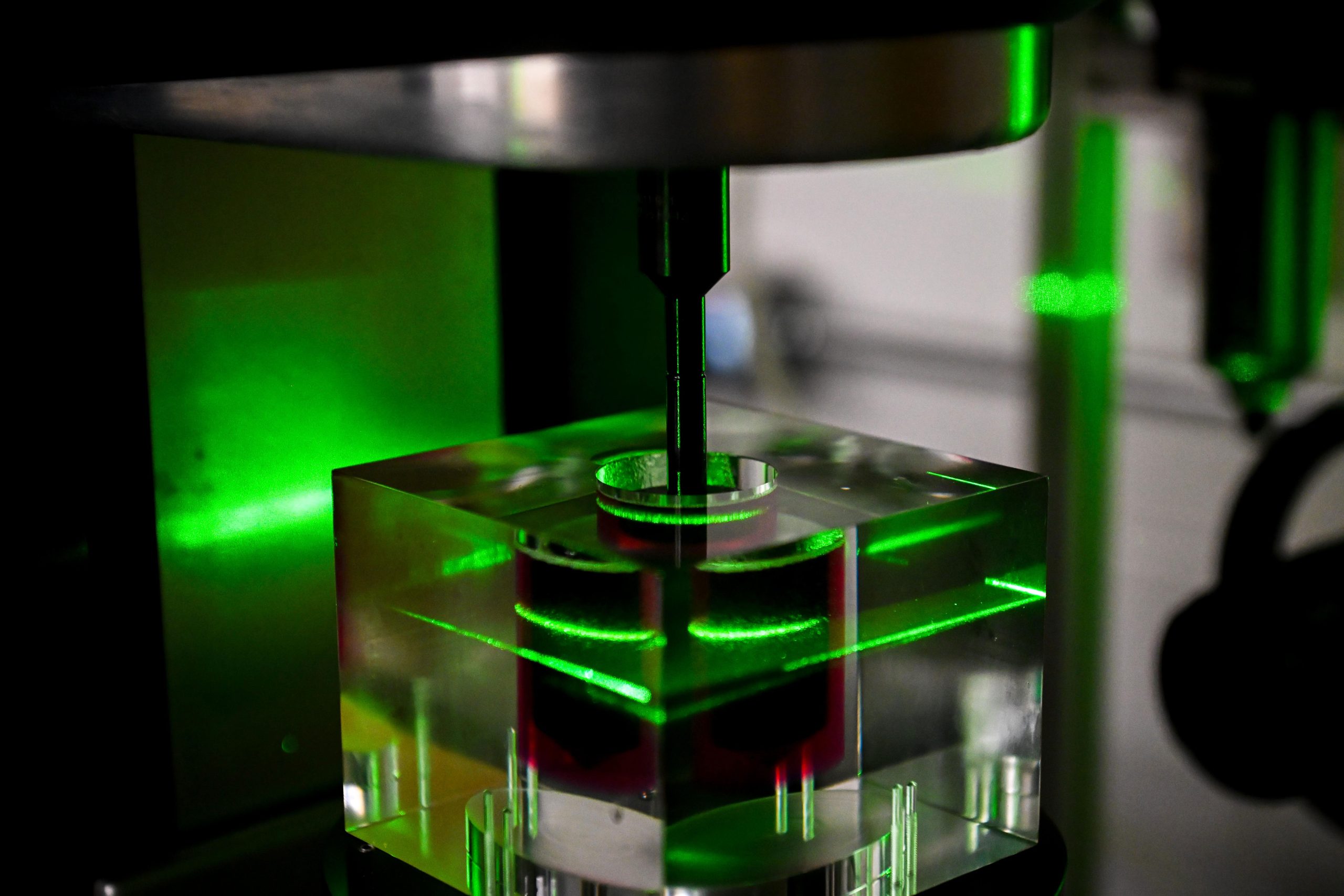
Physicists found that small particles suspended in a thick liquid can remember both the direction and strength of stirring, although one memory can erase the other.
A folded sheet of paper still carries a crease after it is opened again. That mark is a simple example of material memory, in which microscopic structures retain information about earlier deformations.
Learning how such memories form could support the design of materials that respond predictably to changes in their surroundings. It may also offer physical models for exploring how different kinds of memory interact, including the relationship between short-term and long-term memories studied in neuroscience.
Penn State researchers have now shown that two forms of material memory can exist together in a basic suspension of small particles in a thick liquid. Much like human memories, the two records can coexist, compete, and alter one another.
The findings were recently published in Physical Review Letters, where the paper was selected as an editors’ suggestion.
“When you save a file on your computer, that new memory does not influence any of the other files that are already there,” said Surendra Padamata, a graduate student in physics in the Penn State Eberly College of Science and first author of the paper. “But in neuroscience, we know that, for example, a long-term memory might change over time, influenced by new short-term memories gained in the intervening years. For example, a novel read in adolescence may seem to be a simple story. Recalling it later in life, after personal experiences that echo its themes, can reveal layers of meaning that went unnoticed the first time. We were inspired by thinking about how memories interact in this way to see if we could find an analogous situation in a material.”
Stirring writes two distinct memories
The researchers investigate memory in non-Brownian suspensions, mixtures resembling chocolate syrup or fresh concrete in which relatively large particles float within a viscous liquid. Because the particles are too large for Brownian motion, the random movement produced by thermally energized atoms, their motion can be attributed to the researchers’ experimental actions.
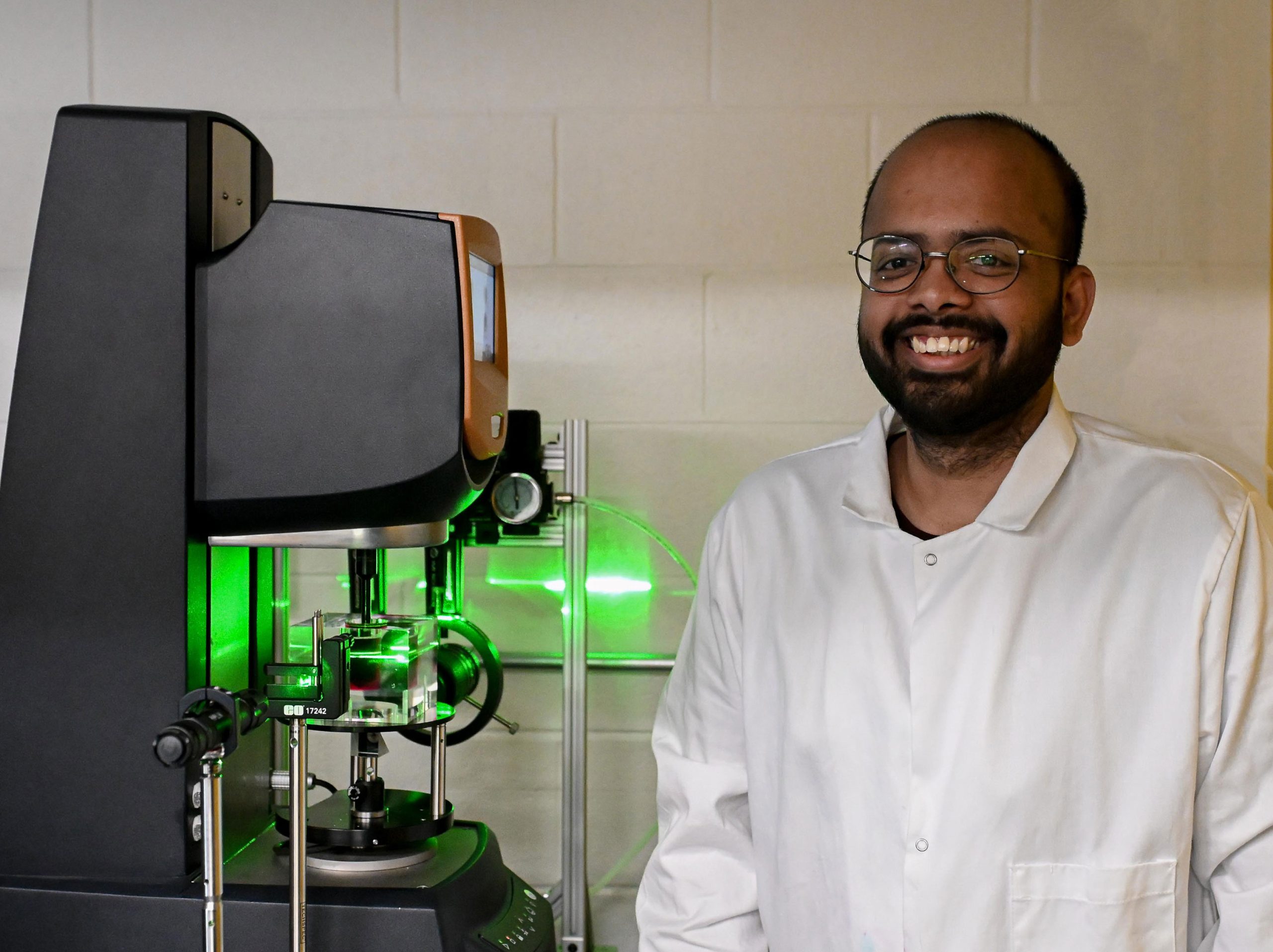
Earlier work showed that the suspension could retain the direction in which it had been stirred. When rocked repeatedly from side to side, it could also record the strength, or amplitude, of that movement.
“Each of these memories had been studied on its own,” Padamata said. “So, in our new experiments, we first stirred the mixture, imprinting a memory of direction, then rocked it back and forth at varying intensities to see how the memories interact.”
One memory can erase another
When the researchers rocked the suspension gently, it preserved both records at once: the original direction of stirring and the amplitude of the rocking. As the rocking became stronger, however, the directional memory faded until it disappeared entirely.
“At a certain threshold of intensity, the rocking completely erased any memory of direction in the suspension, returning it to a perfectly symmetric state, but beyond that threshold, the rocking itself begins to write a new directional memory,” Padamata said. “We are interested in how this model can inform biological memory and, potentially, geophysical processes as well. Changes in temperature and vibrations might impart memories in rock that influence risk for earthquakes and sinkholes, for example. It could be possible to find some way to erase these memories and reduce the risk or make better predictive models.”
Particle encounters may limit memory
The researchers propose that the memories begin competing when particle encounters become too frequent. During weaker rocking, those interactions remain relatively uncommon, allowing both memories to survive.
That explanation may apply specifically to liquid suspensions and could depend on the proportion of particles to fluid. Comparable memory effects have also appeared in solid materials, where neighboring particles remain in constant contact.
“A similar combination of directional memory and amplitude memory appears in soft glasses and granular packings with very different microscopic physics,” said Nathan Keim, associate professor of physics at Penn State and the leader of the research team. “This suggests that there may be a general principle for how disordered matter behaves under simple conditions like stirring or rocking and why they have a limited memory capacity.”
Reference: “Memories of Amplitude and Direction Coexist and Compete in Non-Brownian Suspensions” by Surendra Padamata and Nathan C. Keim, 23 June 2026, Physical Review Letters.
DOI: 10.1103/ckl2-lcpl
The Human Frontier Science Program funded the research.
Never miss a breakthrough: Join the SciTechDaily newsletter.
Follow us on Google and Google News.
3 Comments
Physicists found that small particles suspended in a thick liquid can remember both the direction and strength of stirring, although one memory can erase the other.
VERY GOOD.
Please ask physicists to think deeply:
If not stirred, will the thick liquid affect the small particles that suspende it?
Where does the memory of small particles come from?
Are objects in space derived from the topological evolution of space itself or from God?
Do topological vortices and their antivortices have memory?
Is there any fluid in space without vortices (or eddies)?
These themes reflect a deep-seated institutional resistance to questioning the ontological premises that underlie all of contemporary fundamental physics—premises that have never been empirically verified.
—— Excerpted from https://zhuanlan.zhihu.com/p/2062808500313626237.
I would use other word instead of memory, they leave an imprint but the material is unable to use that information like any other entity that is able to access its “memory” and processes it.
Wow, this is just mind-blowing, more please about research and discovery’s, but why can’t my mind think in a lateral way?!
Sam