
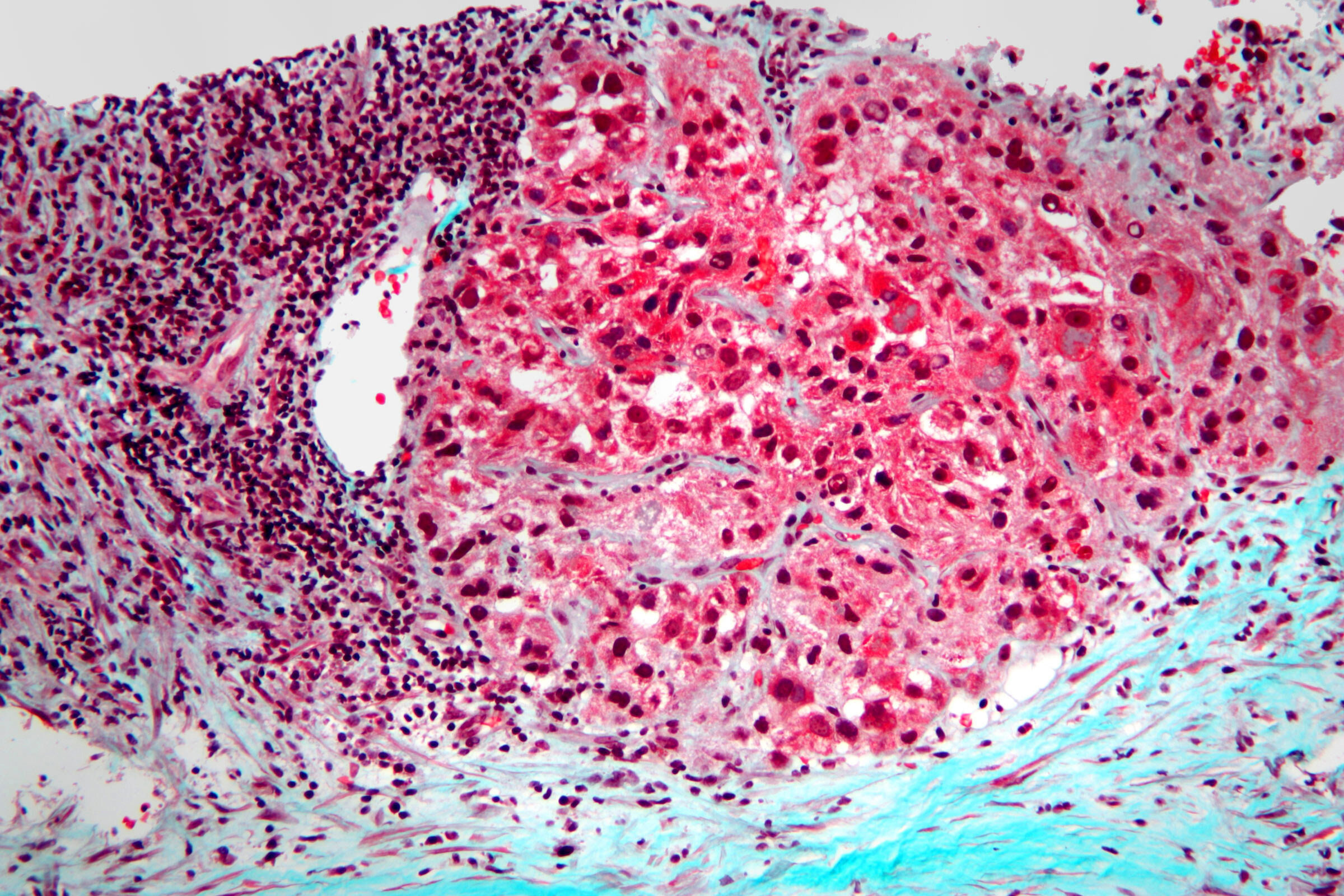
Researchers have developed a compound that attacks cancer cells in two ways by exploiting their demand for sugar while blocking their backup fuel supply.
Cancer cells survive in part by consuming large amounts of sugar to power their rapid growth. Rather than trying to starve them of that fuel, researchers have developed an experimental compound that pushes their sugar consumption even higher while simultaneously blocking access to another major energy source, fat.
Researchers at The University of Texas at Austin report in the journal Nature Chemical Biology that this two-part strategy overwhelms cancer cell metabolism. By accelerating sugar use while interfering with fat metabolism, the compound places the cells under enough stress that many die.
The researchers tested the approach against an aggressive form of melanoma in mice, where the experimental treatment killed most cancer cells while having a much smaller effect on noncancerous cells.
“I like to think of this technology like a two-headed dragon,” said Xiaolu (Lulu) Lim Ang Cambronne, an associate professor of molecular biosciences at UT and co-corresponding author. “We are putting one part of the cell into overdrive while simultaneously weakening another part. It appears to be extremely potent.”
Laboratory experiments showed that the compound also worked against several kinds of human cancer cells, including melanoma, leukemia, breast cancer, lung cancer, liver cancer, and neuroblastoma.
A smaller alternative to antibody drugs
Using two mechanisms to attack cancer at once is not entirely new. Antibody drug conjugates (ADCs), an expanding class of cancer medicines, use antibodies to recognize cancer cells and then deliver chemotherapy directly to the tumor. However, the researchers say these treatments have important limitations.
“Antibodies are difficult to make, and because they’re so large, they’re only able to target proteins in the surface of cancer cells,” said Ken Hsu, an associate professor of chemistry at UT and co-corresponding author. “We think of this new compound as a fully chemical counterpart to ADCs. They are much easier to manufacture. And because they are smaller, they are able to target even proteins that are inside cells.”
The research received support from the National Institutes of Health, the National Institute of General Medical Sciences, the Cancer Prevention and Research Institute of Texas (CPRIT), the University of Washington Beckman Cryo-EM Center, West Virginia University’s Visual Sciences CoBRE program, the Melanoma Research Alliance, the Mark Foundation for Cancer Research, The Welch Foundation, and Tito’s Handmade Vodka.
The drug disrupts two fuel pathways
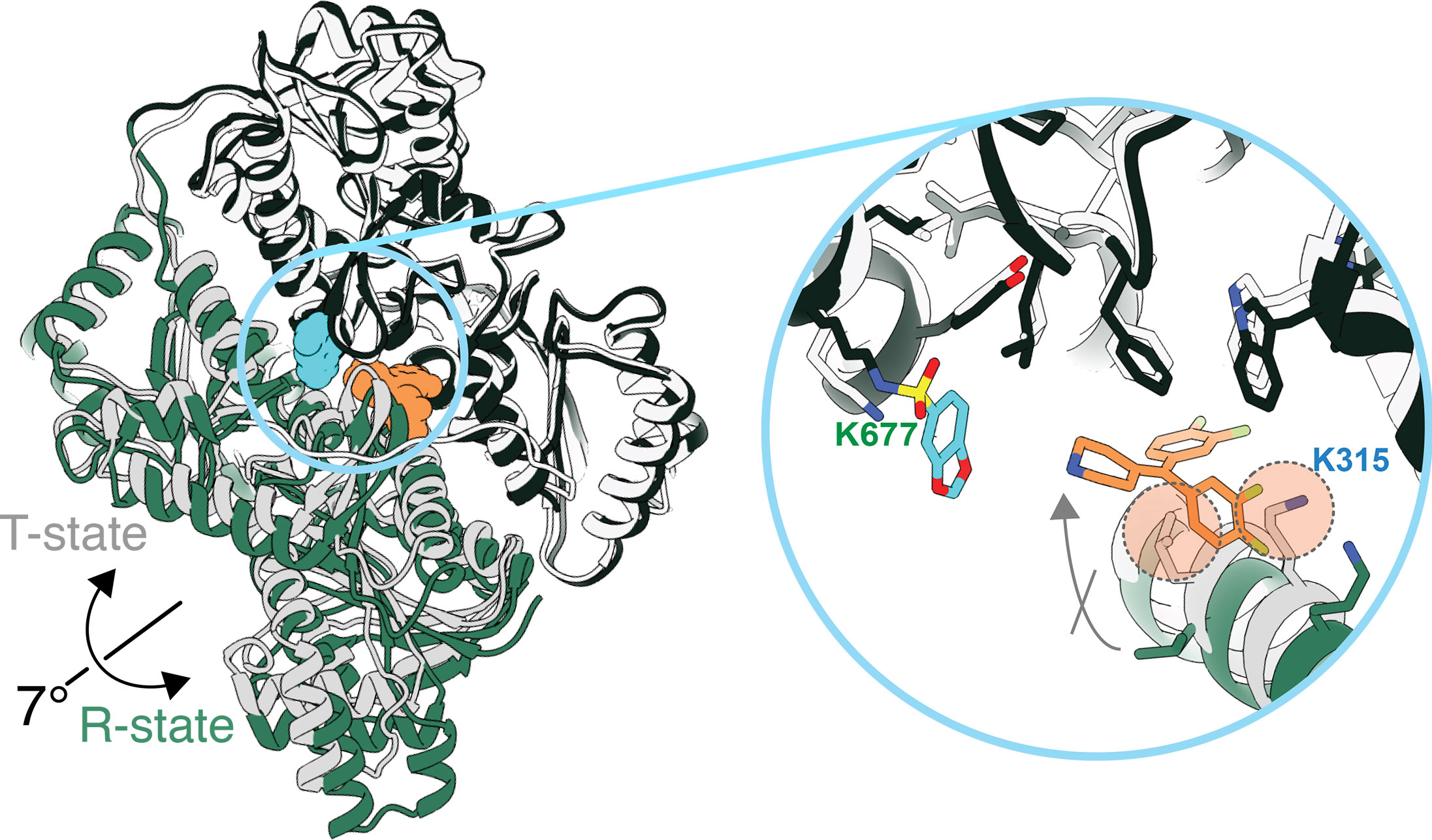
The compound contains two functional parts. Its targeting component, a molecule known as XJ-4-85, binds to an enzyme called PFKL and accelerates glycolysis (the breakdown of sugar) within cancer cells.
Once XJ-4-85 binds, it releases a second compound that targets another enzyme, CPT2. This enzyme normally enables cells to obtain energy by breaking down fatty acids. Increasing sugar consumption while disrupting access to fatty acids interferes with two major sources of cellular energy at the same time, suppressing cancer growth.
“The way this drug works was totally unexpected,” said Xiaoding Jiang, a postdoctoral fellow in the Hsu Lab, who designed the molecule. “A lot of research was required to figure out what it was doing on the molecular level. We were also surprised to see how selectively it binds to cancer cells.”
Human testing remains far away
The findings remain at an early stage. Despite the encouraging laboratory and animal results, considerably more testing will be necessary before researchers can study the compound in people.
The work may also point toward a broader method for constructing similar two-part medicines. The researchers call these compounds “electrophile-drug conjugates” or EDCs.
“They have the potential to be useful beyond cancer, for other kinds of diseases as well,” Cambronne said.
The researchers also credited collaboration among specialists at UT and other institutions with making the work possible. “This project took a village,” said Hsu, a CPRIT Scholar.
Reference: “A covalent PFKL activator suppresses tumor growth” by Xiaoding Jiang, Eric M. Lynch, Congcong Lyu, Crystal N. Wilson, Lauren E. Salay, Hayden T. Hess, Scott N. Lyons, Mu-Jie Lu, Shuangyu Luo, Gibae Kim, Hsin-Ru Chan, Wesley J. Wolfe, Lauren G. Zacharias, Thomas P. Mathews, Yi-Chih Lin, Bradley A. Webb, Justin M. Kollman, Xiaolu A. Cambronne and Ku-Lung Hsu, 5 August 2026, Nature Chemical Biology.
DOI: 10.1038/s41589-026-02289-9
This work was supported by the National Institutes of Health, the National Institute of General Medical Sciences, the Cancer Prevention and Research Institute of Texas (CPRIT), the University of Washington Beckman Cryo-EM Center, West Virginia University’s Visual Sciences CoBRE program, the Melanoma Research Alliance, The Mark Foundation for Cancer Research, The Welch Foundation and Tito’s Handmade Vodka.
Never miss a breakthrough: Join the SciTechDaily newsletter.
Follow us on Google and Google News.
1 Comment
Thanks to the researchers.