

NASA/Johns Hopkins APL/Southwest Research Institute
Researchers used New Horizons images to identify evidence that liquid nitrogen may have flowed from beneath Pluto’s famous heart-shaped glacier.
Dark markings across part of Pluto’s enormous heart-shaped glacier may record something unexpected beneath its frozen surface: liquid nitrogen moving upward and briefly flowing across the ice. Using observations from NASA’s New Horizons spacecraft, researchers led by Southwest Research Institute (SwRI) report what they describe as the first evidence for recent liquid flow on Pluto.
The work was led by SwRI Associate Vice President Dr. Alan Stern, principal investigator of the New Horizons mission.
“Pluto never stops surprising us,” Lead Author Stern said, “and this new result certainly does that. In addition to suggesting that liquids have recently expressed themselves on Pluto’s surface, it also suggests a new kind of time-variable feature on Pluto.”
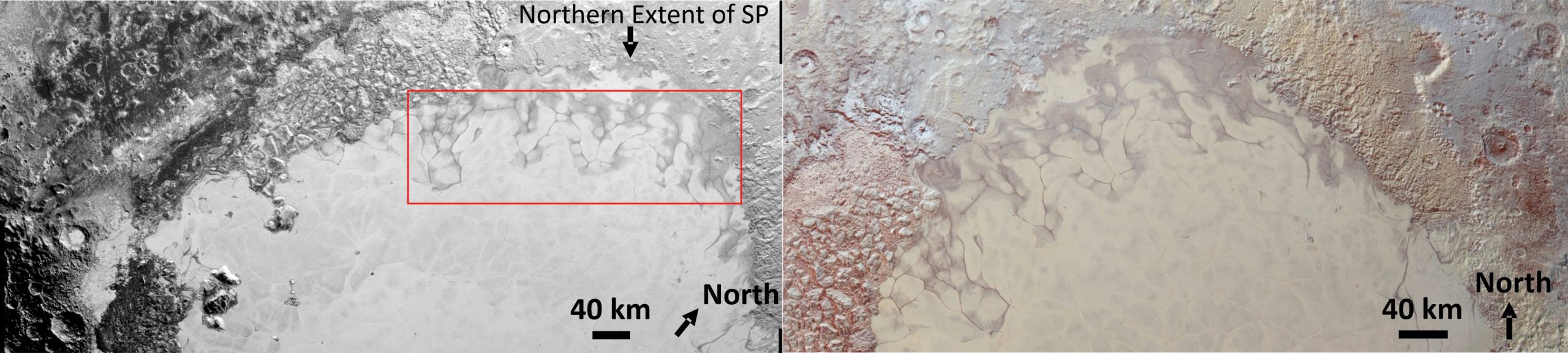
Sputnik Planitia, the western portion of Pluto’s famous heart-shaped region, is a vast glacier made largely of frozen nitrogen and is larger than Texas and Oklahoma combined. Images collected by New Horizons in 2015 and 2016 revealed city-sized convection cells across its northern reaches, separated by narrow dark lines and broader patches of darker material.
A new analysis suggests that some of those markings may form when liquid periodically reaches and wets the surface, most likely in the form of nitrogen. The findings were published in the peer-reviewed Planetary Science Journal.
Dark streaks point to subsurface liquid
Conditions in Pluto’s atmosphere and at its surface rule out liquid nitrogen rain. Yet the darkened patterns across northern Sputnik Planitia resemble features on terrestrial glaciers that have been wetted either by rainwater or by liquid emerging from beneath the surface.
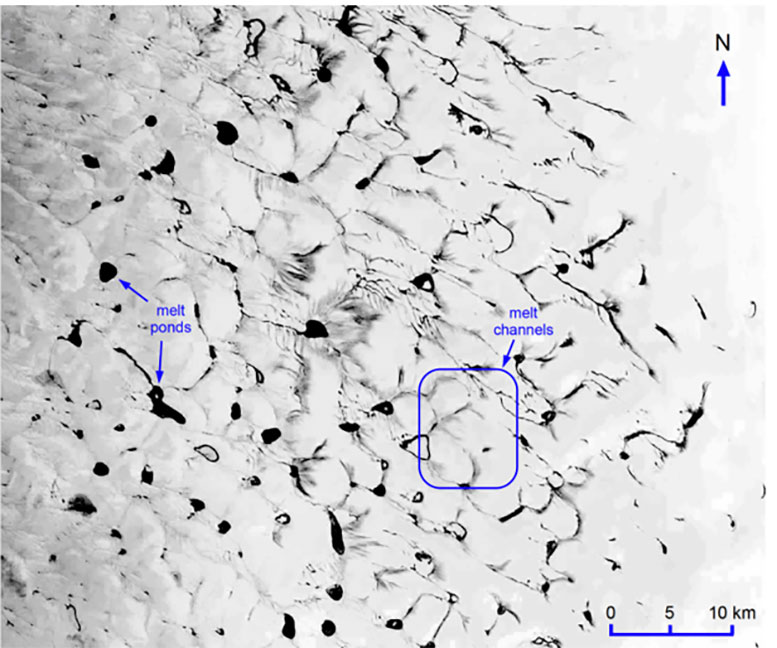
To investigate that similarity, the SwRI-led researchers compared New Horizons observations with NASA Landsat 9 images of icy environments on Earth, including Greenland’s ice sheet. On Earth, narrow dark features occur where liquid water reaches snow and ice.
The corresponding structures on Sputnik Planitia look strikingly similar. That resemblance supports the possibility that nitrogen is moving upward from beneath the glacier and temporarily wetting its frozen surface.
“The surface of Sputnik Planitia is quite young, probably less than one million years based on modeling of the surface overturn, and thus these features that we are looking at must have formed since then,” said SwRI Principal Scientist Dr. Kelsi Singer, one of the study’s co-authors. “Pluto has many unique terrains seen nowhere else in the solar system, and this area of Sputnik Planitia is one of them. Its surface provides a different set of conditions compared to what we are used to on Earth, and exploring that allows us to better understand how materials behave in environments that are difficult to produce on Earth.”
Models show how nitrogen could rise
Previous studies, including earlier work led by Stern, had pointed to ancient episodes of liquid flow on Pluto. The new analysis instead suggests that liquid nitrogen may exist beneath Sputnik Planitia now or have been present there recently enough to leave young surface features.
Computer simulations led by Dr. Orkan Umurhan, senior research scientist at the SETI Institute, provide a possible mechanism. The models show that nitrogen ice deep beneath Sputnik Planitia, which is several kilometers thick, can melt at the base of the glacier and produce liquid nitrogen.
The simulations further indicate that buoyancy or pressure from below could force that liquid upward through narrow passages resembling lava or geyser tubes. Once it arrives at the surface, the nitrogen may remain liquid long enough to travel downslope across the glacier, wetting the ice and creating the dark markings observed by New Horizons.
“I think the great significance of these findings, and the tantalizing picture that it promotes, is a great motivation and reason to further examine solid state nitrogen physics at very low temperatures,” Umurhan said. “Specifically, it’s important to examine the physics taking place in solid nitrogen materials under stress and strain, which can cause them to melt. These processes have never been studied in real detail in the laboratory.”
Much of Pluto remains unexplored
No other region of Pluto currently shows similar evidence for liquid rising from beneath a glacier, but more than half of the dwarf planet has yet to be mapped at high resolution. That leaves open the possibility that comparable features exist elsewhere but have not yet been seen clearly.
The same process of melting and upward liquid movement could potentially help explain activity elsewhere in the solar system, including the geysers observed by NASA’s Voyager 2 on Neptune’s moon Triton.
Higher resolution mapping of Pluto and other worlds in the Kuiper Belt will be needed to determine whether similar processes occur beyond Sputnik Planitia.
Reference: “Evidence for Possible N2 Basal Flow beneath Pluto’s Northern Sputnik Planitia” by S. A. Stern, Orkan Umurhan, Gary D. Clow, Robert S. Anderson, Alan Howard and Kelsi N. Singer, 31 July 2026, The Planetary Science Journal.
DOI: 10.3847/PSJ/ae7e85
Never miss a breakthrough: Join the SciTechDaily newsletter.
Follow us on Google and Google News.