
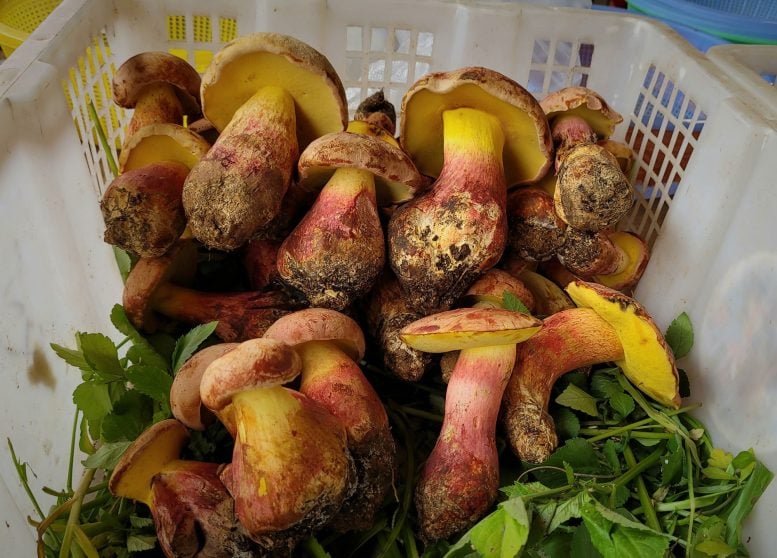
A mushroom sold in markets and served in restaurants in Southwest China has an unusual warning attached to it: cook it thoroughly, or you may start seeing tiny people.
For decades, people have reported extraordinarily detailed hallucinations after eating certain wild mushrooms, describing dozens or even hundreds of miniature humanlike figures walking across tables, climbing furniture, and moving around real objects as if they occupy the same physical world. Scientists have now traced many of these accounts to Lanmaoa asiatica, a prized edible bolete from Yunnan that has also been linked to nearly identical experiences thousands of miles away in the northern Philippines.
Known in Yunnan as “Jian shou qing,” L. asiatica grows in association with pine trees and is valued as a flavorful wild food. When insufficiently cooked, however, it can produce a remarkably specific form of hallucination that researchers are still struggling to explain.
New DNA evidence has made the mystery even more intriguing. Researchers at the University of Utah (U) confirmed that people in Southwest China and an Indigenous community in the northern Philippines were eating the same mushroom species when they reported strikingly similar visions of tiny figures.
Even more surprising, the team found no evidence of psilocybin or any other known mushroom hallucinogen. The results suggest that L. asiatica may contain a psychoactive compound that has never been identified by science.
Colin Domnauer, a doctoral student at the U, and Bryn Dentinger, a mycologist at the U and the Natural History Museum of Utah, reported the findings in a study published in Mycologia.
A Century-Old Mushroom Mystery
The discovery brings new evidence to a mystery that has persisted for nearly a century.
Western scientists first encountered reports of similar mushroom-induced visions in Papua New Guinea in 1934. People who had eaten wild mushrooms described seeing tiny human figures, an experience researchers later referred to as “mushroom madness.”
During the ‘50s and ‘60s, anthropologists and mycologists traveled to the region to investigate. They suspected several mushrooms in the Boletaceae (bolete) family and performed chemical tests in search of a psychoactive ingredient. They found nothing.
Samples were even sent to Albert Hofmann, who first isolated psilocybin and discovered LSD. He also failed to identify an active compound.

The Tiny People Visions Return
With no obvious chemical explanation, researchers began considering a radically different possibility: perhaps the mushrooms were not causing the visions at all. The experience might instead have reflected folklore, expectation, or some other socio-cultural influence. Research largely stopped in the 1960s.
Then the same peculiar story resurfaced elsewhere.
Beginning in the 1990s, people in Yunnan reported seeing miniature figures after consuming certain bolete mushrooms. Mycologists eventually suspected L. asiatica, although the species itself was not formally recognized by science until much later.
In 2024, Domnauer learned of another version of the phenomenon in the remote Northern Cordillera of the Philippines. An Indigenous community there ate a wild mushroom known as “Sedesdem.” Local knowledge held that it could sometimes produce visions of little people.
In Papua New Guinea, a mushroom linked to the phenomenon was called the “Nonda.” In Yunnan, people knew the hallucinogenic bolete as Jian shou qing.
DNA Links the Hallucinations
Three communities, separated by vast distances and distinct cultural traditions, were describing an unusually similar experience after eating wild mushrooms.
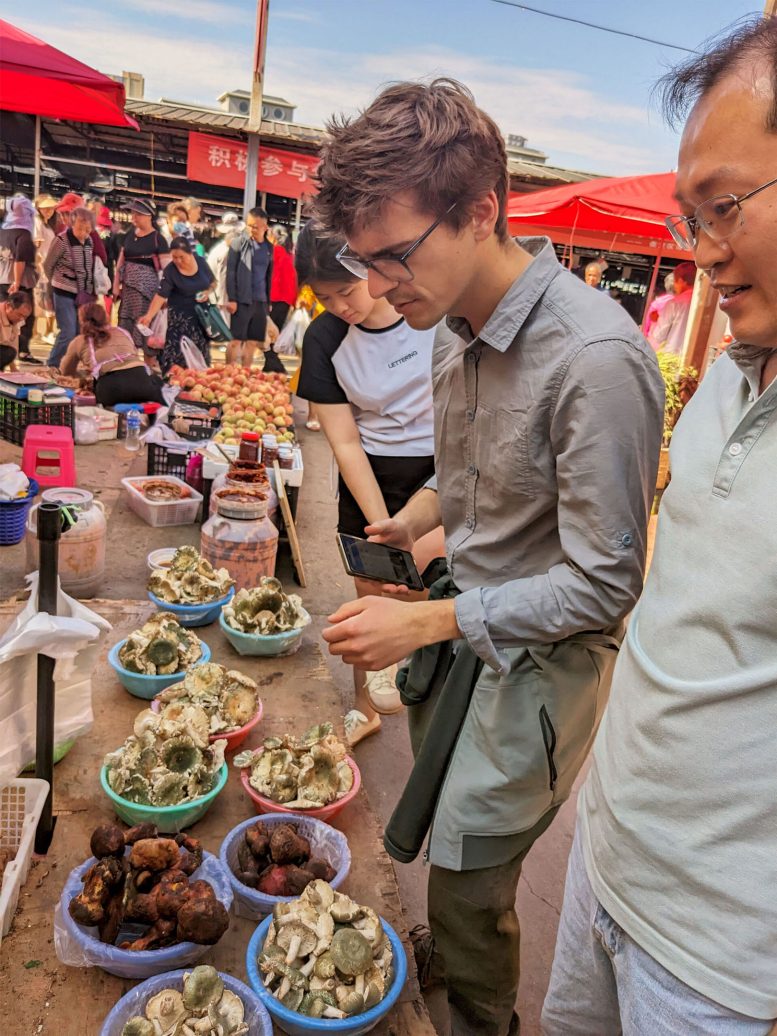
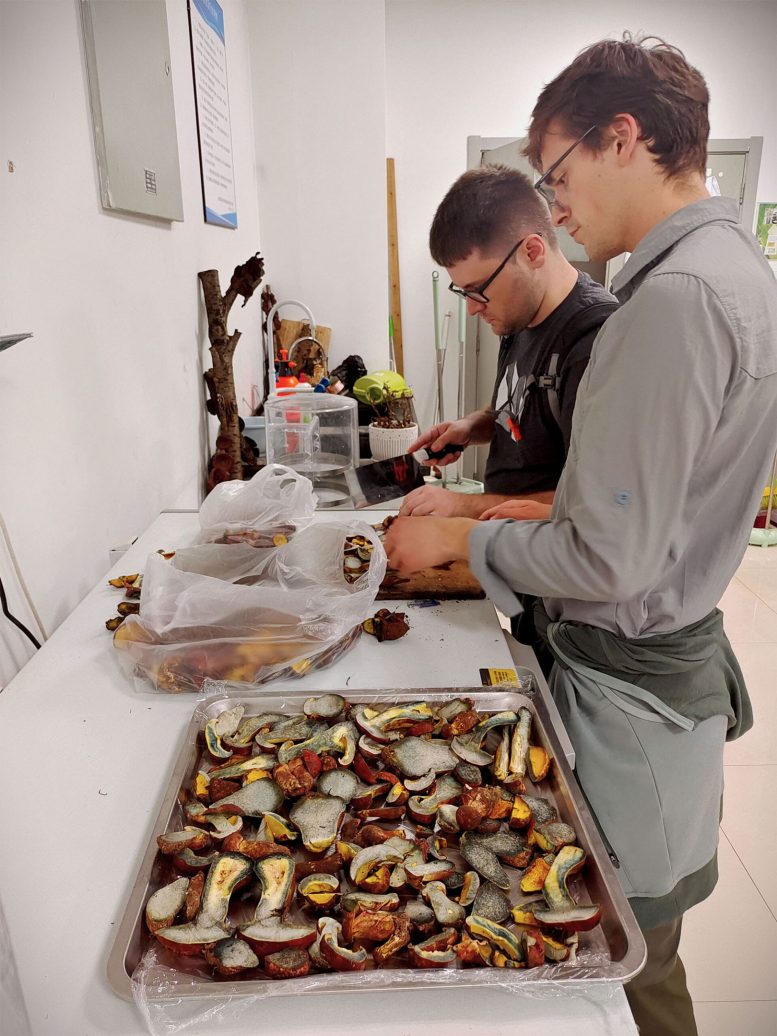
Domnauer traveled to Yunnan and the Philippines, interviewed local residents, and collected L. asiatica and other members of the Lanmaoa genus for genetic analysis. His work in the Philippines also became the first scientific survey of fungi conducted in the northern part of the country.
DNA sequencing produced a striking result: the Jian shou qing mushrooms from China and Sedesdem from the Philippines were both L. asiatica.
That was unexpected because the species was then believed to occur only in China.
Dentinger also traveled to Papua New Guinea in hopes of determining whether the mushrooms involved in the oldest reports were the same species. Unusually dry conditions prevented the team from collecting suitable specimens, leaving that part of the mystery unresolved.
What Lilliputian Hallucinations Look Like
Even without the Papua New Guinea samples, the genetic evidence changes the picture considerably. Two geographically and culturally separate populations independently associated the same species with the same highly distinctive form of hallucination.
That makes a purely cultural explanation much harder to sustain.
People generally describe dozens or hundreds of miniature figures measuring roughly 3 to 30 centimeters (about 1.2 to 11.8 inches) tall. About 90% characterize them as elves, clowns, or other fairy-like beings, often wearing colorful clothing.
Just as unusual is the way the hallucinations appear to blend into the real environment.
The figures do not typically float randomly through space or pass through solid objects. Instead, observers describe them navigating furniture, moving around obstacles, falling from edges, and interacting with ordinary objects.
A Rare Window Into the Brain
One person told Domnauer that while eating soup, tiny people appeared to jump from the spoon into the bowl and swim. When another spoonful was taken, the figures seemed to remain inside the person’s mouth.
Medicine has a name for experiences like these: Lilliputian hallucinations, after the tiny inhabitants of Lilliput in “Gulliver’s Travels.”
They are not unique to mushroom poisoning.
A systematic review published in 2021 examined 226 documented cases and found that Lilliputian hallucinations can occur alongside a wide range of psychiatric, neurological, and visual disorders. Schizophrenia spectrum disorders, alcohol-related conditions, loss of vision, and neurological disease accounted for a large share of reported cases. In 97% of the cases reviewed, the tiny figures appeared embedded in the person’s real surroundings rather than existing in an entirely separate imagined scene.
The brain is not simply generating an image of a miniature person. Somehow, it appears to be placing that figure into an internally coherent model of the surrounding world, complete with apparent size, depth, surfaces, obstacles, and motion.
Searching for an Unknown Psychedelic
Scientists still do not understand why the brain sometimes produces this very specific perceptual error. That is what could make L. asiatica scientifically valuable.
Lilliputian hallucinations are uncommon and unpredictable in most medical conditions. The mushroom, by contrast, appears capable of producing them repeatedly. If researchers can isolate the molecule responsible, they may gain an experimental tool for probing how the brain combines internally generated imagery with information arriving from the senses.
The chemical search has already ruled out familiar explanations.
Domnauer and his colleagues examined the mushroom chemically and genetically for known psychoactive substances and found no evidence of established mushroom hallucinogens. The result fits with the unusual nature of the experience, which differs sharply from the effects typically associated with psilocybin-containing mushrooms.
Hidden Diversity in Lanmaoa
Researchers are now working to isolate the unknown active compound.
To reconstruct the evolutionary history of Lanmaoa, the team sequenced genomes from 53 wild and fungarium specimens collected around the world. They identified 17 species in the group, including four species that had not previously been recognized by science. Two of those newly identified species were already sitting in U.S. collections.
Among the species examined, L. asiatica was the only one associated with psychoactive effects.
Museum Collections Reveal New Species
The researchers are now building an evolutionary map of the genus to determine where that unusual trait originated and whether closely related mushrooms manufacture chemically similar substances.
The finding also illustrates why natural history collections can remain scientifically valuable decades after specimens are gathered. A mushroom preserved in a museum drawer may look nearly identical to another species, yet DNA can reveal that it represents an entirely separate branch of fungal evolution.
In this case, some of the biodiversity was not hiding in an unexplored rainforest. It was already stored in collections, waiting for the right technology to expose it.
Fungi have repeatedly rewarded this kind of investigation. Penicillin famously came from a fungus and transformed medicine. Other fungal compounds have become important antibiotics, cholesterol-lowering drugs, and immunosuppressants.
Reference: “Phylogenomic systematics of Lanmaoa (Boletaceae) reveals cryptic diversity, resolves global evolutionary relationships, and suggests a novel psychoactive lineage” by Colin Domnauer and Bryn T. M. Dentinger, 5 June 2026, Mycologia.
DOI: 10.1080/00275514.2026.2670968
This research was funded by the National Science Foundation (award #DEB-2114785).
Never miss a breakthrough: Join the SciTechDaily newsletter.
Follow us on Google and Google News.
3 Comments
This sounds very similar to the story of the Irish leprechauns. Has anybody thought to research mushrooms from Ireland?
This is the most bizarre thing I’ve come across in a long long time. So many questions.
Are these hallucinations of tiny humans the only hallucinations that people get from these mushrooms? They don’t see anything else? Everyone just sees these tiny humans? Not tiny animals or plants or cartoon characters or aliens or inanimate objects…ONLY tiny humans? How is that even possible?!
What if, stay with me….what if….they are not hallucinations…? What if these tiny people are real, and eating the mushrooms simply allows/enables you to see them? Anyone think of that? Hmmmmmm? Perhaps we need paranormal investigators in this situation.
Do the people who’ve seen these tiny humans say that they make sounds or speak or say anything? Is there any evidence left behind of their existence? Are they seen only indoors, or outdoors as well? How long do these hallucinations last? How do people react to seeing them? Has anyone tried to communicate with these tiny humans? When you have more than one person hallucinating in a group of people, are they describing the same tiny individuals or are they all seeing unique hallucinations specific to each person? That would indicate actual hallucinations. But if multiple people are seeing the same tiny humans at the same time doing the same things and wearing the same clothes…that would indicate they are real. It could be some kind of time/space dimensional cross-over or something.
And most importantly, where can I get these mushrooms?
My thought exactly. As I read I was coming to the same conclusion .
I’ll take some as well.