
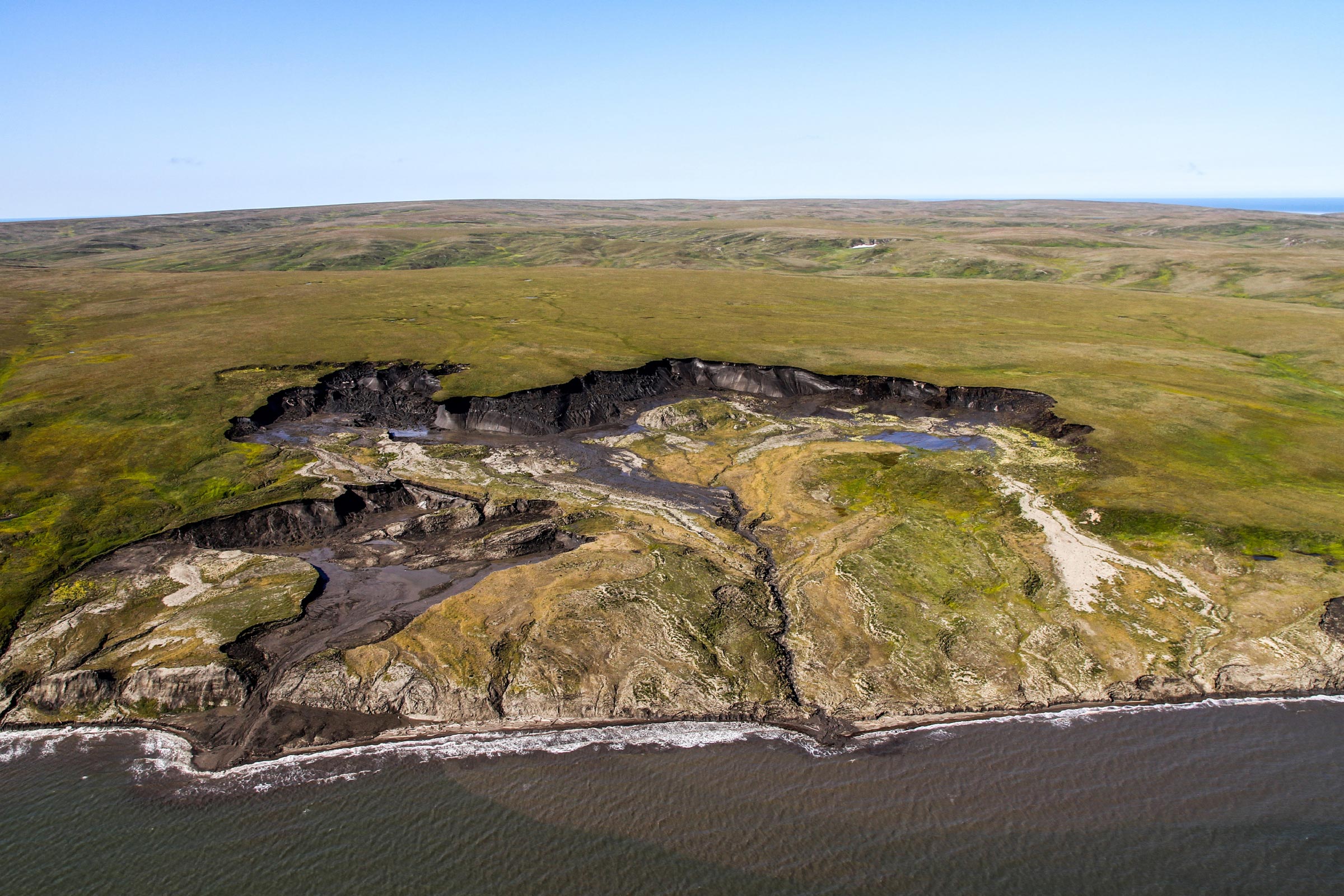
Much of the ancient carbon released from thawing Arctic permafrost appears to end up trapped in seabed sediments rather than quickly returning to the atmosphere.
The Arctic’s frozen ground holds an enormous reservoir of organic carbon. As permafrost thaws and coastlines erode, some of that carbon is carried into the ocean, where microorganisms can break it down and potentially turn it into greenhouse gases.
Until now, scientists have had only a limited idea of how much of that carbon ultimately escapes into the atmosphere and how much remains trapped in the ocean. Researchers from the Alfred Wegener Institute and MARUM – Centre for Marine Environmental Sciences at the University of Bremen have now investigated that question along the permafrost coast of Qikiqtaruk (Herschel Island) in Canada.
By studying sediment cores from the seafloor, the team found that a substantial amount of carbon from land is being stored in seabed sediments. They also uncovered an unexpected biological preference: the microorganisms living there appear to favor fresh marine carbon over the much older carbon released from permafrost. The findings were published in Nature Geoscience.
A Vast Carbon Reservoir Is Starting to Thaw
Permafrost ecosystems across the Arctic contain roughly 1,300 gigatonnes of organic carbon, much of it derived from ancient plant remains. Another 400 gigatonnes are stored in sediments in oceans and river deltas.
That frozen carbon reservoir is becoming increasingly vulnerable as the Arctic warms faster than any other region on Earth. As permafrost thaws, rivers and collapsing coastlines can carry its carbon into the Arctic Ocean.
“Consequently, up to 0.02 gigatonnes are entering the sea each year, and according to forecasts, this outflow could rise by 70 to 150 percent by the year 2100,” says Dr Manuel Ruben, lead author of the study from the Alfred Wegener Institute, Helmholtz Centre for Polar and Marine Research (AWI). “However, how much of this is released back into the atmosphere as a greenhouse gas and how much is stored in the seabed has, until now, been largely unknown.”
Knowing what happens to this carbon is important because it helps scientists estimate how strongly thawing permafrost could influence future climate change.
Sediment Cores Reveal Where the Carbon Goes
To investigate, the researchers collected sediment cores at different distances from the coast of Herschel Island. Together, those cores preserve about 50 years of deposits.
The results showed that large amounts of organic carbon are indeed being swept away from the coast, but relatively little of it becomes part of the ocean’s active carbon cycle.
“Although the sea here carries away huge quantities of organic carbon from the coast, surprisingly little of it ends up in the ocean’s active carbon cycle,” says Manuel Ruben. “Microorganisms convert around ten percent of the organic carbon from the sediments into gases, which rise into the water and can then enter our atmosphere.”
Most of the remaining carbon stays stored in the seafloor.
Following Carbon With Isotopes
The scientists also examined how quickly permafrost material builds up on the seabed and what happens to it after burial.
They measured dissolved inorganic carbon inside tiny spaces between sediment particles – known as pore water. This allowed them to estimate how much CO2 microorganisms had produced after breaking down organic matter.
The team then studied the isotopic makeup of that carbon to determine where the microbes’ food came from.
”Carbon isotopes represent our atomic indicators that can identify the food source of the microorganisms,” says Prof. Gesine Mollenhauer, a geochemist at the AWI and co-spokesperson for the ‘The Ocean Floor – Earth’s Unexplored Interface’ cluster of Excellence. “The 13C isotope, for example, tells us whether they have consumed carbon from land or from the sea. By way of the 14C isotope, we were able to determine whether the single-celled organisms preferred old organic carbon from permafrost or fresh organic carbon from algae remains.”
“Gourmet” Bacteria Prefer Fresher Food
That analysis revealed a striking pattern. The microorganisms buried in the sediments seem to favor fresh carbon from marine sources, such as recently produced algae, rather than older carbon released from thawing permafrost.
“The sediment is home to ‘gourmet’ bacteria that apparently prefer fresh carbon stemming from, for example, more recent algal remains over the ‘old’ carbon from permafrost deposits,” explains Gesine Mollenhauer.
That preference suggests carbon carried into the sea from land may contribute less to atmospheric greenhouse gas levels than scientists had feared.
Still, the researchers caution that the picture is not complete.
“However, we do need further research here. This is because some of the organic carbon from the permafrost may already have been broken down before it reaches the seabed.”
Thawing Permafrost Also Changes Coastal Ecosystems
The movement of carbon from land into the sea could affect more than greenhouse gas emissions. It can also change the chemistry and biology of coastal waters that help support food sources for local communities.
Material eroded from the coast can reduce the amount of sunlight penetrating the water in two ways. Freshly broken sediment makes the water cloudier, while dissolved organic carbon can darken it.
That matters because single-celled organisms such as algae depend on sunlight to produce biomass and oxygen. This process, known as primary production, provides the foundation of marine food webs that support fish, crustaceans and seals.
Researchers plan to study these connections further during the international ‘Arctic Pulse’ campaign scheduled for 2027. Using the Polarstern research icebreaker, AWI research aircraft and land-based measurements, scientists will investigate how rapid environmental change is reshaping Arctic ecosystems.
Improving Climate Predictions
The new results give scientists a clearer picture of what happens after carbon escapes from thawing Arctic permafrost and reaches the ocean.
“Our study shows, more precisely than ever before, how much carbon is safely stored in the seabed – and just how much of the decomposed material actually originates from the old permafrost,” says Manuel Ruben. “This provides an important foundation for climate models that can predict the consequences of permafrost thawing for the global climate.”
Reference: “Limited remineralization of Arctic permafrost-derived organic carbon in nearshore marine sediments” by Manuel Ruben, Bingbing Wei, Anabel von Jackowski, Jens Hefter, Torben Gentz, Florence Schubotz, Heidi Taubner, Bo Liu, Michael Fritz, Anna Irrgang, Walter Geibert, Maarten Boersma, Gabriel A. Juma, Silla Thomsen and Gesine Mollenhauer, 31 July 2026, Nature Geoscience.
DOI: 10.1038/s41561-026-02060-8
Never miss a breakthrough: Join the SciTechDaily newsletter.
Follow us on Google and Google News.
1 Comment
While this research offers fascinating insight into how Arctic marine microorganisms process organic matter, it is worth looking at these changes through a broader geological lens. From a paleoclimate perspective, Earth is currently in an interglacial period of the Quaternary Ice Age, which began over two million years ago. Throughout the vast majority of its history, the planet’s baseline state has been a greenhouse climate, with average temperatures significantly warmer than today and no permanent polar ice sheets. Understanding how carbon cycles behaved during those warmer historical epochs could provide crucial context for how modern ecosystems will continue to shift.