
Close Menu
    Facebook X (Twitter) Instagram
    SciTechDaily
    • Biology
    • Chemistry
    • Earth
    • Health
    • Physics
    • Science
    • Space
    • Technology
    Facebook X (Twitter) Pinterest YouTube RSS
    SciTechDaily
    Home»Science»90-Million-Year-Old Fossil Reveals a Small Dinosaur Living Along Japan’s Coast
    Science

    90-Million-Year-Old Fossil Reveals a Small Dinosaur Living Along Japan’s Coast

    By University of TsukubaSeptember 13, 2026No Comments3 Mins Read
    Facebook Twitter Pinterest Telegram LinkedIn WhatsApp Email Reddit
    Share
    Facebook Twitter LinkedIn Pinterest Telegram Email Reddit
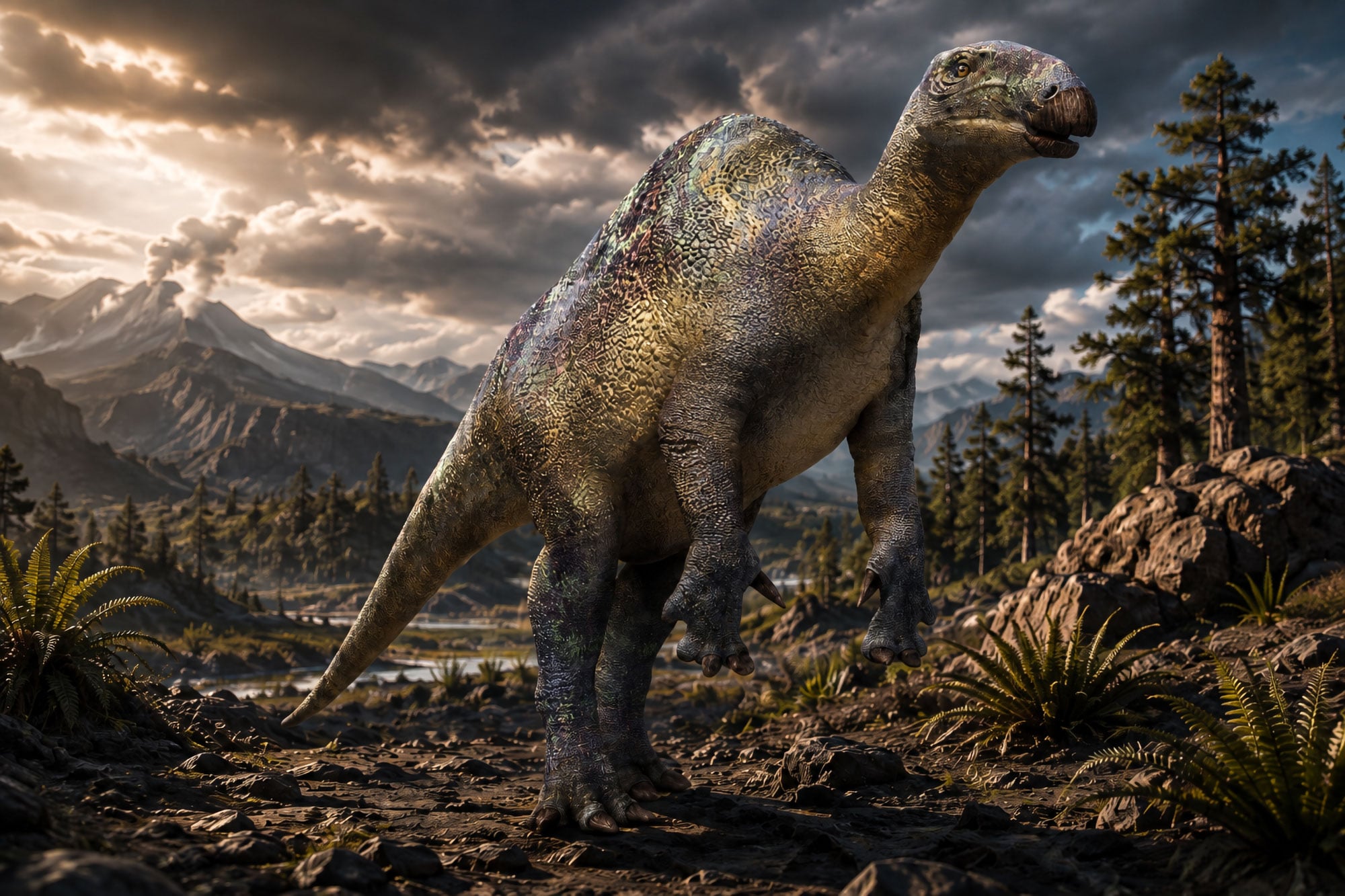
    Reconstruction of the Iguanodontian
    Iguanodontians were a diverse group of plant-eating dinosaurs that thrived from the Late Jurassic through the Late Cretaceous. Ranging widely across the Northern Hemisphere, they included both relatively small species and much larger forms closely related to hadrosaurs. Credit: Masato Hattori

    A small iguanodontian fossil from Japan adds evidence that Late Cretaceous coastal ecosystems supported dinosaurs of widely different body sizes.

    Iguanodontians were widespread plant-eating dinosaurs that lived from the Late Jurassic through the Late Cretaceous. Their movement between Asia, North America, and Europe helped shape their diversification across Laurasia, making fossils from Japan especially useful for understanding how the group evolved and spread.

    Recent discoveries in Japan have strengthened evidence that iguanodontians lived in coastal environments along eastern Asia. Yet much of the Japanese fossil record remains incomplete. Although researchers have described a nearly complete skeleton of a large iguanodontian (approximately 8 meters in length), most specimens consist only of isolated teeth and other fragmentary remains, leaving important questions about their ecology and diversity unresolved.

    A forgotten fossil waited two decades

    One such fossil was discovered in 1999 on the grounds of the Iwaki City Ammonite Center in Fukushima Prefecture. The site lies within the Obisagawa Member of the Ashizawa Formation (formed approximately 90-88 million years ago), part of the lower Upper Cretaceous Futaba Group, which preserves sediments deposited in a shallow-marine environment.

    The isolated bone was initially thought to be the sternal plate, or breastbone, of a hadrosauroid dinosaur. Despite that tentative identification, the specimen remained unstudied for more than 20 years.
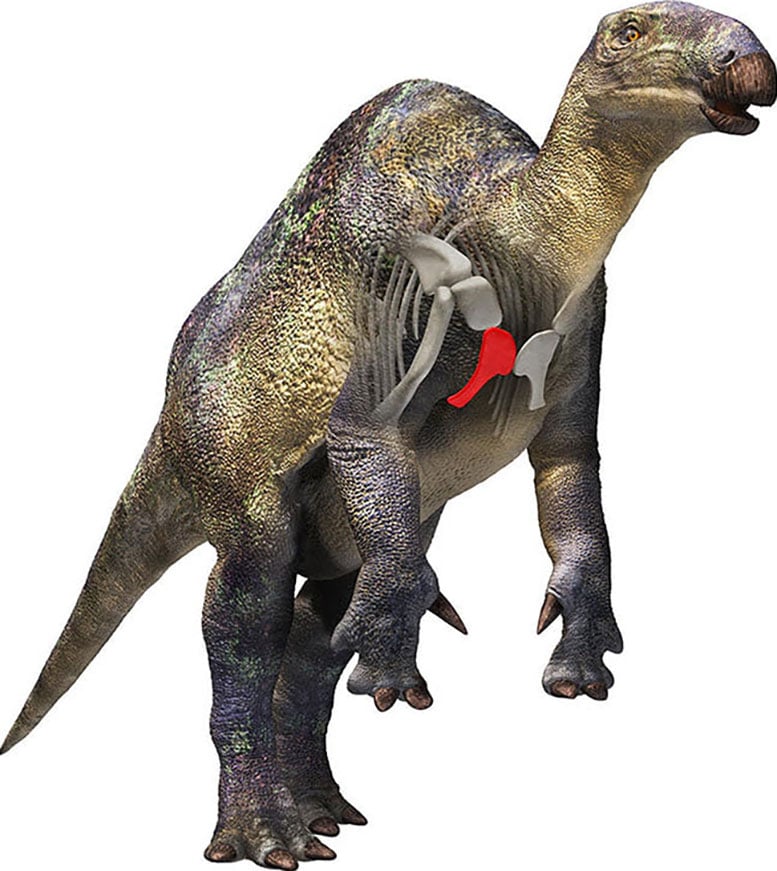
    Reconstruction of the Iguanodontian (Styracosternan) From Iwaki City, Fukushima Prefecture
    Reconstruction of the iguanodontian (styracosternan) from Iwaki City, Fukushima Prefecture. The red bone is the right sternal. Credit: Masato Hattori

    A smaller dinosaur expands coastal diversity

    A detailed morphological analysis has now identified the fossil as the right sternal plate of an indeterminate styracosternan, a derived iguanodontian group that includes hadrosauroids. Comparisons with related species suggest that the animal was approximately 3 meters long, making it substantially smaller than other iguanodontians previously recovered from the same formation.

    Larger iguanodontians, including hadrosauroids, are already known from Late Cretaceous Japan. The presence of this much smaller animal, therefore, suggests that iguanodontians spanning a wider range of body sizes occupied coastal environments in East Asia, adding new evidence for the diversity of these ancient ecosystems.

    Reference: “An iguanodontian sternal plate from the Upper Cretaceous Ashizawa Formation (Futaba Group) of Fukushima Prefecture, Japan” by Masami Kondo, Kohei Tanaka, Fumiaki Utagawa, Junki Yoshida and Darla K. Zelenitsky, 2026, Paleontological Research.
    DOI: 10.2517/prpsj.250042

    Never miss a breakthrough: Join the SciTechDaily newsletter.
    Follow us on Google and Google News.

    Cretaceous Period Dinosaurs Fossils Paleontology University of Tsukuba
    Share. Facebook Twitter Pinterest LinkedIn Email Reddit

    Related Articles

    Scientists Finally Solve the 20-Year Mystery of Strange Tiny Dinosaur Fossils

    Scientists Reconstruct a Giant 31-Foot “Dinosaur-Killer” Crocodile in Unprecedented Detail

    Soaring vs. Flapping: “Remarkable” Fossils Unlock Flight Secrets of Giant Pterosaurs

    New Dinosaur Egg Species Helps Crack Mystery of Cretaceous Ecosystem in Japan

    Who Was King Before T. rex? Dinosaur Fossil Reveals New Apex Predator

    Fossils Reveal Headbutts May Have Been Used as a Dinosaur Courtship Behavior

    Cretaceous Period Sankofa Pyrenaica Fossilized Eggs Are Unusually Shaped

    Microraptor Feathers Were Black With Iridescent Sheen

    Jurassic Period Super-Sized Fleas Had Armored Mouthparts to Attack the Thick Hide of Dinosaurs

    Leave A Reply Cancel Reply

    • Facebook
    • Twitter
    • Pinterest
    • YouTube

    Don't Miss a Discovery

    Subscribe for the Latest in Science & Tech!

    Trending News

    One of Earth’s Driest Deserts Just Turned White

    A Century-Old Mystery in Cat Kidneys May Finally Have an Answer

    Black Hole Winds Are 100 Times More Powerful Than Astronomers Thought

    “Cancer Melted Away”: Immunotherapy Delivers Striking Results in Bowel Cancer Trial

    Captive Crocodiles Released Into the Wild Did Something Researchers Didn’t Expect

    A Massive 29-Square-Mile Iceberg Hit an Island and Kept Going

    New Mexico’s Largest Reservoir Was Nearly Full. Now It’s at 1.4%

    This Southern-Style Mediterranean Diet Helped People Lose 10 Pounds

    Follow SciTechDaily
    • Facebook
    • Twitter
    • YouTube
    • Pinterest
    • Newsletter
    • RSS
    SciTech News
    • Biology News
    • Chemistry News
    • Earth News
    • Health News
    • Physics News
    • Science News
    • Space News
    • Technology News
    Recent Posts
    • 90-Million-Year-Old Fossil Reveals a Small Dinosaur Living Along Japan’s Coast
    • Thawing Permafrost Is Releasing Carbon, but Something Unexpected Happens
    • Scientists Resurrect 160-Million-Year-Old Molecules With Surprising Power Against Superbugs
    • Stardust Buried in Antarctic Ice Exposes an 80,000-Year-Old Cosmic Mystery
    • Scientists Turn Common Plastic Waste Into Fuel Using Heated Salts
    Copyright © 1998 - 2026 SciTechDaily. All Rights Reserved.
    • Science News
    • About
    • Contact
    • Editorial Board
    • Privacy Policy
    • Terms of Use

    Type above and press Enter to search. Press Esc to cancel.