
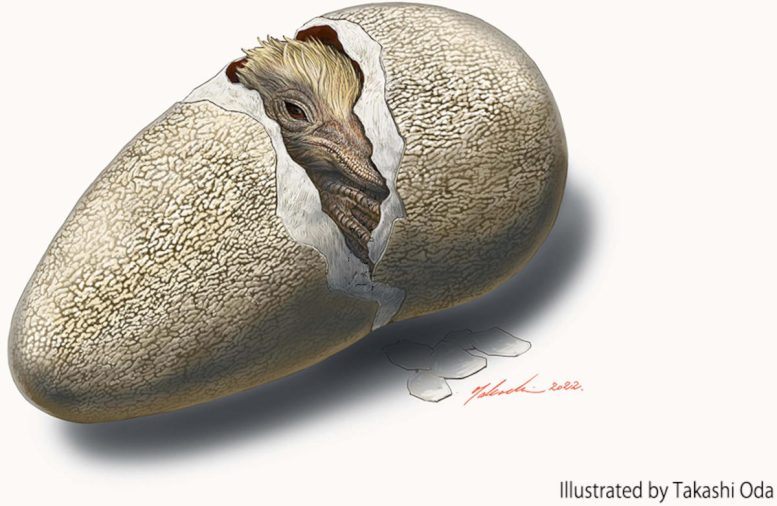
Fossilized eggshells from Gifu Prefecture, Japan, dating back to the Early Cretaceous period, reveal previously unknown egg species from a small theropod dinosaur.
Dinosaurs left behind more evidence than just giant skeletons. Tiny eggshell fragments can provide insights into Mesozoic ecosystems that fossils of bones and teeth do not. This is particularly valuable for understanding the smaller animals that were less likely to be preserved. Early Cretaceous eggshell fragments, the oldest found in Japan, offer a glimpse into the ecosystem of dinosaurs during this time period.
A research team from the University of Tsukuba has recently published a study in Historical Biology, where they examined fossil eggshell fragments found in northern central Japan. The study focused on seven eggshell fragments and six eggshell impressions, which were collected from the Okurodani Formation in Gifu Prefecture between 1988 and 2009. The team described and classified the fossils into at least two types. Two of the eggshell fragments were identified as belonging to the Testudoolithidae family, a family of turtle egg fossils.
Two eggshell impressions belonged to indeterminate egg groups. Most of the egg material, including five fragments and four impressions, belonged to a new egg genus and species, which the researchers named Ramoprismatoolithus okurai.
Analysis of Dinosaur Eggshells
The researchers carefully analyzed the physical characteristics of the eggshell fragments and impressions and performed phylogenetic analysis (which examines the evolutionary development of a species, group of organisms, or a particular characteristic they have) to determine the type of dinosaur most likely to have laid the eggs. According to study co-author Professor Kohei Tanaka, “The shell fragments of Ramoprismatoolithus are characterized by a prismatic microstructure with branching ridges on the outer surface. Our analysis suggests an affinity with the troodontids, a group of small non-avian theropod dinosaurs.”
Fossils of the small raptor that laid the eggs have not yet been discovered in the Lower Cretaceous strata that yielded these fossils. As first author Rina Uematsu explains, “Based on the dimensions of the egg fragments, we calculated that the adults of the maniraptoran species that laid them would have weighed about 12 to 17 kilograms. The discovery of small maniraptoran eggs of this age in Japan also extends the temporal and geographic ranges of these small, non-avian theropods to the middle of the Early Cretaceous of the eastern margin of Asia.”
The turtle eggshells reveal the presence of small-sized non-marine turtles that can be ascribed to previously recognized skeletal remains from the strata where they were found.
Together, these findings illustrate the value of even tiny, fragmentary eggshells in reconstructing ancient ecosystems, especially the presence of smaller animals that may be underrepresented in the skeletal fossil record.
Reference: “Fossil eggshells from the Early Cretaceous Okurodani Formation, northern central Japan” by Rina Uematsu, Kohei Tanaka, Shohei Kozu, Shinji Isaji and Shizuo Shimojima, 24 November 2022, Historical Biology.
DOI: 10.1080/08912963.2022.2142910
The study was funded by the Japan Society for the Promotion of Science.
Never miss a breakthrough: Join the SciTechDaily newsletter.
Follow us on Google and Google News.
1 Comment
Troodon is not a tetanuran dinosaur it’s not a dinosaur it’s a true bird.tetanuran dinosaur have the most sensoritive face out of any animal the alive tetanuran dinosaur the gator show that .troodon have a bird skull it will never be as wide as tetanuran dinosaur .and dinosaur will never have a unique brain like a owl the tetanuran dinosaur inner ear is different from birds .troodon is not a thecodont .Jurassic park hype will never turn birds into dinosaur .dinosaur do not have bird muscle in there toes.