
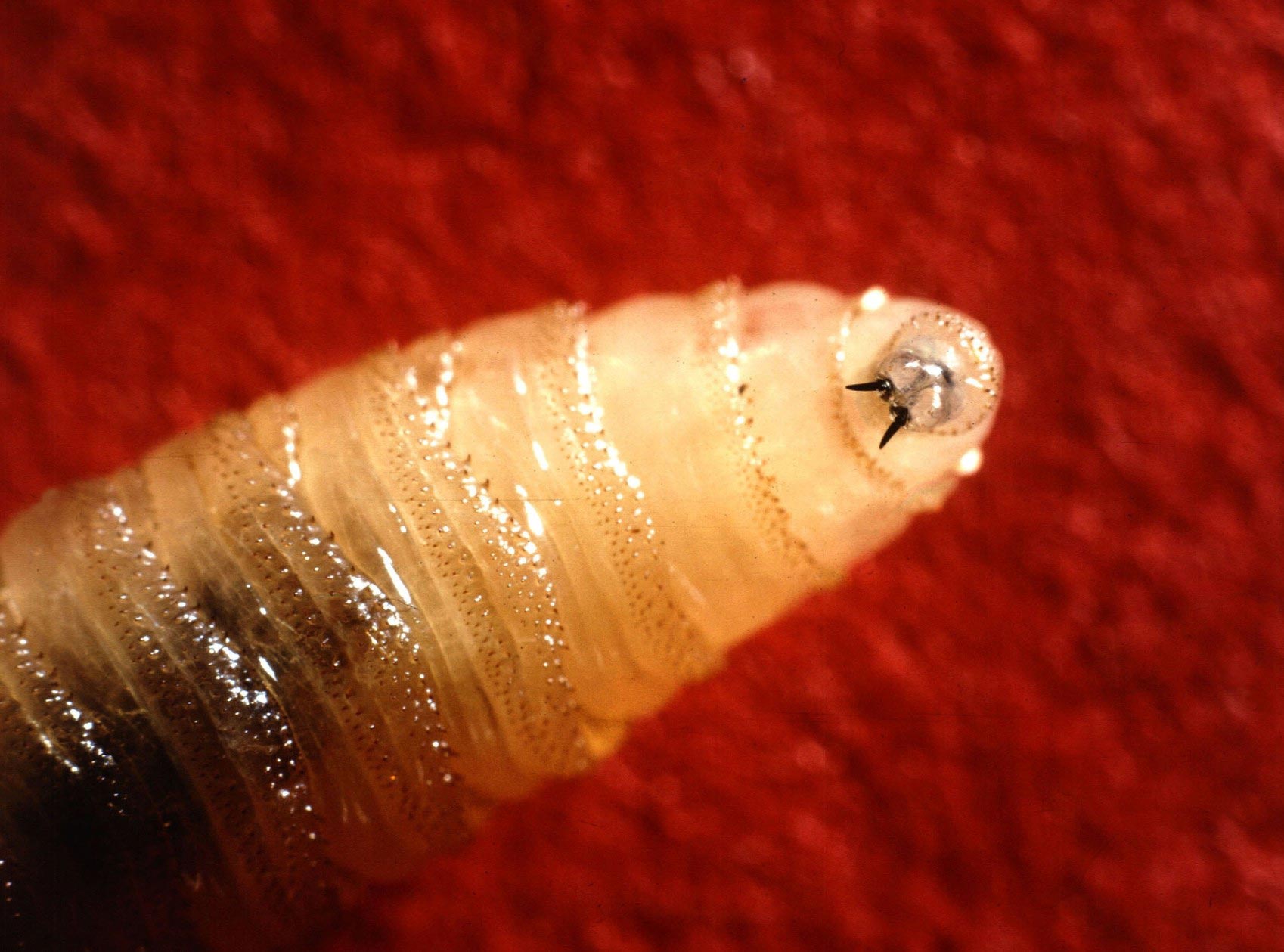
A wound no bigger than a tick bite can be enough for New World screwworm to take hold.
A female New World screwworm fly can deposit hundreds of eggs at a time in an animal’s or person’s wound. When those eggs hatch, the larvae do something most maggots do not: they burrow into healthy flesh and begin feeding. A single female may lay as many as 3,000 eggs during her lifetime.
For decades, the United States had largely escaped that threat. An ambitious eradication campaign eliminated New World screwworm from the country and eventually forced the parasite south to Panama. But after spreading north through Central America and Mexico, the fly has returned.
The U.S. Department of Agriculture confirmed the first animal case of the current U.S. outbreak on June 3, 2026. Since then, detections have been reported in Texas and New Mexico. Across Central America and Mexico, the wider outbreak has already produced more than 209,400 reported animal cases and 2,440 human cases. No locally acquired human infestations have been reported in the United States, and the Centers for Disease Control and Prevention say the current risk to the U.S. public remains very low.
Scientists Race to Predict Screwworm’s Next Move
The return is reviving memories of a pest that once inflicted enormous losses on American agriculture. In the 1950s, New World screwworm cost U.S. livestock producers tens of millions of dollars annually, with losses reaching an estimated $50 million to $100 million a year in the hardest-hit areas of the Southwest.
Now, researchers and public health officials are trying to answer an urgent question before the fly spreads farther: Where is it most likely to appear next?
The County of San Diego Health and Human Services Agency (HHSA) Public Health Services and researchers at the University of California San Diego have developed a dashboard designed to estimate New World screwworm risk across the country.
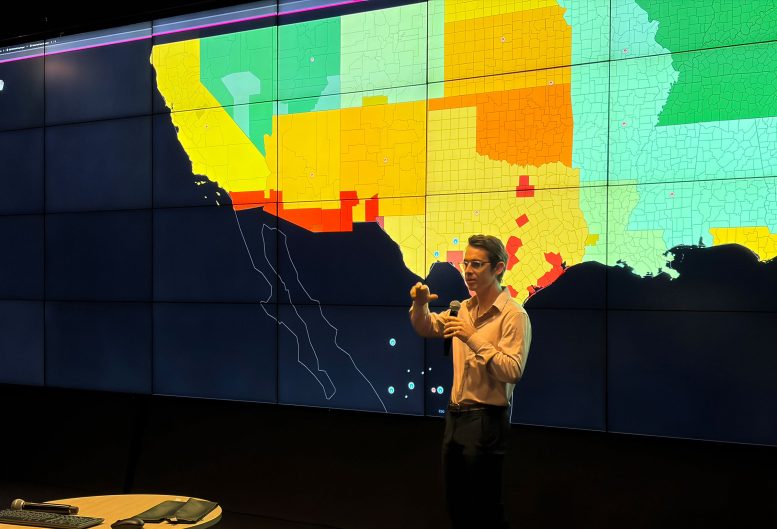
Rather than simply plotting confirmed cases, the system combines multiple signals, including reported detections, environmental conditions that could allow the fly and its larvae to survive, and media coverage. It then produces county-by-county risk estimates that can help officials judge where the threat may be growing.
“Our county public health partners alerted us to the need for better situational awareness of New World screwworm,” said Eliah Aronoff-Spencer, MD, PhD, professor of medicine at UC San Diego School of Medicine and affiliate member of the UC San Diego Design Lab and Qualcomm Institute. “We built a dashboard to generate regional risk profiles. This is just one example of how we are responding to county needs with a focus on real-world issues. It’s a model that has brought us great success, like the Tijuana River Crisis Environmental Dashboard.”
How News Reports Could Provide an Early Warning
The screwworm dashboard is currently limited to project partners and public health officials, although its developers hope to eventually make a public version available.
What makes the system especially useful for early warning is that it does not rely solely on confirmed cases. Among the signals it tracks is news coverage, which can reveal possible outbreaks before they appear in official surveillance data.
Disease surveillance often depends on laboratory results and formal reporting systems, which can lag behind events on the ground. News reports may provide weaker evidence than a confirmed laboratory finding, but they can also provide an earlier signal that something unusual is happening.
“Traditional reporting mechanisms for public health are often delayed,” said Seema Shah, MD, MPH, medical director of the Epidemiology and Immunization Services Branch for the County of San Diego’s Public Health Services Department. “Lab confirmation can take days or weeks. By incorporating media reports, we can identify potential threats sooner and stay one step ahead.”
Predicting Where Screwworm Could Strike Next
For officials making preparations, the distinction between a threat that could arrive within weeks and one that remains months away can influence surveillance, veterinary outreach, staffing, and other decisions.
“The tool gives you a sense of where you might expect to see cases next,” said Mark Beatty, MD, MPH, assistant medical director for the County’s Epidemiology and Immunization Services Branch. “That’s helpful in determining how we should be preparing. Is the threat imminent, or do we have six months? We’re in a very concerning phase right now, and the tool backs that up.”
Why New World Screwworm Is So Dangerous
New World screwworm, Cochliomyia hominivorax, is not a worm but a species of parasitic fly whose larvae behave very differently from those of most familiar flies. While many fly larvae feed on dead or decomposing material, screwworm larvae consume living tissue.
Female flies are attracted to wounds and natural body openings such as the eyes, ears, nose, and mouth. After the eggs hatch, the larvae enter the tissue and feed for roughly a week. They then leave the host, fall to the ground, burrow into the soil, and later emerge as adult flies to continue the cycle.
As the larvae feed, an initially small injury can become deeper and larger. The damaged tissue can also develop bacterial infections. Without treatment, severe infestations can badly injure or kill livestock and wildlife.
People can become infested as well, although human cases are far less common. New World screwworm is not contagious in the way COVID-19 or influenza is. It cannot spread directly from one person to another, from animals to people, or between animals. A fly must deposit eggs on a suitable wound or body opening.
For people in areas where the flies are circulating, the CDC recommends keeping even small wounds clean and covered. Warning signs can include a rapidly worsening painful wound, bleeding, a foul odor, or the sensation or sight of larvae moving in a wound.
Screwworm’s Rapid Return to the United States
The fly’s advance has been striking.
An outbreak was identified in Panama and Costa Rica in 2023. The parasite subsequently spread through every Central American country and into Mexico before returning to the United States.
“We knew in 2023 that New World screwworm was going to move northward, but I wasn’t expecting it to move as fast as it has,” said Beatty. “Although the source of the infections in the U.S. is still under investigation, the fact that it’s in the U.S. is 100% clear.
“Once it entered Texas, we quickly saw an increase in detections,” he continued. “It’s in a place where it used to live, so it’s not surprising it’s taking a hold again.”
The flies can travel miles while searching for hosts, but their spread is not driven by flight alone. Livestock, pets, birds, and wildlife can transport infestations into new areas.
How the U.S. Eradicated Screwworm Before
The consequences extend beyond animal health. The outbreak has also disrupted livestock trade. As of August 14, 2026, USDA said all southern U.S. ports of entry remained closed to livestock trade, although the agency planned to begin a phased reopening at Douglas, Arizona, on August 24 if outbreak control milestones continued to be met.
The United States has beaten this parasite once, using a biological strategy that sounds almost counterintuitive: fight flies with more flies.
During the original eradication campaign, enormous numbers of screwworm flies were raised in captivity and sterilized with radiation. Sterile males were then released into affected regions. When wild females mated with them, no viable offspring resulted.
Repeated releases gradually pushed the population toward collapse.
Genetic Technology Could Strengthen the Fight
The sterile insect technique became one of the landmark successes of biological pest control, and officials are once again relying on the same underlying idea. Today’s USDA-led campaign combines sterile fly releases with pesticides, surveillance, and restrictions on animal movement.
Scientists are also working on ways to make the strategy more powerful.
A genetically modified strain called NovoFly is designed so that females do not survive to adulthood, leaving males that can be used for releases. Other research is exploring genetic sex sorting and CRISPR-based approaches that could produce sterile males without radiation. UC San Diego scientists are among those developing next-generation technologies that could make future screwworm suppression faster or more efficient.
For San Diego officials, the goal is to identify changing risk before a local infestation is discovered.
“We are working closely with the California Department of Food and Agriculture to connect local veterinarians with screwworm resources for surveillance in our region,” said Emily Trumbull, DVM, veterinarian and lead for the Epidemiology Unit’s One Health Program. “The flies can affect any warm-blooded animal, so working together with veterinarians serving livestock, pets, and wildlife is critical for identifying suspect cases and preventing cases in people. The dashboard takes into account environmental factors that can help us understand how the risk to our local region is changing before the fly arrives. That’s why the dashboard is valuable.”
Building Public Health Tools Around Real-World Threats
That combination of human, animal, and environmental surveillance reflects what public health agencies call a One Health approach. The idea is particularly relevant to screwworm because an outbreak can simultaneously involve livestock producers, veterinarians, wildlife officials, physicians, environmental researchers, and public health departments.
The screwworm dashboard is part of Resilient Shield, a UC San Diego initiative and U.S. Centers for Disease Control (CDC)-funded center led by Aronoff-Spencer and co-PIs. Resilient Shield is one of 13 core facilities in Insight Net, the CDC’s national outbreak and disease modeling network.
Its operating model reverses a familiar research process.
Instead of academics developing a tool and later looking for agencies that might use it, public health organizations can tell Resilient Shield what problem they need solved. Those requests are submitted as tickets, much like a technical support system.
A Scalable System for the Next Outbreak
“In public health, we always know our most urgent priorities, but too often we don’t have the immediate resources or in-house technical solutions to achieve them,” said Shah. “The screwworm is a perfect example. It is a critical threat, but it is an issue our academic partners might never have prioritized without our direct ticket. This partnership solves our immediate problem while providing shareable, open reference designs that demonstrate exactly how public health, academia, and industry can successfully work together.”
Partners include San Diego County, the California Department of Public Health, the Navajo Nation, and organizations across Insight Net. Its first ticket, also submitted by Shah, involved flu tracking and was co-led by Resilient Shield co-PI Ruy Ribeiro at Los Alamos National Laboratory. The screwworm project brought Aronoff-Spencer together with mathematical epidemiologist Natasha Martin, DPhil, professor of medicine and vice chief in the Division of Infectious Diseases and Global Public Health at UC San Diego School of Medicine.
Behind those projects is a modular resource hub built to combine data and computational tools without starting from scratch for every new emergency. Working with technology partners including Google and MITRE, Resilient Shield can draw from human disease information, livestock data, environmental and weather observations, health records, and social signals. Depending on the problem, teams can assemble public websites, secure computing systems, simulations, or AI-based tools.
“Our central innovation is the true convergence of partner priorities with scalable engineering,” said Aronoff-Spencer. “We do not build in a vacuum. Our infrastructure is built directly on the priorities dictated by our partners. In addition, because our platform is built on an open, modular architecture, every solution we develop strengthens the system and makes it more adaptable for the next public health challenge.”
Never miss a breakthrough: Join the SciTechDaily newsletter.
Follow us on Google and Google News.