
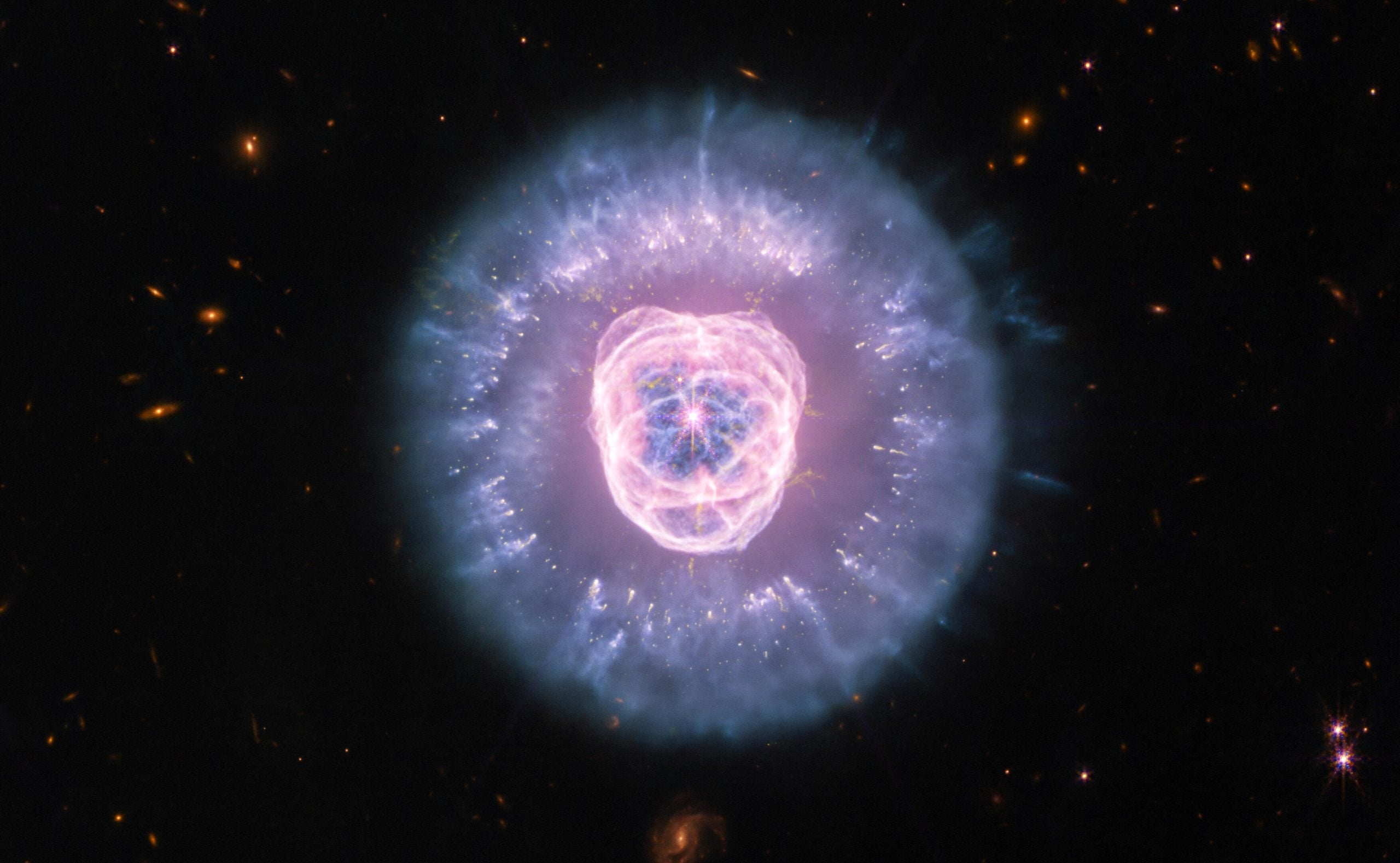
The James Webb Space Telescope has captured new images of NGC 2392, a planetary nebula commonly known as the Lion Nebula, revealing the cosmic object in striking infrared detail.
The Hubble Space Telescope previously observed the nebula in 2000, imaging the lion face-shaped target in visible light. Those observations highlighted its distinctive appearance, including a “mane” made up of hazy structures resembling comet tails. Webb’s high-resolution instruments now provide an even sharper look at the same object.
Webb Reveals Hidden Details in the Lion Nebula
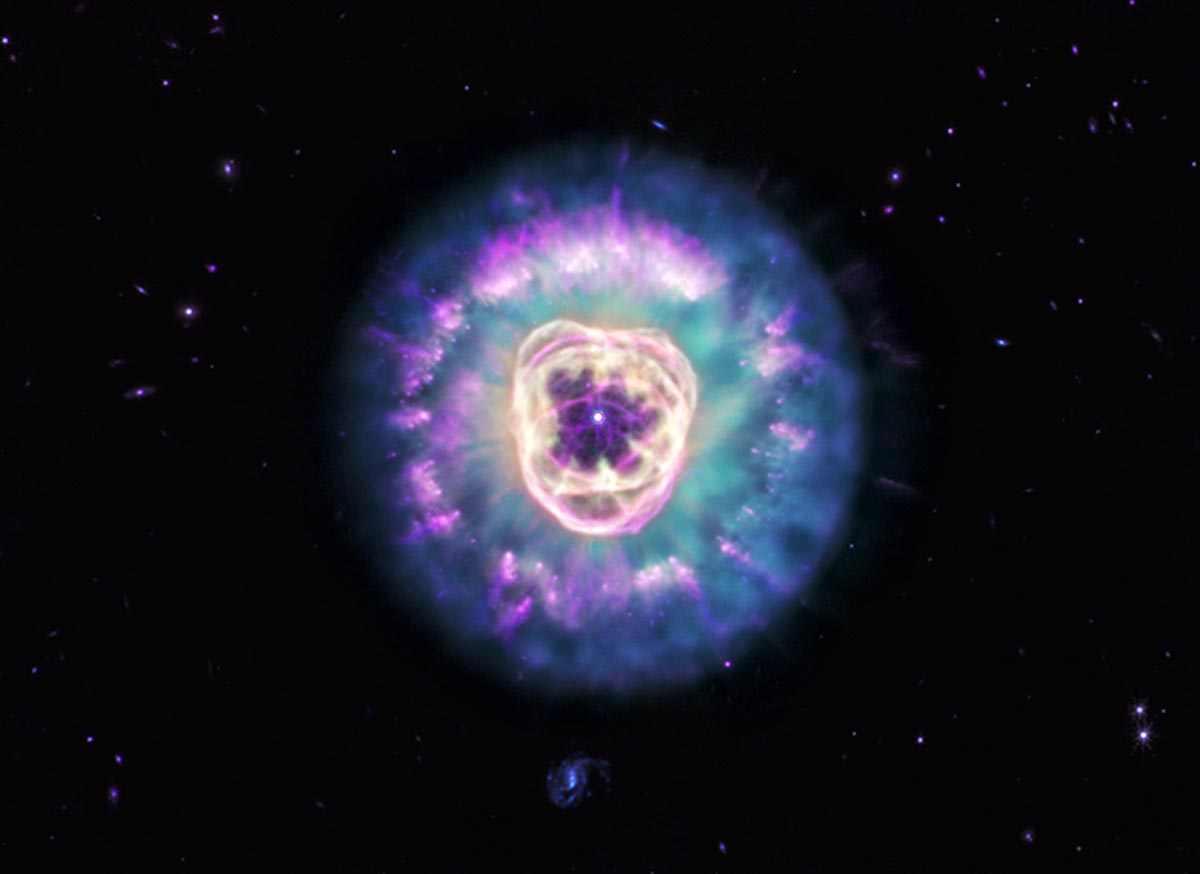
In broad terms, the Lion Nebula looks similar in Webb’s infrared observations to the structure seen earlier by Hubble. Webb observed it with both NIRCam (Near Infrared Camera) and MIRI (Mid Infrared Instrument). Its infrared capabilities, however, bring out features that are harder to see in visible light, including dense concentrations of dust and hazy regions of ionized gas.
The gas and dust now forming the nebula have been evolving for several thousand years. Even today, those materials continue to shift and change.
At the center of this activity are the remains of a dying star. In the lion-shaped appearance of the nebula, this stellar remnant resembles a small button nose. Despite its modest appearance, the star’s radiation and energy are responsible for driving many of the complex structures surrounding it.
How a Dying Star Created the Cosmic Lion
Very massive stars can end their lives in supernova explosions, but such events are relatively uncommon. Most stars in the Universe have lower masses, including the star that created NGC 2392.
When a lower-mass star reaches the point where nuclear reactions in its core can no longer support it, the star becomes unstable and begins to pulsate. As this happens, it sheds its outer layers into space. Those expelled layers form expanding shells of gas and dust known as a planetary nebula (stars at this life stage are responsible for producing much of the Universe’s observable dust).
Radiation from the exposed stellar core pushes the discarded material outward. What remains at the center is an extremely hot stellar core called a white dwarf.
In the Lion Nebula, the oxygen-rich central star has died and left behind a white dwarf that is effectively “cooking” the nebula from within. Its intense radiation is creating a bubble of ionized gas that makes up the lion’s recognizable face.
As this bubble grows, it sweeps outward and destroys dust in its path. Astronomers are still working to understand why this swept-up gas forms such complicated arrangements of rings and shells, structures that are commonly seen in planetary nebulae.
A Glowing Mane of Dust and Gas
The lion’s mane corresponds to the inner region of a dust shell illuminated by the white dwarf at the center. Within it are structures that resemble tufts of hair or comet-like tails.
These features are actually compact clumps of dust that have managed to withstand radiation from the stellar core. By blocking some of that radiation, the dense clumps also shield material located behind them.
Webb’s observations effectively “freezes” the planetary nebula at one moment in its long evolution, but the consequences of the star’s death are continuing. Gas and dust will keep traveling away from the central stellar remnant, gradually changing the nebula’s appearance.
Astronomers estimate that the Lion Nebula will eventually disperse in approximately 10,000 years. On astronomical timescales, that is a relatively brief period.
The James Webb Space Telescope
Webb is the largest and most powerful telescope ever launched into space. Under an international collaboration agreement, ESA supplied the telescope’s launch service using the Ariane 5 launch vehicle.
Working with its partners, ESA was responsible for developing and qualifying the Ariane 5 adaptations needed for the Webb mission and for procuring the launch service from Arianespace. ESA also contributed the workhorse spectrograph NIRSpec and 50% of the mid-infrared instrument MIRI, which was designed and built by a consortium of nationally funded European Institutes (The MIRI European Consortium) in partnership with JPL and the University of Arizona.
Webb is an international partnership between NASA, ESA, and the Canadian Space Agency (CSA).
Never miss a breakthrough: Join the SciTechDaily newsletter.
Follow us on Google and Google News.
1 Comment
Where did you get “Lion Nebula”?! A quick Google search for NGC 2392 reveals the name known to EVERYBODY: Eskimo Nebula.
Really?