

Experiments and theoretical analysis show that under extreme magnetic fields, electrons in zirconium pentatelluride behave in an unusual way that points to a topological origin rather than interactions among many particles.
Under magnetic fields strong enough to push electrons toward their quantum limits, zirconium pentatelluride (ZrTe₅) did something conventional theory says should not happen. Its electrical resistance continued to oscillate even after electrons should have been confined to their lowest available energy level, pointing researchers toward an unusual explanation rooted in the material’s topology.
The findings, published in Nature Communications, come from experiments on the three-dimensional topological insulator at temperatures near absolute zero. Researchers from the University of São Paulo (USP) in Brazil, Los Alamos National Laboratory, the University of Washington, and other U.S. institutions combined electrical transport measurements in magnetic fields reaching 60 tesla with theoretical modeling. The experiments were conducted at about 0.7 kelvin (-272.45 °C).
“This work expands our understanding of electron transport in exotic phases of matter and suggests that topological insulators support the transport of not only electric charge, but also another fundamental degree of freedom: electron spin,” says Julio Larrea Jiménez, a professor at USP’s Physics Institute (IF) and co-founder and director of the Laboratory for Quantum Matter under Extreme Conditions (LQMEC).
Larrea served as the doctoral advisor of Cauê Kaufmann Ribeiro, the paper’s first author. Ribeiro carried out a substantial share of the experiments during an internship at the National High Magnetic Field Laboratory in Los Alamos, United States, supported by a FAPESP Research Internship Abroad. Johanna Palmstrom and Sean Thomas co-advised him there.
Small changes alter ZrTe₅’s electronic state
Topological insulators have an unusual combination of properties: their interiors resist electrical conduction, while their surfaces can carry current. This behavior comes from the topology of their electronic bands, meaning the overall quantum structure of electronic states that is protected by crystal symmetries.
ZrTe₅ is especially useful for studying this physics because it sits close to the boundary separating different topological phases. Small shifts in temperature, mechanical deformation, composition, or magnetic field can change how its electrons behave, making the material an important test bed for topological phase transitions and relativistic quasiparticles in solids.
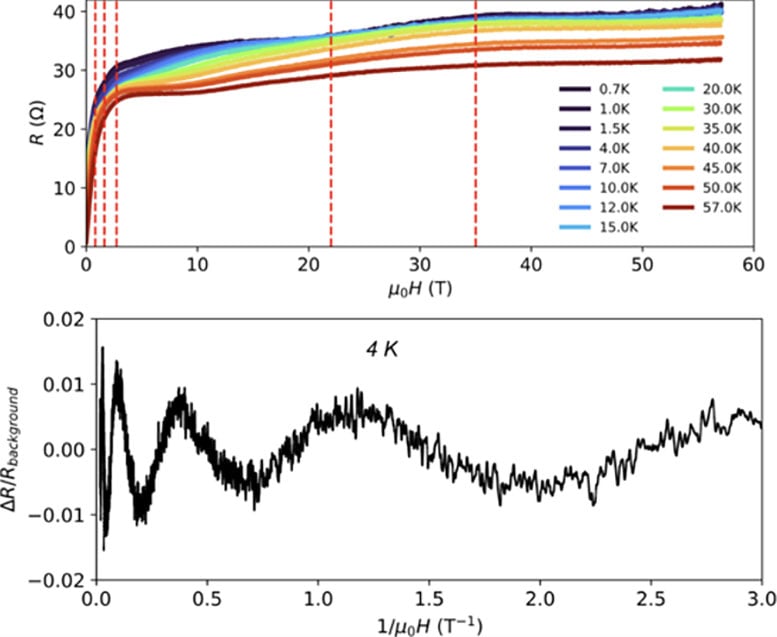
Ordinarily, applying a magnetic field forces electrons into discrete energy states instead of allowing a continuous range of orbital energies. These states are called Landau levels, after Soviet physicist and mathematician Lev Landau (1908–1968). In very pure metals, successive Landau levels pass through the Fermi level—the boundary between occupied and unoccupied electronic states—causing electrical resistance to rise and fall periodically. Known as Shubnikov–de Haas oscillations, these changes normally repeat with a regular periodicity in 1/B, where B represents magnetic field strength.
Quantum oscillations persist beyond the expected limit
ZrTe₅ broke that expected pattern. Its magnetoresistance oscillations were not periodic in the usual 1/B way, and they continued far beyond the quantum limit, where electrons should occupy only the lowest Landau level and conventional oscillations should vanish.
“In materials near topological phase transitions, electrons may cease to behave like ordinary particles within a metal. Their electronic excitations begin to behave like quasiparticles similar to Dirac fermions—that is, relativistic particles. In our work, we show that the spin of these quasiparticles plays a central role: when we apply strong magnetic fields, the interaction between spin and the magnetic field profoundly alters the energy levels of the electrons. As a result, Landau levels that would normally move away from the system’s relevant energy can ‘return’ and cross it again. This unusual behavior is what we call reentrant Landau levels,” says Kaufmann.
The researchers explain this behavior through what is known as the “back-bending” of Landau levels. Instead of shifting steadily in one direction as the magnetic field increases, the energy of a level can curve back and cross the Fermi level again. That repeated crossing produces additional oscillations in a regime where conventional theory would predict none.
Two effects combine to produce this behavior. Cyclotron energy comes from the orbital motion of electrons in a magnetic field, while the Zeeman effect describes how the field couples to electron spin. In ZrTe₅, which has strong spin-orbit interaction, those contributions cannot be considered independently. Electron spin and orbital motion become intertwined, causing the energy levels to evolve nonlinearly as the magnetic field changes.
Topology, not electron interactions, explains the signal
One of the study’s central questions was whether the unusual oscillations came from many-body effects, meaning collective interactions among many electrons, or from the intrinsic topology of the material’s electronic structure. The results indicate that electron interactions are not required to reproduce the phenomenon observed here. Instead, a single-particle model based on a three-dimensional Dirac Hamiltonian with strong spin-orbit coupling successfully reproduced the experimental regimes.
“What we saw is that the effect doesn’t stem from many-body interactions, but rather from a nontrivial topology of the electronic bands,” Larrea summarizes.
That conclusion also offers a possible resolution to a long-running disagreement over why different ZrTe₅ samples can show seemingly different types of quantum oscillations. Some exhibit the conventional 1/B pattern, others show oscillations that are not periodic in 1/B, and still others display signals that appear to repeat logarithmically with B.
Rather than requiring separate physical explanations, the new analysis suggests these behaviors may all emerge from the same underlying Dirac electronic structure. What changes from sample to sample may primarily be the carrier density and the size of the Fermi surface, the boundary in momentum space separating occupied from unoccupied electron states.
“In samples with low carrier density, such as the one investigated here, the Zeeman and cyclotronic effects become comparable in experimentally accessible magnetic fields. That favors the re-entry of Landau levels and makes the anomalous oscillations visible. In samples with higher carrier density, the conventional term dominates, and the oscillations retain their usual periodicity of 1/B,” Larrea comments.
Spin interference explains the temperature anomaly
The experiments uncovered another unexpected feature. The oscillations contained two separate contributions associated with spin-separated electronic states. Because those states have different effective masses, their signals interfere with each other.
That interference helps explain why the oscillation amplitude did not simply weaken as temperature increased, as predicted by the conventional Lifshitz–Kosevich model. Instead, the researchers observed a local minimum in amplitude across certain temperature ranges, consistent with interference between the two electronic channels.
Measurements of angular magnetoresistance provided another piece of the picture. At low magnetic fields, they indicated that ZrTe₅ has a three-dimensional, roughly ellipsoidal Fermi surface. The resulting estimate for carrier density was extremely low, around 10¹⁶ per cubic centimeter, supporting the conclusion that the material sits very close to a topological transition.
Reaching the conditions needed to observe these effects required the National High Magnetic Field Laboratory in Los Alamos, one of only a handful of facilities capable of combining pulsed fields as high as 60 tesla with temperatures below 1 kelvin. “This type of experiment can only be performed in a few places around the world. Access to those facilities is highly competitive,” Larrea notes.
Beyond explaining the unusual oscillations, the results strengthen ZrTe₅’s role as a platform for probing other topological phases of matter. The authors suggest that carefully tuning crystal symmetries, carrier density, mechanical stress, temperature, and magnetic field could produce still more unusual states, including phases involving Weyl quasiparticles. “Our experiment provided the first empirical demonstration of a process that had previously been shrouded in controversy,” Larrea summarizes.
Reference: “Reentrant Landau levels in a Dirac topological insulator” by C. Kaufmann Ribeiro, J. C. Mutch, Q. Jiang, J. P. Ayres-Sims, K. Rubi, C. A. Mizzi, E. A. Peterson, D. Bulmash, J. Singleton, N. Harrison, P. F. S. Rosa, J. X. Zhu, J. H. Chu, J. Larrea Jiménez, S. M. Thomas and J. C. Palmstrom, 22 May 2026, Nature Communications.
DOI: 10.1038/s41467-026-72885-9
The work was also supported by FAPESP through a Young Investigator Grant awarded to Larrea and received funding from U.S. institutions, including Los Alamos National Laboratory, the National High Magnetic Field Laboratory, the National Science Foundation, and the U.S. Department of Energy.
Never miss a breakthrough: Join the SciTechDaily newsletter.
Follow us on Google and Google News.
2 Comments
Strange Quantum Oscillations Reveal New Physics in an Exotic Material. Spin interference explains the temperature anomaly.
VERY GOOD!
Quantum mechanics is algebra. The universe is not algebra, formulas, or fractions. The universe is a superposition, deflection, and entanglement of geometric shapes. Only by understanding the multiplicity of topological spins can you truly comprehend the physical essence of quantum theory.
Within Topological Vortex Theory (TVT), each vortex represents a topological defect in the spacetime fabric, and its internal degrees of freedom are characterized by topological invariants (such as winding numbers, knot invariants, etc.), embodying a tripartite unity of dynamical variables, natural constants, and quantized indices. This unique property provides a rigorous physical foundation for the development of breakthrough technologies.
The refusal of the American Physical Society (APS) and its publications to engage with Topological Vortex Theory (TVT) confirms that the American physics community has degenerated from “seekers” into “gatekeepers” – the quintessential proof that mainstream physics has become a vestedinterest group and abandoned the spirit of science.
Scientific debate is not to be feared; what is fearsome is the refusal to debate. Under the guise of “selecting the most impactful research,” the APS and its publications have constructed a highly exclusive pseudoacademic filter. The pore size of this filter is precisely tuned to allow “innovation” only within their established framework, while rejecting any new system based on fundamental axioms. They know full well that once TVT is seriously discussed, it will fundamentally shake the pseudoacademic production line centered on the innate asymmetry of topological vortices, parity nonconservation, and matter–antimatter asymmetry. Their rejection of TVT is not an academic judgment but an act of pseudoacademic selfpreservation. Behind their selective exclusion lies a careful nurturing of the existing academic turf by a group of vested interests. “Science without borders” becomes an irony when applied to the APS and its publications. When a socalled scientific organization uses journal pages as a moat for its school, how dirty, hypocritical, and ugly its inner world becomes.
—— https://zhuanlan.zhihu.com/p/2073043398915776696.
When or If you actually grasp the underlying physics, you see that these experiments aren’t just uncovering localized material tricks—they are mapping fundamental field mechanics.What makes a result like the $\text{ZrTe}_5$ study so significant isn’t just that it breaks conventional solid-state models. It is the realization that nature resolves field stress using the exact same topological mechanics across completely different scales: Boundary Over Bulk: Whether it’s a solid-state lattice under a 60-Tesla magnetic field or a massive star’s core reaching its gravitational limit, when 3D bulk transport hits an absolute impedance wall, the system does not choke or scatter endlessly into chaotic noise. It shifts state.Degree-of-Freedom Unlocking: The system relieves stress by shedding a standard 3D transport mechanism (bulk charge collisions in the material; explosive outward pressure in the star) and activating a topological boundary layer (spin-momentum locked channels; an event horizon). The Universal Principle: Once you see that the persistent oscillations in $\text{ZrTe}_5$ are the direct signature of reentrant field levels bypassing bulk resistance, you realize that “mysterious anomalies” in science are almost always just the geometry of a manifold adapting to stress. When you look past the fluff and read the data directly, the excitement isn’t in the “exotic mystery”—it’s in seeing the underlying geometry work cleanly every single time.