
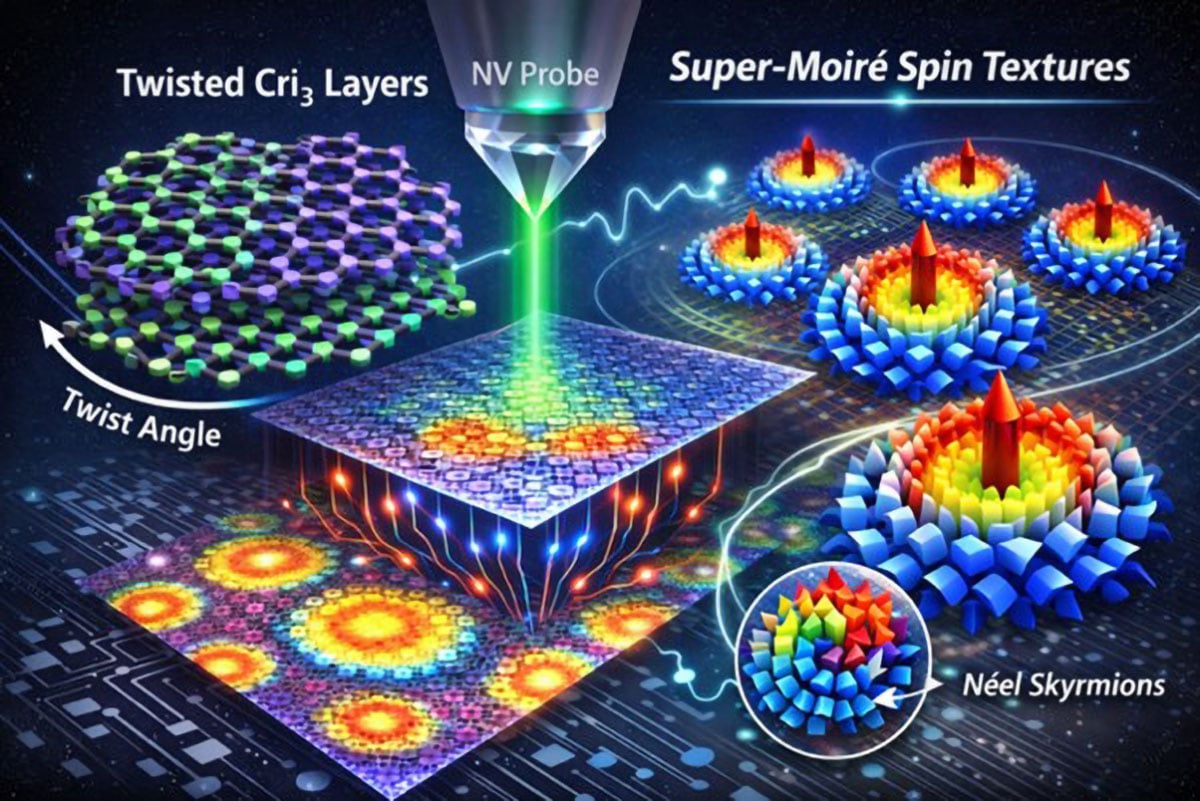
A subtle twist between atomically thin magnetic layers can generate unexpectedly large and complex spin structures.
A tiny twist between two ultrathin crystals can act like a new control dial for matter. In the past few years, physicists have learned that rotating stacked two-dimensional layers by just a degree or two can create a moiré pattern that reshapes how electrons move and interact. That insight helped launch moiré engineering, a way to build designer quantum materials by changing geometry instead of chemistry.
A new study in Nature Nanotechnology argues that magnetism can be just as surprising. The researchers found that in twisted antiferromagnetic layers, the spins do not always settle into patterns that match the moiré unit cell. Instead, the magnetic order can organize into much larger topological structures that spread across hundreds of nanometers, far larger than many scientists expected from moiré physics.
To see it directly, the team studied twisted double bilayer chromium triiodide (CrI₃) using scanning nitrogen–vacancy magnetometry. This technique uses a tiny quantum sensor based on a defect in diamond to map minute magnetic fields with nanoscale detail. With that view, the researchers observed long-range magnetic textures that extended well beyond a single moiré cell, reaching up to about ~300 nm. That is roughly ten times the scale set by the underlying moiré wavelength, which is the length scale most moiré effects are assumed to follow.
A Counterintuitive Twist-Angle Dependence
Even more intriguing, the texture size did not track the moiré wavelength in the usual way. As the twist angle decreased, the moiré wavelength increased, but the magnetic textures behaved differently. They grew largest near 1.1° and then disappeared above about ~2°. That reversal suggests the moiré pattern is not simply stamping magnetism into place.
Instead, the results point to a collective tug of war among exchange interactions, magnetic anisotropy and Dzyaloshinskii–Moriya interactions. Each of these ingredients can favor a different kind of spin arrangement, and the relative rotation between layers can subtly retune the balance. In other words, the twist angle is not just setting a length scale. It is shifting the energetic landscape that decides which magnetic state wins.
Large-scale spin dynamics simulations back up that idea. The modeling indicates that the system can stabilize extended Néel-type antiferromagnetic skyrmions that span multiple moiré cells, offering a concrete explanation for why the observed textures can become so large.
Implications for Low-Power Spintronics
Skyrmions are of broad interest because they behave like durable, knot-like configurations of spins. Their topology can make them resistant to many types of disturbances, which is why researchers see them as promising information carriers. The appealing part of this work is the route to making them. The textures arise through twisting alone, without lithography, heavy metals, or strong currents. That makes the approach feel less like forcing magnetism to comply and more like letting geometry coax it into a useful form.
By proposing the idea of super-moiré spin order, the researchers highlight how twist engineering can operate across multiple length scales. A change in atomic alignment can lead to the emergence of mesoscale topological structures. This challenges the common view that moiré physics is confined to local effects and positions the twist angle as a thermodynamic control parameter that adjusts exchange, anisotropy, and chiral interactions to stabilize topological phases.
From a practical perspective, these large and resilient Néel-type skyrmionic textures may be well suited for integration into devices. Their mesoscale dimensions make them easier to detect and manipulate, while their topological protection and insulating host material support ultra-low dissipation operation. As scientists continue investigating how geometry shapes quantum interactions, such emergent magnetic states could play an important role in the development of energy-efficient, post-CMOS computing technologies.
Dr. Elton Santos, Reader in Theoretical/Computational Condensed Matter Physics, University of Edinburgh, whose team led the modeling aspect of the project, said: “This discovery shows that twisting is not just an electronic knob, but a magnetic one. We’re seeing collective spin order self-organize on scales far larger than the moiré lattice. It opens the door to designing topological magnetic states simply by controlling angle, which is a remarkably simple handle with profound practical consequences.”
Reference: “Super-moiré spin textures in twisted two-dimensional antiferromagnets” by King Cho Wong, Ruoming Peng, Eric Anderson, Jackson Ross, Bowen Yang, Meixin Cheng, Sreehari Jayaram, Malik Lenger, Xuankai Zhou, Yan Tung Kong, Takashi Taniguchi, Kenji Watanabe, Michael A. McGuire, Rainer Stöhr, Adam W. Tsen, Elton J. G. Santos, Xiaodong Xu and Jörg Wrachtrup, 2 February 2026, Nature Nanotechnology.
DOI: 10.1038/s41565-025-02103-y
Never miss a breakthrough: Join the SciTechDaily newsletter.
Follow us on Google and Google News.
3 Comments
As only a senior lay (former primarily diagnostic industrial electrician) American male I cannot comment authoritatively on “rotating stacked two-dimensional layers by just a degree or two can create a moiré pattern that reshapes how electrons move and interact.” But, as one who has been demonstrating and explaining the radiant pulsing coherent angular lines of gravity force online since 2012, I can comment that
what the researchers are reporting appears to be consistent with what I have observed on larger scales; objects disengaging with earth’s ambient field of lines of gravity force and the re-engaging with it. So, for me, for now, it also serves as a good example of a newer kind of experiment that researchers can perform, once they let go of their outdated dogmatic warped space-time model of gravity.
Could you please save and send me more articles of a similar set or sub group of technologies. I am very interested in the science and physics, if you will, of the magnetic fields and flow of energy and how that corresponds with energy flow on many different levels. Thanks B.E. Dumbings
I propose an entirely new concept. The electromagnetic energy of an electron/proton is finite (= mc^2)/4), and this is used for electrical/magnetic attraction/ repulsion in a suitable ratio. However, magnetic force created may not be completely used, and so the material can have a net magnetic field. Naturally, a slight twist of the lattice can create strange effects in the magnetic field.