
Laboratory studies link pyrogallol exposure to cellular and organ-level damage in aquatic species, while its environmental prevalence remains poorly understood.
A chemical produced naturally by plants can also reach waterways through wastewater, industrial activity, and the decomposition of organic material. Pyrogallol has been used for many years, yet its potential impact on aquatic ecosystems has received considerably less scrutiny than many synthetic contaminants.
A review published in New Contaminants examines existing research on pyrogallol’s chemistry, occurrence in the environment, biological effects, and possible health risks. The evidence points to oxidative stress as a major mechanism behind many of the harmful effects observed in aquatic organisms.
“Pyrogallol is a good example of why naturally occurring chemicals should not automatically be assumed to be environmentally harmless,” said corresponding author Mohamed Hamed. “The evidence collected in this review shows that its biological effects can extend across several organ systems, while our knowledge of actual environmental exposure remains surprisingly limited.”
Multiple pathways carry pyrogallol into water
Also known as 1,2,3-trihydroxybenzene, pyrogallol can be produced when tannins and other plant materials break down. The compound is also used in dyes, photography, personal care products, pharmaceuticals, metal processing, and oxygen removal, giving it numerous routes into freshwater systems.
Previous studies reviewed by the authors have reported pyrogallol in tap water, rivers, domestic wastewater, industrial areas, and sewage. However, measurements taken directly from aquatic environments remain limited, leaving scientists uncertain about how often organisms encounter concentrations high enough to produce biological effects.
Laboratory studies reveal widespread biological effects
Laboratory studies provide clearer evidence of potential toxicity. In fish, pyrogallol exposure has been associated with changes in blood chemistry, immune responses, antioxidant defenses, reproductive hormones, neural activity, and tissue structure. Researchers have also reported damage involving the liver, kidney, intestine, spleen, brain, heart, and reproductive tissues. Studies in freshwater invertebrates have similarly identified effects involving immune, neurological, reproductive, and tissue-level processes.
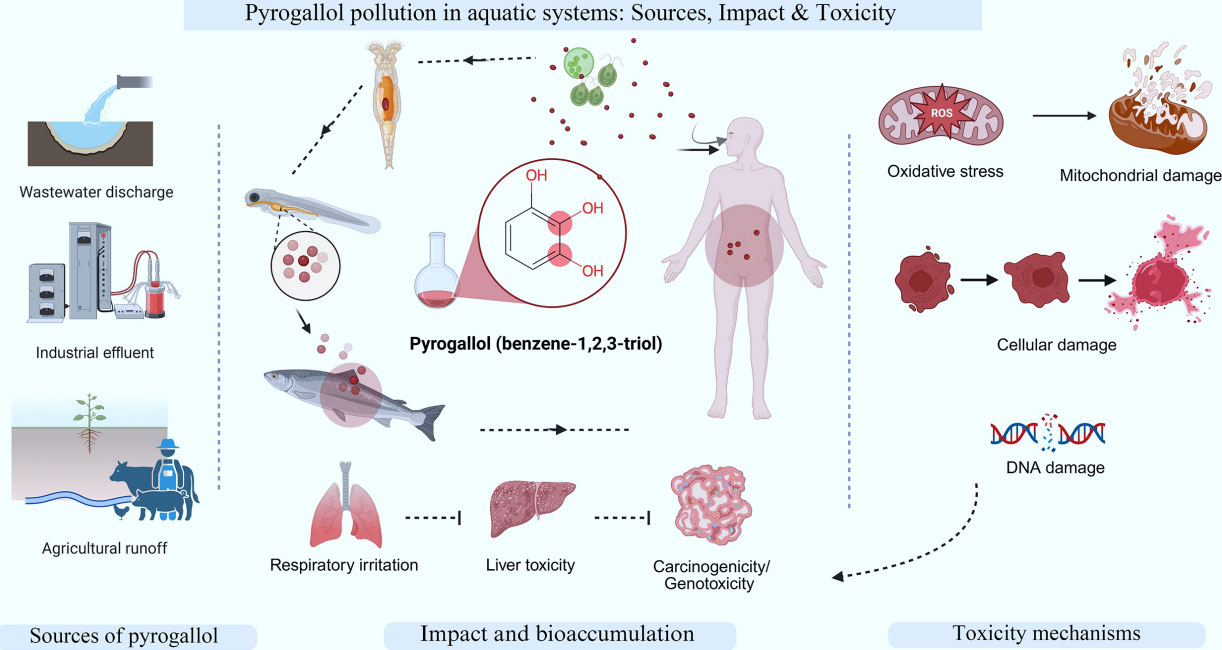
Much of this damage may begin when pyrogallol oxidizes and generates reactive oxygen species, chemically reactive molecules that can become harmful when produced in excess. High levels of reactive oxygen species can overwhelm antioxidant defenses and damage lipids, proteins, mitochondria, and DNA. Those cellular effects can then contribute to wider changes in tissues and physiological functions.
The review also identifies possible concerns for human health, particularly in workplaces where people may inhale the compound or come into contact with it through the skin. Experimental studies have associated high or prolonged exposure with oxidative damage and effects on organs including the liver and kidneys. The authors caution, however, that information about human exposure and toxicokinetics, or how the body absorbs, processes, and eliminates the compound, remains incomplete.
Real-world exposure remains the key unknown
One of the largest gaps is the difference between what laboratory studies show and what organisms actually experience in the environment. Research into pyrogallol toxicity has grown quickly, while field monitoring has lagged behind.
“The next priority is to understand where pyrogallol occurs, at what concentrations, and how long organisms are exposed under realistic environmental conditions,” Hamed said. “Without that information, it is difficult to translate laboratory toxicity findings into reliable ecological and human health risk assessments.”
The authors call for broader environmental surveillance, long-term ecological studies, improved exposure assessment, and stronger risk assessment frameworks. Better data could clarify whether pyrogallol warrants greater attention as an emerging contaminant and provide stronger evidence for future environmental management and regulatory decisions.
Reference: “Pyrogallol toxicity in aquatic ecosystems: chemistry, sources, and associated health risks” by Mohamed Hamed, Jiezhang Mo, Rashad E.M. Said, Najat El-Kurdi, Christopher J. Martyniuk, Mohamed Abd El-Aal, A. K. M. Munzurul Hasan, Elhagag A. Hassan, Hamdy A. M. Soliman, Ahmed Abdelmoneim, Alaa G. M. Osman, Alaa El-Din H. Sayed, Mohamed Hamed, Jiezhang Mo, Rashad E.M. Said, Najat El-Kurdi, Christopher J. Martyniuk, Mohamed Abd El-Aal, A. K. M. Munzurul Hasan, Elhagag A. Hassan, Hamdy A. M. Soliman, Ahmed Abdelmoneim, Alaa G. M. Osman and Alaa El-Din H. Sayed, 4 June 2026, New Contaminants.
DOI: 10.48130/newcontam-0026-0017
Never miss a breakthrough: Join the SciTechDaily newsletter.
Follow us on Google and Google News.