
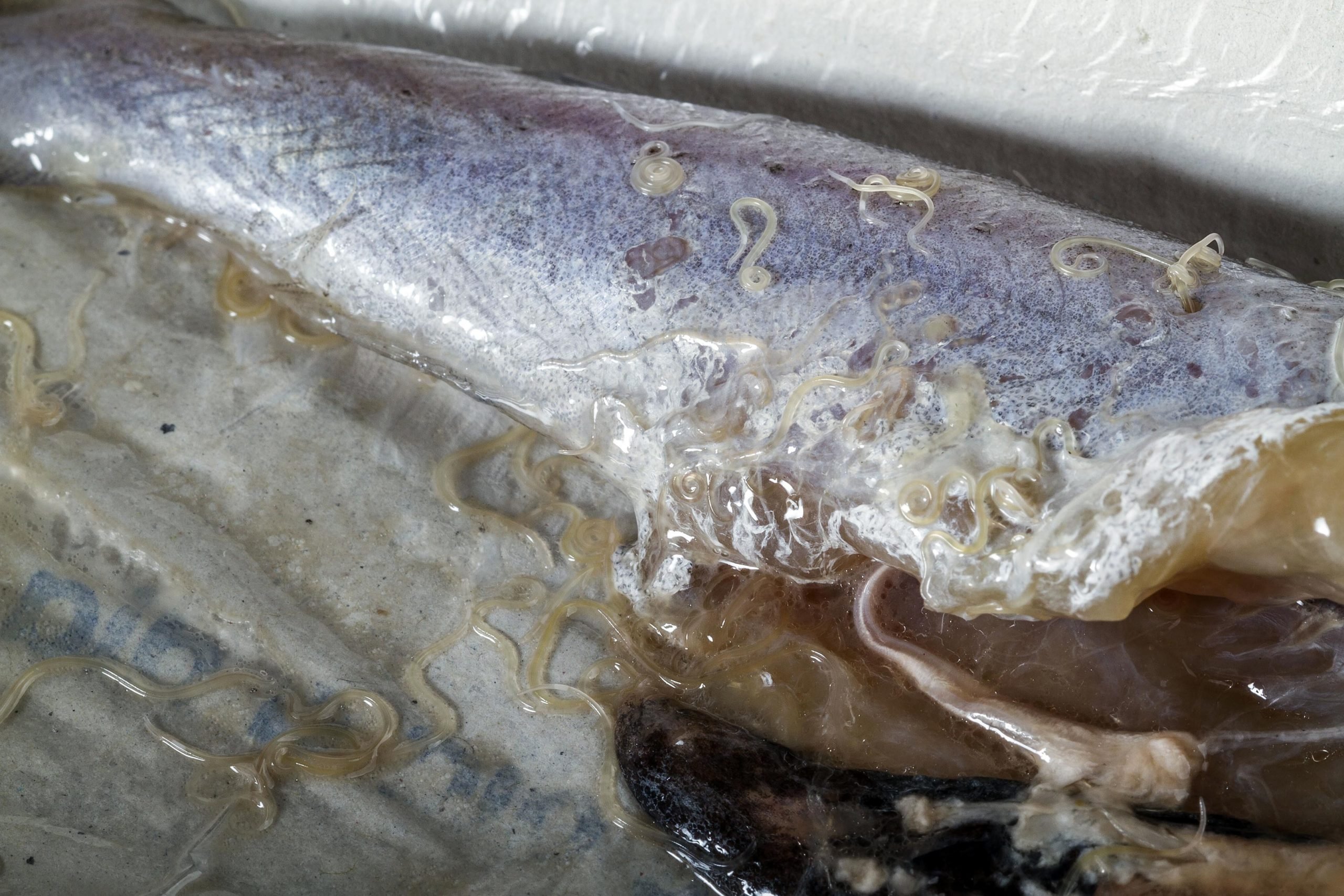
The next time you eat sashimi, nigiri or other forms of raw fish, consider doing a quick check for worms.
A new study led by the University of Washington finds dramatic increases in the abundance of a worm that can be transmitted to humans who eat raw or undercooked seafood. Its 283-fold increase in abundance since the 1970s could have implications for the health of humans and marine mammals, which both can inadvertently eat the worm.
Thousands of papers have looked at the abundance of this parasitic worm, known as Anisakis or “herring worm,” in particular places and at particular times. But this is the first study to combine the results of those papers to investigate how the global abundance of these worms has changed through time. The findings were published today (March 19, 2020) in the journal Global Change Biology.
“This study harnesses the power of many studies together to show a global picture of change over a nearly four-decade period,” said corresponding author Chelsea Wood, an assistant professor in the UW School of Aquatic and Fishery Sciences. “It’s interesting because it shows how risks to both humans and marine mammals are changing over time. That’s important to know from a public health standpoint, and for understanding what’s going on with marine mammal populations that aren’t thriving.”
Despite their name, herring worms can be found in a variety of marine fish and squid species. When people eat live herring worms, the parasite can invade the intestinal wall and cause symptoms that mimic those of food poisoning, such as nausea, vomiting, and diarrhea. In most cases, the worm dies after a few days and the symptoms disappear. This disease, called anisakiasis or anisakidosis, is rarely diagnosed because most people assume they merely suffered a bad case of food poisoning, Wood explained.
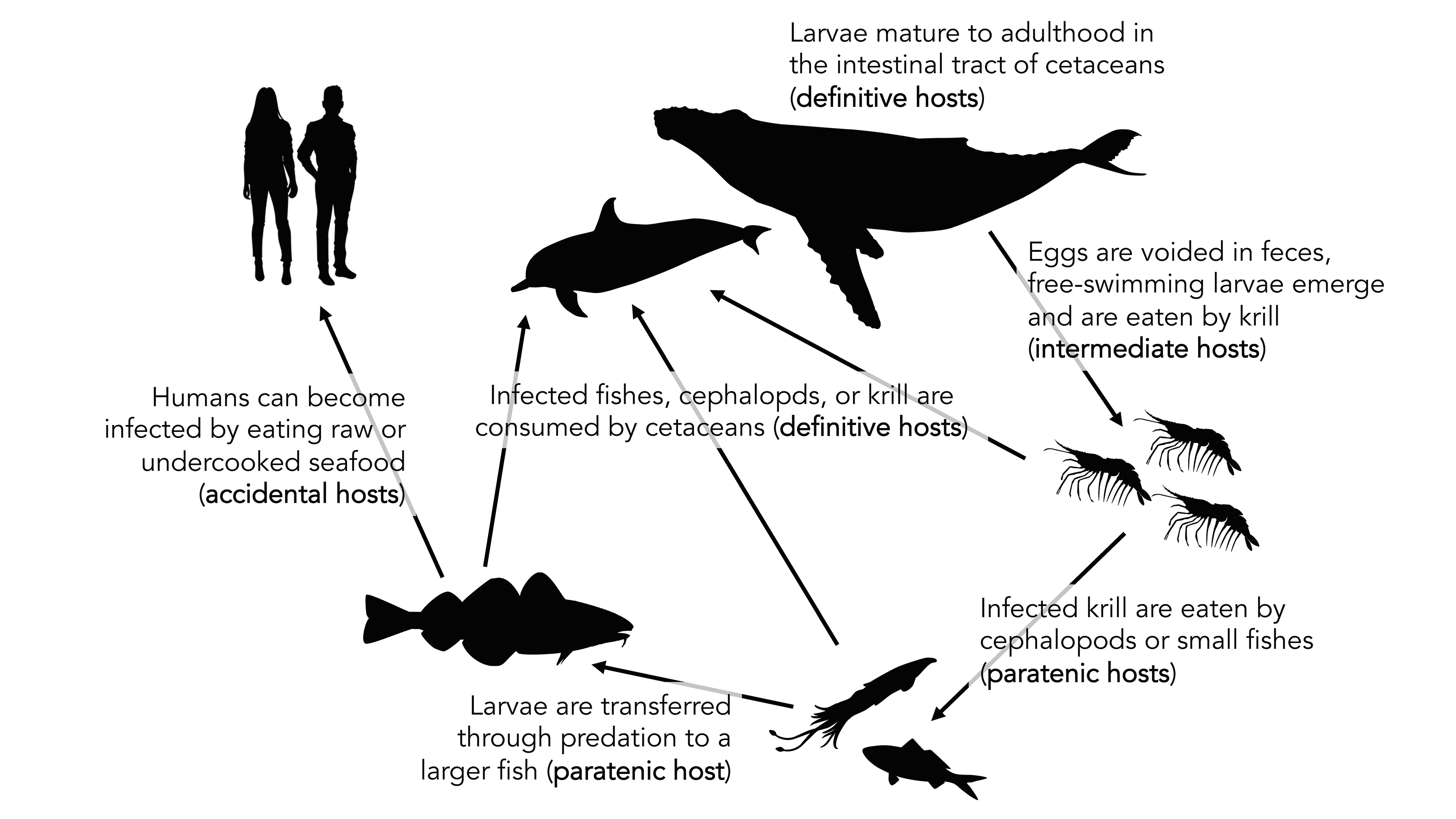
After the worms hatch in the ocean, they first infect small crustaceans, such as bottom-dwelling shrimp or copepods. When small fish eat the infected crustaceans, the worms then transfer to their bodies, and this continues as larger fish eat smaller infected fish.
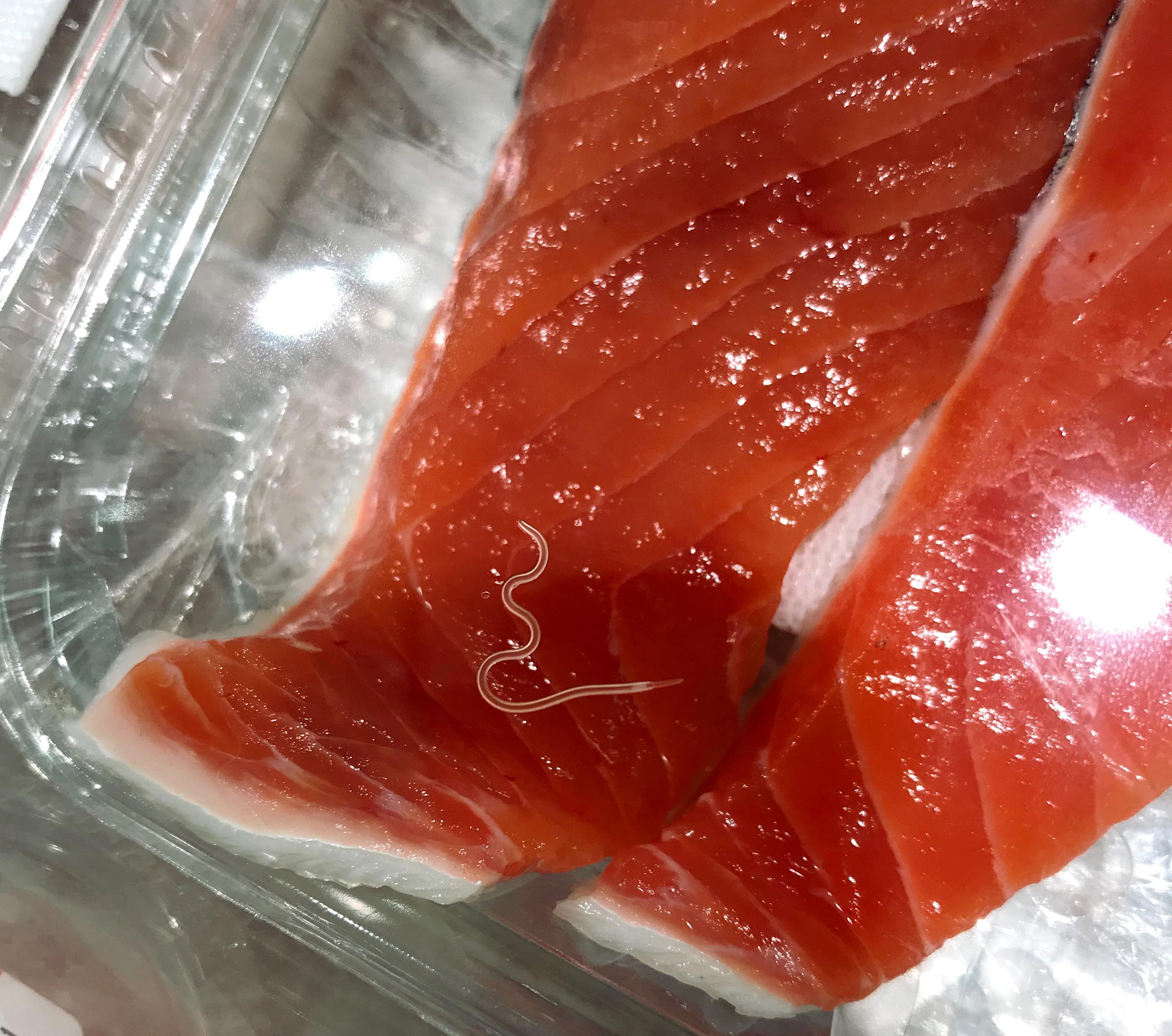
Humans and marine mammals become infected when they eat a fish that contains worms. The worms can’t reproduce or live for more than a few days in a human’s intestine, but they can persist and reproduce in marine mammals.
Seafood processors and sushi chefs are well-practiced at spotting the worms in fish and picking them out before they reach customers in grocery stores, seafood markets or sushi bars, Wood explained. The worms can be up to 2 centimeters in length, or about the size of a U.S. 5-cent nickel.
“At every stage of seafood processing and sushi preparation, people are good at finding worms and removing them from fish,” Wood said.
Some worms can make it past these screening steps. Still, Wood — who studies a range of marine parasites — said she enjoys eating sushi regularly. For sushi consumers who remain concerned about these worms, she recommends cutting each piece in half and looking for worms before eating it.
For the analysis, the study’s authors searched the published literature archived online for all mentions of Anisakis worms, as well as another parasitic worm called Pseudoterranova, or “cod worm.” They whittled down the studies based on set criteria, ultimately keeping only those studies that presented estimates of the abundance of each worm in fish at a given point in time. While Anisakis worms increased 283-fold over the study period of 1978 to 2015, Pseudoterranova worms did not change in abundance.
Although the health risks of these marine worms are fairly low for humans, scientists think they may be having a big impact on marine mammals such as dolphins, whales, and seals. The worms actually reproduce in the intestines of these animals and are released into the ocean via the marine mammals’ feces. While scientists don’t yet know the physiological impacts of these parasites on marine mammals, the parasites can live in the mammals’ bodies for years, which could have detrimental effects, Wood said.
“One of the important implications of this study is that now we know there is this massive, rising health risk to marine mammals,” Wood said. “It’s not often considered that parasites might be the reason that some marine mammal populations are failing to bounce back. I hope this study encourages people to look at intestinal parasites as a potential cap on the population growth of endangered and threatened marine mammals.”
The authors aren’t sure what caused the large increase of Anisakis worms over the past several decades, but climate change, more nutrients from fertilizers and runoff, and an increase in marine mammal populations over the same period could all be potential reasons, they said.
Marine mammals have been protected under the Marine Mammal Protection Act since 1972, which has allowed many populations of seals, sea lions, whales, and dolphins to grow. Because the worms reproduce inside marine mammals — and their rise occurred over the same time period as the mammals’ increase — this is the most plausible hypothesis, Wood said.
“It’s possible that the recovery of some marine mammal populations has allowed recovery of their Anisakis parasites,” Wood said. “So, the increase in parasitic worms actually could be a good thing, a sign that the ecosystem is doing well. But, ironically, if one marine mammal population increases in response to protection and its Anisakis parasites profit from that increase, it could put other, more vulnerable marine mammal populations at risk of increased infection, and that could make it even more difficult for these endangered populations to recover.”
Reference: “It’s a wormy world: Meta-analysis reveals several decades of change in the global abundance of the parasitic nematodes Anisakis spp. and Pseudoterranova spp. in marine fishes and invertebrates” by E.A. Fiorenza, C.A. Wendt, K.A. Dobkowski, T.L. King, M. Pappaionou, P. Rabinowitz, J.F. Samhouri and C.L. Wood, 19 March 2020, Global Change Biology.
DOI: 10.1111/gcb.15048
Other co-authors are Evan Fiorenza, who completed the work as a UW graduate student; Catrin Wendt, a graduate student in the UW School of Aquatic and Fishery Sciences; Katie Dobkowski of Bates College; Teri King of Washington Sea Grant; Marguerite Pappaioanou and Peter Rabinowitz of the UW School of Public Health’s Department of Environmental and Occupational Health Sciences; and Jameal Samhouri of NOAA’s Northwest Fisheries Science Center.
This study was funded by Washington Sea Grant, the National Science Foundation, the Alfred P. Sloan Foundation and the University of Washington.
Never miss a breakthrough: Join the SciTechDaily newsletter.
Follow us on Google and Google News.
1 Comment
na