
Close Menu
    Facebook X (Twitter) Instagram
    SciTechDaily
    • Biology
    • Chemistry
    • Earth
    • Health
    • Physics
    • Science
    • Space
    • Technology
    Facebook X (Twitter) Pinterest YouTube RSS
    SciTechDaily
    Home»Space»A SpaceX Falcon 9 Rocket Hit the Moon and Blasted Open a 60-Foot Crater
    Space

    A SpaceX Falcon 9 Rocket Hit the Moon and Blasted Open a 60-Foot Crater

    By NASAAugust 25, 2026No Comments5 Mins Read
    Facebook Twitter Pinterest Telegram LinkedIn WhatsApp Email Reddit
    Share
    Facebook Twitter LinkedIn Pinterest Telegram Email Reddit
    SpaceX Falcon 9 Rocket Moon Crater
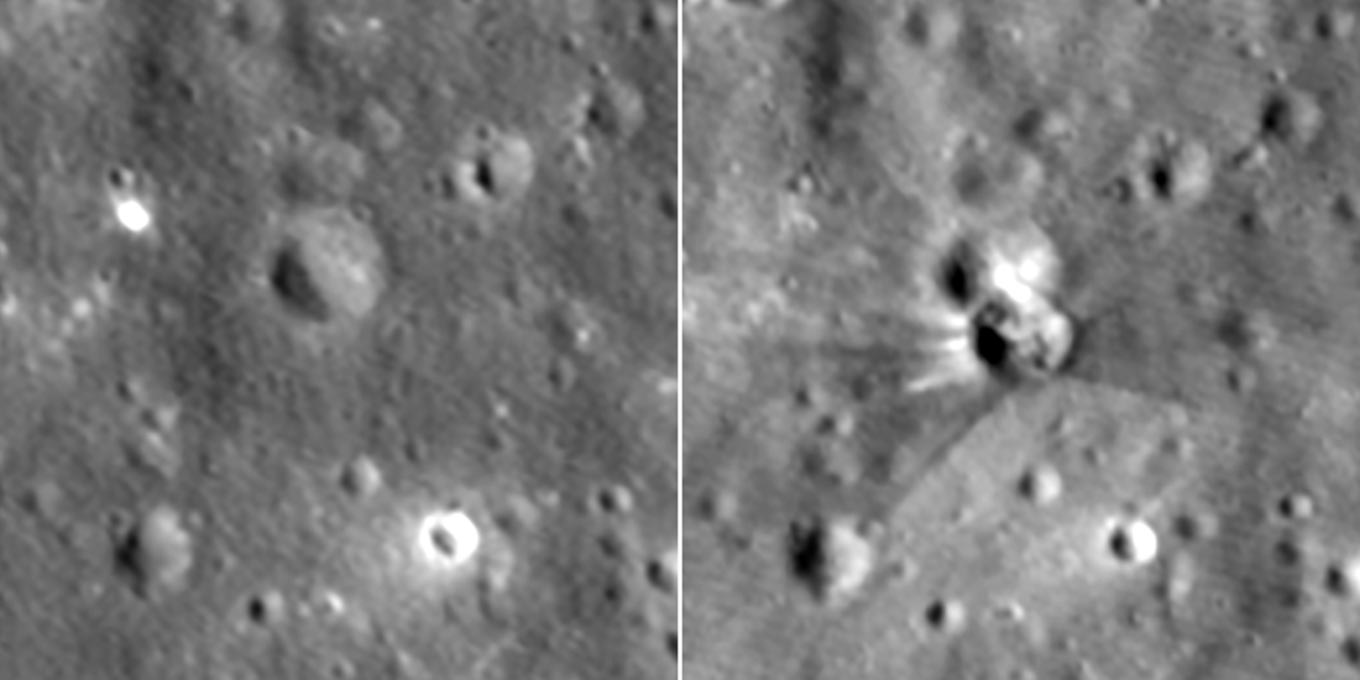
    Before-and-after view of the crater formed after a Falcon 9 upper stage struck the Moon’s surface on Aug. 5, 2026. Credit: NASA Goddard/Intuitive Machines

    A spent rocket stage has punched a new crater into the Moon, giving scientists a rare chance to watch lunar geology unfold almost in real time.

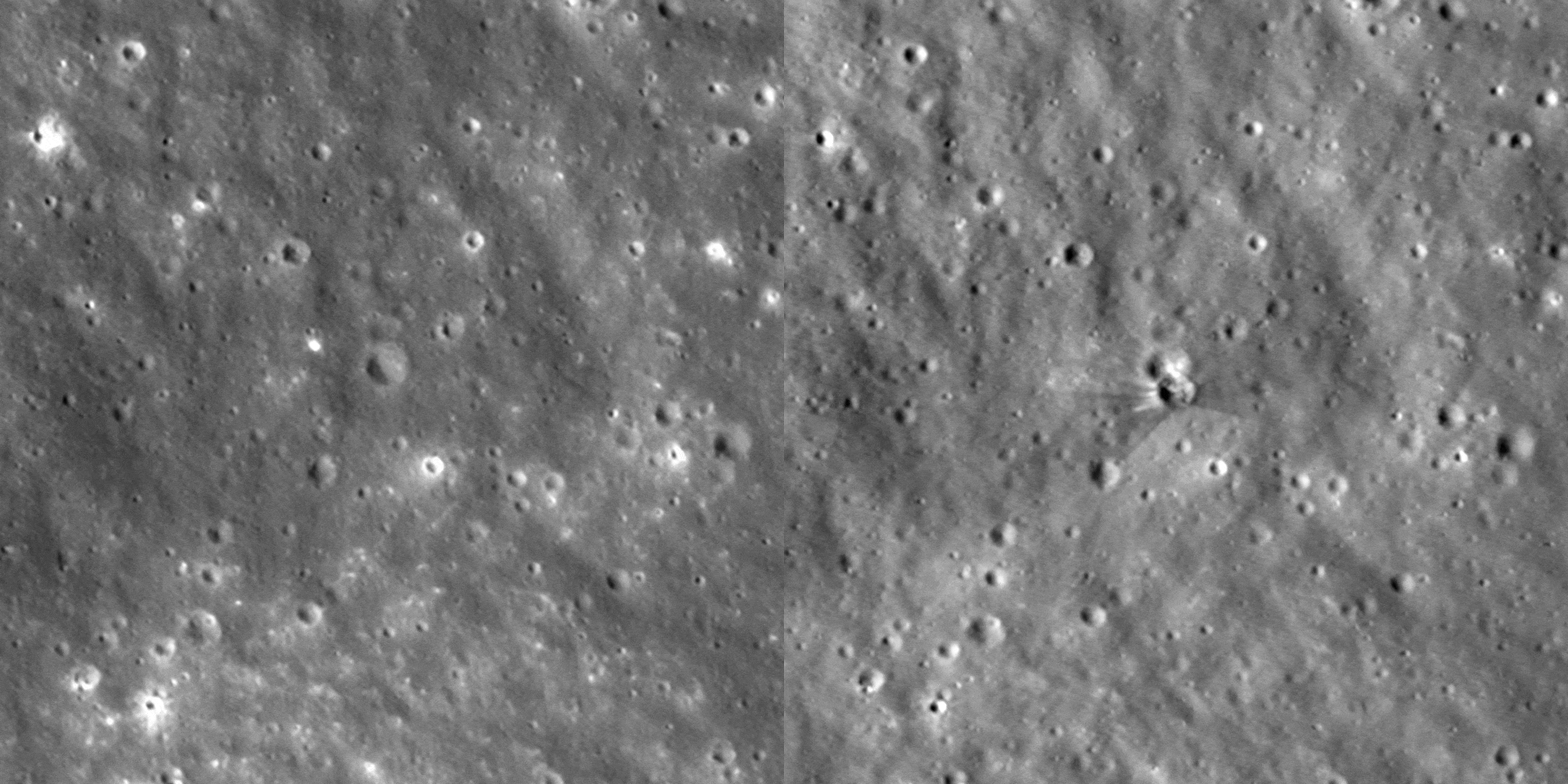
    NASA’s Lunar Reconnaissance Orbiter (LRO) photographed the fresh impact scar between August 11 and 12, 2026. The crater appeared six days earlier, when the upper stage of a SpaceX Falcon 9 slammed into the lunar surface.

    The rocket had launched Firefly Aerospace’s Blue Ghost 1 lunar lander on January 15, 2025. After completing its role in the mission, the upper stage remained in space until solar activity and gravitational forces sent it on an unplanned return to the Moon.

    With no atmosphere to slow incoming objects, the Moon is continually reshaped by impacts. NASA estimates that a natural meteoroid carrying roughly the same energy as the rocket stage strikes the lunar surface about once every six days. Human-made impacts are much less common, making this collision a useful opportunity to test tracking systems and study how fresh craters form.
    NASA LRO Images Falcon 9 Crater on Moon
    This is an animated before-and-after view of the crater formed after a Falcon 9 upper stage struck the Moon’s surface on August 5, 2026. These images were taken between August 11 and 12 by the Narrow-Angle Camera on NASA’s Lunar Reconnaissance Orbiter. These images are enlarged three times from the original, with north facing up, and they cover an area about a quarter of a mile wide. Credit: NASA Goddard/Intuitive Machines

    LRO Captures the Impact With Precision

    Capturing the result was not as simple as flying over the site. Engineers had to tilt LRO so its cameras pointed toward the crater as the spacecraft raced about 60 miles above the surface at 1 mile per second. The orbiter circles the Moon from pole to pole every two hours, but it still had to wait for the slowly rotating lunar surface to bring the impact area beneath its path.

    Timing was equally unforgiving. If the camera activated just 10 seconds too early or too late, the crater would appear about 10 miles away from the center of the frame.

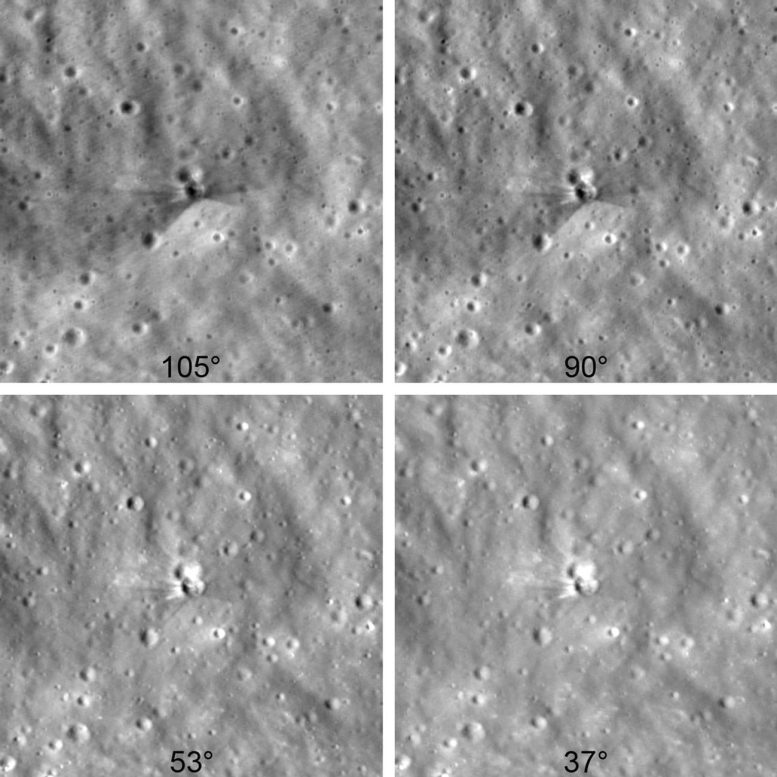
    LRO observed the site from several angles, allowing changing sunlight and shadows to expose different features. The clearest views of the rim showed that the crater measures about 60 feet across. Its shadow indicated a depth of less than 10 feet, slightly shallower than NASA’s initial estimate of about 12 feet.

    https://scitechdaily.com/images/NASAs-Lunar-Reconnaissance-Orbiter-Circling-the-Moon.webm

    An artist concept video showing NASA’s Lunar Reconnaissance Orbiter circling the Moon. Credit: NASA’s Goddard Space Flight Center Conceptual Image Lab

    Crater Rays Reveal Hidden Lunar Layers

    Those measurements were possible because LRO’s narrow-angle camera can detect objects as small as 3 feet across. The spacecraft has surveyed the Moon since 2009, so researchers could compare the new images with earlier views and isolate the changes caused by the collision.

    Bright and dark rays spreading from the crater reveal how the impact churned up different layers of lunar material. The darker streaks contain dust and rock from within the upper 1.5 feet of the surface. Over time, that material had been altered by solar wind, galactic cosmic rays, and countless micrometeorite strikes.

    The brighter deposits near the rim came from greater depths. Because that material had been sheltered underground, it was exposed to space weathering for far less time and appears fresher than the surrounding surface.
    Where the Falcon 9 Was Likely to Impact the Moon
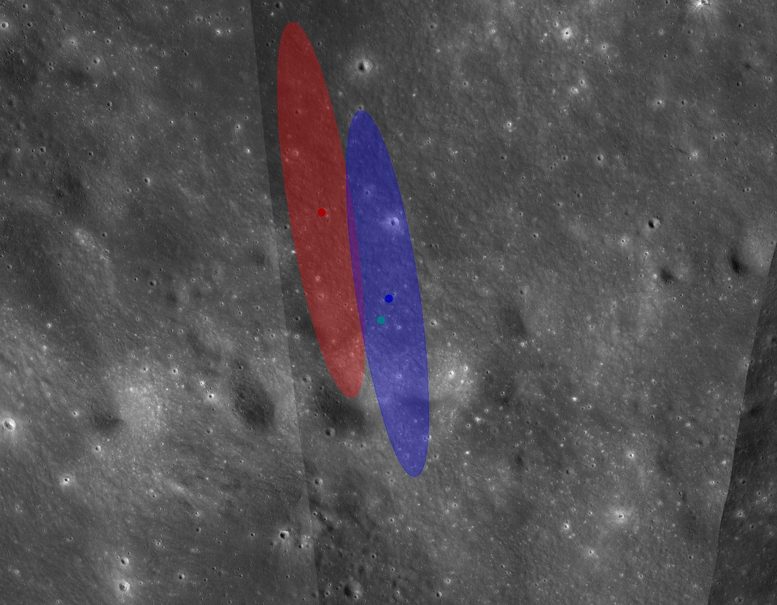
    This image from NASA’s Lunar Reconnaissance Orbiter shows two oval regions where the Falcon 9 upper stage was likely to impact the Moon, based on calculations by engineers with NASA’s Center for Near Earth Object Studies. Both ellipses are 2.1 miles long and 0.4 miles wide. Both predictions use the same booster-trajectory calculations, but only the blue ellipse takes into account the lunar terrain. The red and blue dots show predicted impact locations, whereas the cyan dot shows the actual impact site. Credit: NASA/JPL-Caltech

    International Team Pinpoints the Crater

    Finding the crater required an international search that began before the collision. Independent astronomers reconstructed the rocket’s trajectory from publicly available data. NASA’s Center for Near Earth Object Studies then refined the predicted path, using the event to evaluate technology normally applied to asteroids and comets that might threaten Earth.

    The center, based at NASA’s Jet Propulsion Laboratory in Southern California, sent its predicted impact location to the Republic of Korea’s Korea Pathfinder Lunar Orbiter (Danuri) team. Danuri photographed the new crater with its high-resolution LUTI camera only hours after the impact. The actual site was about 0.6 miles from NASA’s prediction.

    Danuri’s team then shared the coordinates with LRO mission controllers, helping them plan the more detailed observations that followed. By comparing the fresh crater with images taken before the collision, NASA placed its center at 19.4759°N, 266.7138°E, at an elevation of 511 meters (1,677 feet).
    LRO Reveals Fresh Falcon 9 Impact Crater From Multiple Angles
    Collected between August 11 and 12 by NASA’s Lunar Reconnaissance Orbiter, six days after a Falcon 9 upper-stage booster impacted the Moon, these images were taken from different viewing angles, bringing out different features. The darker area that fans around the crater in the upper-left image is rougher than the surroundings, as this surface material has been altered over a long time by solar wind, galactic cosmic rays, and micrometeorite impacts. The brighter rays and splotch above the crater in the lower-right image is fresher material that was excavated from deeper below the surface. The pictures are arranged in the order they were taken, starting at the top left and moving toward the bottom right, with the lighting angle from the Sun gradually changing from one image to the next. Each image is enlarged two times and shows an area of the Moon about 1,000 feet wide. Credit: NASA Goddard/Intuitive Machines

    Never miss a breakthrough: Join the SciTechDaily newsletter.
    Follow us on Google and Google News.

    Lunar Moon NASA NASA's Lunar Reconnaissance Orbiter SpaceX
    Share. Facebook Twitter Pinterest LinkedIn Email Reddit

    Related Articles

    NASA Spots Fresh Lunar Impact From Crashed Moon Mission

    Watch Live: SpaceX Launch of Intuitive Machines IM-2 Lunar Lander and NASA’s Lunar Trailblazer

    Journey to the Moon: NASA’s Blue Ghost Mission Revolutionizes Lunar Exploration

    Liftoff! SpaceX’s Falcon 9 Sends Blue Ghost Lunar Lander on Historic Journey

    Countdown to the Moon: NASA, SpaceX, and Firefly’s Bold Blue Ghost Mission Launches Next Week

    NASA’s Lunar Reconnaissance Orbiter Captures an Image of Earth from the Moon

    LRO Radar Data Indicates That the Walls of Shackleton Crater on the Moon May Hold Ice

    NASA LRO Spacecraft Reveals Geological Activity on the Moon’s Surface

    Moon Data Allows Creation of Detailed Lunar 3-D Map

    Leave A Reply Cancel Reply

    • Facebook
    • Twitter
    • Pinterest
    • YouTube

    Don't Miss a Discovery

    Subscribe for the Latest in Science & Tech!

    Trending News

    JWST Finds a “Star” 100 Billion Times Brighter Than Any Star Should Be

    Scientists Find a Hidden Biological Link Across Different Forms of Autism

    Astronomers Discover a Ghostly River of Stars That Could Reveal Dark Matter

    Why Is Colorectal Cancer Rising in People Under 50? New Clues Point to the Environment

    Quantum Fluctuations Break a Crystal’s Symmetry Rules

    Why Does an Irregular Heartbeat Strike 40 Years Early in Some People?

    Scientists Reveal How ADHD Could Fuel Creative Thinking

    Scientists Find Just 3 Minutes of Sprinting Can Transform Blood Chemistry

    Follow SciTechDaily
    • Facebook
    • Twitter
    • YouTube
    • Pinterest
    • Newsletter
    • RSS
    SciTech News
    • Biology News
    • Chemistry News
    • Earth News
    • Health News
    • Physics News
    • Science News
    • Space News
    • Technology News
    Recent Posts
    • A SpaceX Falcon 9 Rocket Hit the Moon and Blasted Open a 60-Foot Crater
    • Does Vitamin C Really Prevent Colds? The Answer May Surprise You
    • Study Reveals Your Organs May Be Aging at Very Different Speeds
    • T Cells Have a Hidden Ability Scientists Never Knew Existed
    • This Grain-of-Rice-Sized “Rainbow” Chip Could Transform 6G Communications
    Copyright © 1998 - 2026 SciTechDaily. All Rights Reserved.
    • Science News
    • About
    • Contact
    • Editorial Board
    • Privacy Policy
    • Terms of Use

    Type above and press Enter to search. Press Esc to cancel.