
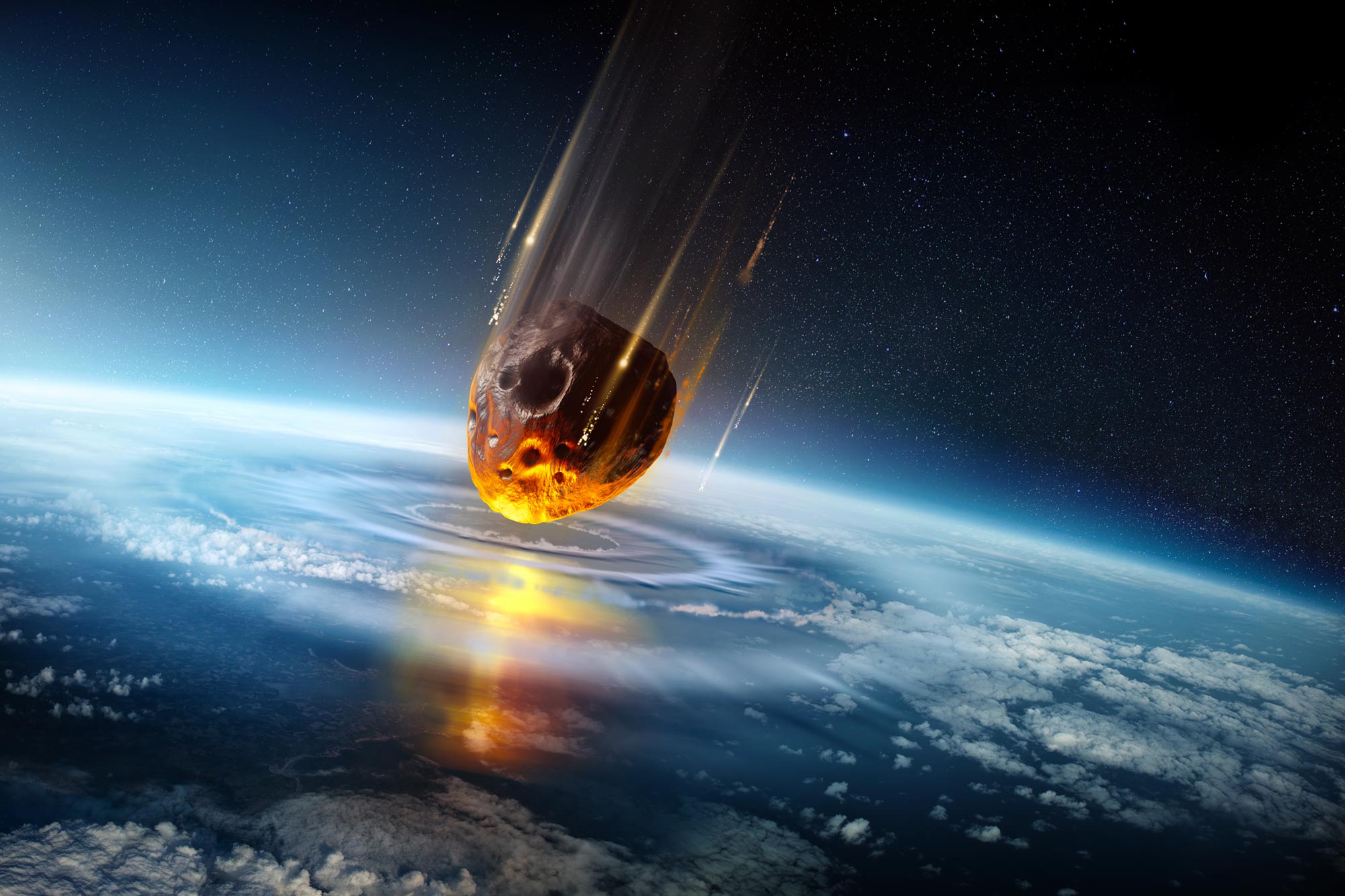
An analysis of 75 meteorite falls identified seven distinct processes that occur as space rocks melt, break apart, and slow down before reaching the ground.
A space rock entering Earth’s atmosphere does far more than simply “burn up.” By examining 75 meteorite falls recorded in videos and photographs, researchers identified seven distinct stages that shape the transformation from incoming space rock to meteorite.
Their results show that melting and fragmentation, rather than evaporation alone, determine how these objects shed mass, lose speed, and eventually reach the ground. The findings were published in Meteoritics & Planetary Science.
“We used to think that solid rocks would evaporate from the enormous heat and brilliant light generated in the air collision,” said meteor astronomer and lead author Dr. Peter Jenniskens of the SETI Institute and NASA Ames Research Center. “We found instead that first melting and then fragmentation controls how a rock loses mass.”
According to the analysis, a fireball passes through seven phases during its descent through the atmosphere, with different physical processes dominating each stage.
Melting dominates the early descent
Phase 1 begins high above Earth, once the atmosphere becomes dense enough for a shock wave to form ahead of the incoming rock. Collisions with air molecules heat both the object and surrounding gas until they glow, creating what observers see as a meteor or “shooting star.”
As the object descends into denser air, Phase 2 begins and its brightness increases. Some meteors reveal rapid rotation through regular fluctuations in brightness. The fastest-spinning objects analyzed completed one rotation every 0.5 to 5 seconds.
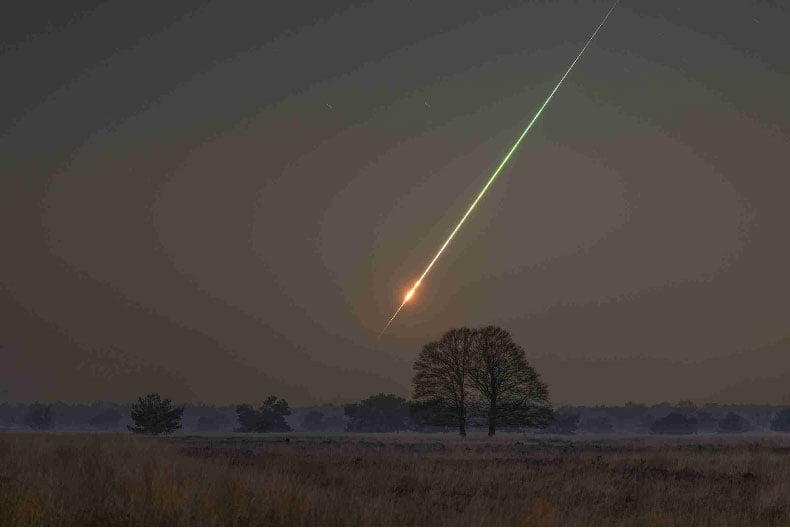
One of the meteorite falls included in the research was asteroid 2023 CX1, which produced a fireball over Normandy, France, on February 13, 2023. Meteorites known as Saint-Pierre-le-Viger fell during the event and were later recovered. Credit: Image courtesy of G. de Reijke.
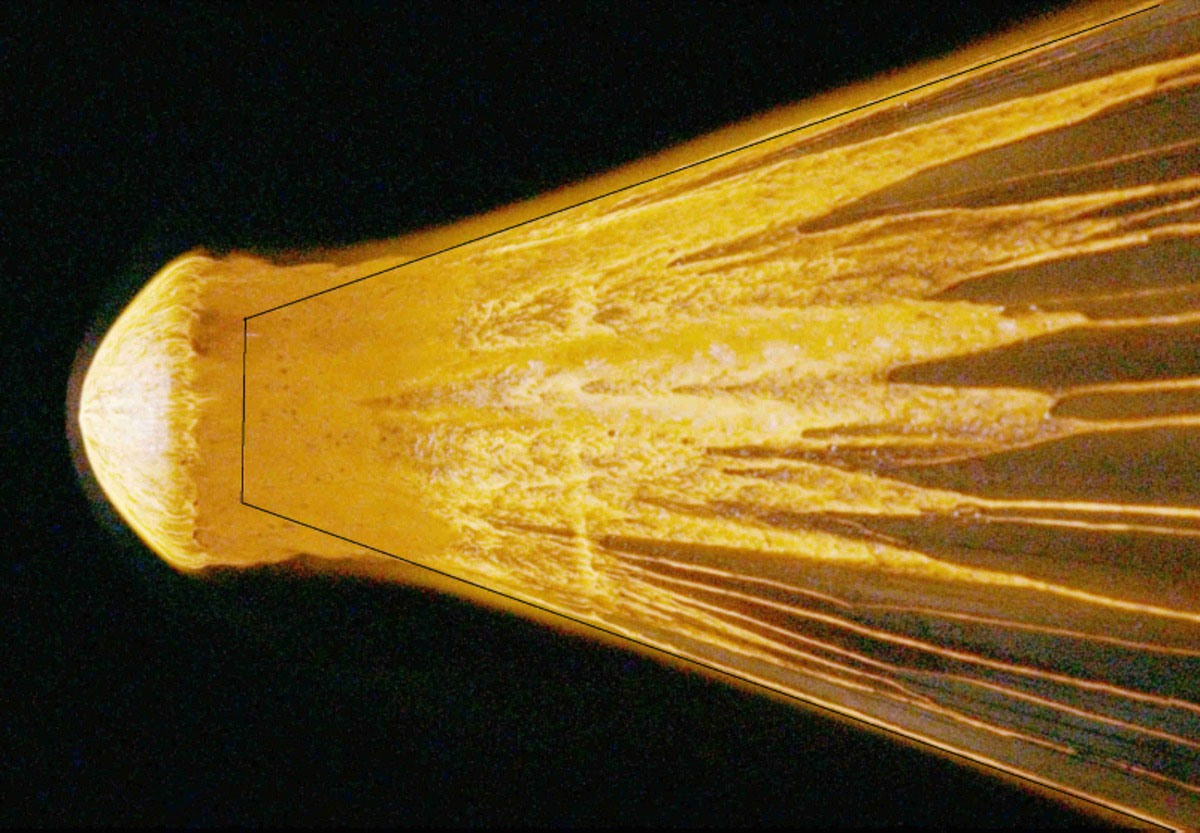
During Phase 3, the meteor brightens sharply and becomes a fireball. At this point, the researchers found that melting accounts for most of the rock’s mass loss. Fast-moving air strips molten material from the surface, producing droplets that continue to evaporate behind it.
“In the laboratory, we cannot generate the amount of radiation that occurs in a natural atmospheric entry at those speeds,” said Eric Stern, formerly at NASA Ames and now chief scientist at Hyperspace Technologies, Inc. “Rock could aggressively fragment and erode instead, but then we would not expect the observed systematics in how fireballs brighten.”
At roughly 60 kilometers (around 40 miles) above Earth, the fireball enters Phase 4 and reaches a melting equilibrium. Its brightness either levels off or rises at a steady rate. By this stage, melting alone can remove as much as 40 percent of the original rock’s mass.
Fragmentation drives the sharpest slowdown
As the fireball plunges deeper into denser air, increasing pressure begins to break the rock apart, marking Phase 5. Multiple flares can appear as fragments separate from the main body.
The researchers found that fragmentation begins when the air pressure in front of the falling rock reaches only about one-fifth of the strength measured for meteorites after they have landed. They suggest that heating and cracks created by earlier collisions in space may weaken the rocks enough to explain this unexpectedly early breakup.
This is also when the surviving object begins shrinking rapidly and losing speed more dramatically, especially when fragmentation is severe.
“We were able to tie that slow-down from fragmentation to the previous mathematical descriptions based on ablation,” said co-author Stu Pilorz of the SETI Institute.
If the rear portion of the main rock remains intact, it forms a low-pressure wake that can draw smaller fragments along behind it.
“Our modeling shows that as long as the back of the space rock remains intact, that rock pulls a vacuum in its wake into which fragments tend to flow,” says co-author Darrel Robertson of NASA Ames Research Center. “Those small meteorites fall in a narrow strip on the ground.”
Phase 6 begins when the back of the main rock finally breaks apart. The disruption produces a last bright flare and throws fragments outward at greater relative speeds. Because the object has already slowed considerably, these late flares tend to appear red rather than the bright green seen earlier in the descent.
“That final disruption sends fragments flying at higher relative speeds,” said Jenniskens. “In past falls, we noticed that meteorites larger than about 20g tended to be scattered wider and many came from close to the surface of the original space rock, which must have been its backside.”
The meteorites that ultimately land began this stage as larger fragments, but they continued melting and breaking apart until they slowed enough to survive the remainder of the fall.
The final phase determines what survives
During Phase 7, melting and fragmentation continue until the remaining pieces slow enough that they no longer glow. Melting then stops, leaving a thin fusion crust on the surfaces of the surviving fragments. As they descend through the lower atmosphere, winds can push the darkened pieces away from their original paths before they finally reach the ground as meteorites.
The 75 events included several different types of meteorites. By comparing them, the researchers determined the altitudes at which different materials passed through each of the seven stages.
Studying how small, solid space rocks of different compositions slow in the atmosphere can also provide insight into the behavior of more dangerous airbursting asteroids ranging from car-sized objects to bodies as large as city blocks.
“Asteroids up to tens of meters in size are also solid rocks because they tend to spin faster than do the larger rubble pile asteroids,” said Jenniskens. “The 20-m diameter asteroid that caused the airburst over Chelyabinsk, Russia, in 2013 went through the same phases.”
Reference: “Bolide Light Curve Systematics from 75 Recovered Meteorites” by Peter Jenniskens, Stuart Pilorz, Darrel Robertson and Eric C. Stern, 16 August 2026, Meteoritics & Planetary Science.
DOI: 10.1111/maps.70203
This work was financially supported by the NASA grant 80NSSC25K7667 and the NASA Ames Asteroid Threat Assessment Project.
Never miss a breakthrough: Join the SciTechDaily newsletter.
Follow us on Google and Google News.