
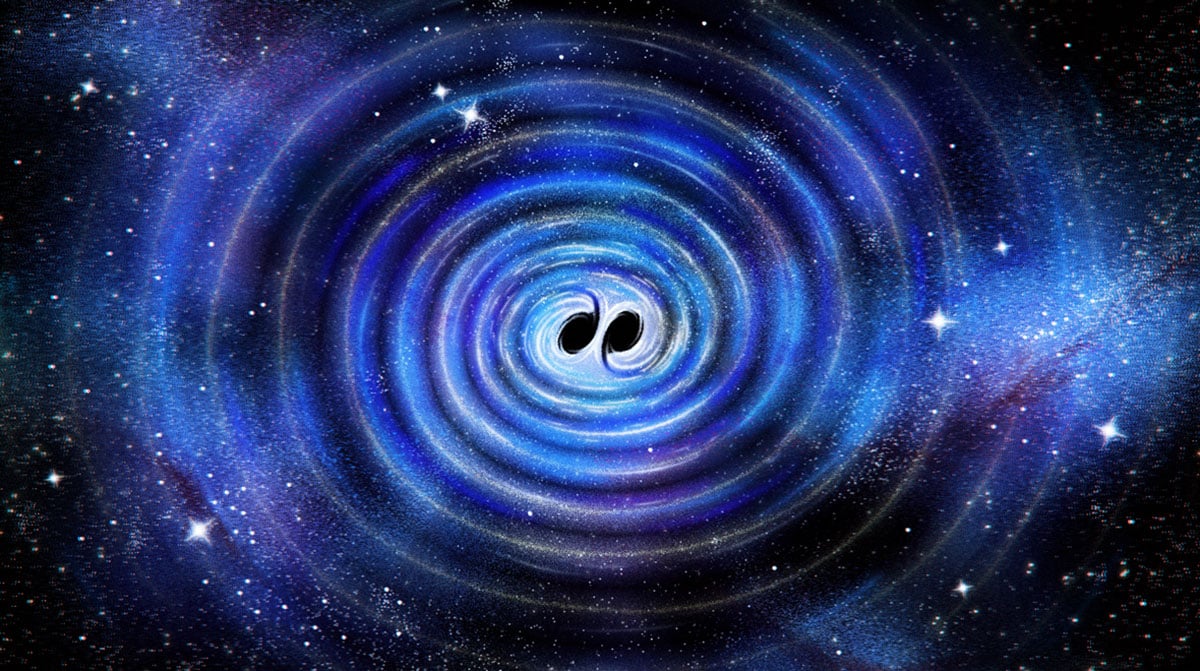
A new method maps the subtle gravitational wave vibrations produced by merging black holes, potentially enabling more precise tests of general relativity.
When two black holes collide, the violence of the merger does not end immediately. The newly formed, larger black hole continues to ‘ring’ as it settles into a stable shape, and researchers have developed a new way to analyze those vibrations in greater detail.
Unlike a bell or guitar string, a black hole does not produce sound. Instead, it sends out gravitational waves, ripples in spacetime first predicted by Albert Einstein.
The frequencies of these vibrations depend on the final black hole’s mass and spin, allowing scientists to extract information about the object created by the merger.
Known as quasinormal modes, these vibrations act like a fingerprint for the black hole. Measuring them provides an important way to test Einstein’s general theory of relativity under some of the most extreme gravitational conditions in the universe.
A new method separates the black hole’s notes
Researchers at the University of Cambridge have now developed a technique that can identify and catalog these modes more accurately. In a study published in Physical Review Letters, they analyzed computer simulations of black hole mergers and detected not only the fundamental ‘note’ produced during the ringdown, but also ‘overtones,’ weaker harmonics that disappear more rapidly.
“While the loudest mode is routinely observed in gravitational wave data, many quieter modes are much more difficult to detect, and there has been ongoing debate about which modes are present and when they appear,” said Richard Dyer from Cambridge’s Institute of Astronomy, the study’s first author. “Our method provides a systematic, data-driven way to resolve this uncertainty, and our results provide a reference for both theoretical studies and real observations.”
The technique relies on Bayesian analysis, a statistical approach that weighs competing evidence to determine which explanation is most probable for a particular dataset.
Fainter vibrations reveal more complex behavior
Beyond the fundamental ‘notes’ and ‘overtones,’ the researchers identified unusual ‘nonlinear modes’ in the simulations. These vibrations arise when two or more fundamental frequencies interact, producing more complicated signals similar to the tones generated by an electric guitar played with heavy distortion. Finding them requires high-quality data and careful analysis because the weaker signals must be separated from noise.
“The ringdown is one of the most direct probes of black holes we have,” said Dyer. “But extracting all the information it contains is hard. We wanted a principled, data-driven way to do that.”
Better mode maps could sharpen relativity tests
Dyer and coauthor Dr Christopher Moore tested the method using a publicly available catalog of highly precise simulations that follow gravitational waves out to the theoretical boundary where the signals can be measured cleanly. Across simulated mergers involving a wide range of mass ratios and spin configurations, they recorded which modes could be detected and when those signals appeared.
The researchers say these results could aid interpretation of observations from current gravitational wave detectors such as LIGO and Virgo, as well as next-generation instruments. Knowing which frequencies are likely to appear in a particular merger could enable more precise tests of general relativity, including checks of whether the final black hole has the properties predicted by Einstein’s equations.
Reference: “Quasinormal Mode Content of Binary Black Hole Ringdowns” by Richard Dyer and Christopher J. Moore, 13 May 2026, Physical Review Letters.
DOI: 10.1103/ptmd-rz1t
Never miss a breakthrough: Join the SciTechDaily newsletter.
Follow us on Google and Google News.