
Close Menu
    Facebook X (Twitter) Instagram
    SciTechDaily
    • Biology
    • Chemistry
    • Earth
    • Health
    • Physics
    • Science
    • Space
    • Technology
    Facebook X (Twitter) Pinterest YouTube RSS
    SciTechDaily
    Home»Biology»New Data on the Mechanism of Action of Plitidepsin in Tumor Cells
    Biology

    New Data on the Mechanism of Action of Plitidepsin in Tumor Cells

    By Paula Fernandez, PharmaMarApril 17, 2018No Comments2 Mins Read
    Facebook Twitter Pinterest Telegram LinkedIn WhatsApp Email Reddit
    Share
    Facebook Twitter LinkedIn Pinterest Telegram Email Reddit
    New Data on Plitidepsin in Tumor Cells
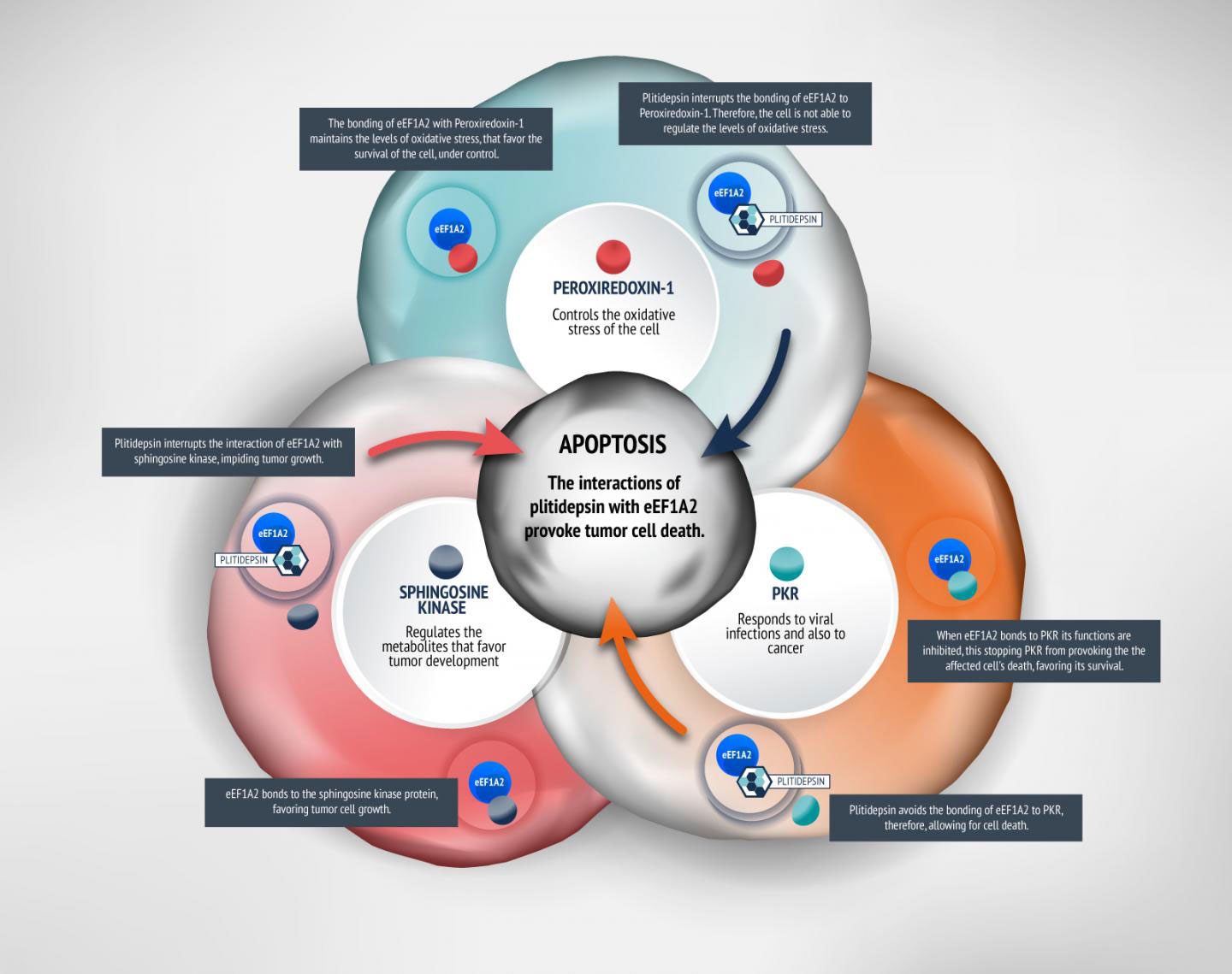
    Mechanism of action of plitidepsin. @PharmaMar 2018

    PharmaMar (MSE: PHM) has presented during the AACR meeting (American Association for Cancer Research) in Chicago new data about how plitidepsin works on the tumor cells.

    Under the title “eEF1A2 interacts with and inhibits PKR to enhance cancer cell survival”, the Company has presented the newly discovered oncogenic properties of eEF1A2, the target of plitidepsin. PharmaMar has discovered that this protein bond to the enzyme favoring in this way tumor growth. Plitidepsin inhibits this interaction obtaining the induction of cell death.

    Indeed, this is one step more in the understanding of the mechanism of action of plitidepsin. Up to today, PharmaMar has described that the target of plitidepsin is the eEF1A2 protein, over expressed in tumor cells, as in breast cancer or multiple myeloma. Through its bonding to eEF1A2, plitidepsin annuls the oncogenic properties of its target.

    For example, the bonding between eEF1A2 and Peroxiredoxin-1 controls the oxidative stress levels that favor tumor cell survival. Plitidepsin, on interrupting eEF1A2´s bonding with Peroxiredoxin-1, increases the oxidative stress levels, provoking tumor cell death.

    In the same way, plitidepsin interrupts the bonding of eEF1A2 with sphingosine kinase in the same way, an enzyme that regulates the level of the metabolites responsible for cell proliferation. The bonding of Plitidepsin to eEF1A2 inhibits the formation of the above mentioned metabolites, thus also limiting tumor growth.

    In all cases, the final consequence of these interactions of plitidepsin with eEF1A2 is the activation of a suicidal program of cells called apoptosis.

    Never miss a breakthrough: Join the SciTechDaily newsletter.
    Follow us on Google and Google News.

    Cancer Medicine Pharmaceuticals Pharmacology
    Share. Facebook Twitter Pinterest LinkedIn Email Reddit

    Related Articles

    Researchers Identify the P2Y2 Receptor Molecule as the Gateway for Metastases

    Highly Recurrent Mutations Discovered in “Dark Matter” of the Cancer Genome

    Scorpion Protein Helps Illuminate Brain Tumors

    Radiation Exposure Could Be Countered By Ingesting Ex-Rad Pills

    Magnets Used to Eradicate Cancer Cells

    New Drug CD47 Could Potentially Shrink and Cure All Tumors

    Zelboraf Nearly Doubles Median Survival Time for Patients with Metastatic Melanoma

    Cancer-Causing Mutations Disrupt Cells’ Ability to Differentiate

    Researchers Use Body’s Immune System to Fight Cancer

    Leave A Reply Cancel Reply

    • Facebook
    • Twitter
    • Pinterest
    • YouTube

    Don't Miss a Discovery

    Subscribe for the Latest in Science & Tech!

    Trending News

    Don’t Miss: A Brilliant Venus and Glowing Harvest Moon Light Up the Sky

    New Twist on the Einstein Problem Reveals Unexpected Physics

    JWST Captures Stunning Evidence of How Supermassive Black Holes Feed

    Early Exercise May Permanently Change How Much Energy the Body Uses To Move

    New Molecule Wipes Out Aggressive Lymphoma Tumors in Mice in Just 11 Days

    The Human Family Tree May Need a Major Rewrite

    Scientists Find a Surprising Cancer-Fighting Effect in Dark Sweet Cherries

    New AI Detects Hidden Warning Signs of Solar Eruptions Hours Before They Emerge

    Follow SciTechDaily
    • Facebook
    • Twitter
    • YouTube
    • Pinterest
    • Newsletter
    • RSS
    SciTech News
    • Biology News
    • Chemistry News
    • Earth News
    • Health News
    • Physics News
    • Science News
    • Space News
    • Technology News
    Recent Posts
    • Scientists May Have Finally Explained Why Astronauts Get Constipated in Space
    • Pomegranates Could Unlock a New Treatment for Heart Failure
    • Africa’s Giant Herbivores Were Disappearing Millions of Years Before Humans Could Hunt Them
    • This Utah Mountain Is Hiding Enough Ice To Fill 600 Olympic Pools
    • Vagus Nerve Stimulation Could Unlock the Brain’s Hidden Learning Potential
    Copyright © 1998 - 2026 SciTechDaily. All Rights Reserved.
    • Science News
    • About
    • Contact
    • Editorial Board
    • Privacy Policy
    • Terms of Use

    Type above and press Enter to search. Press Esc to cancel.