
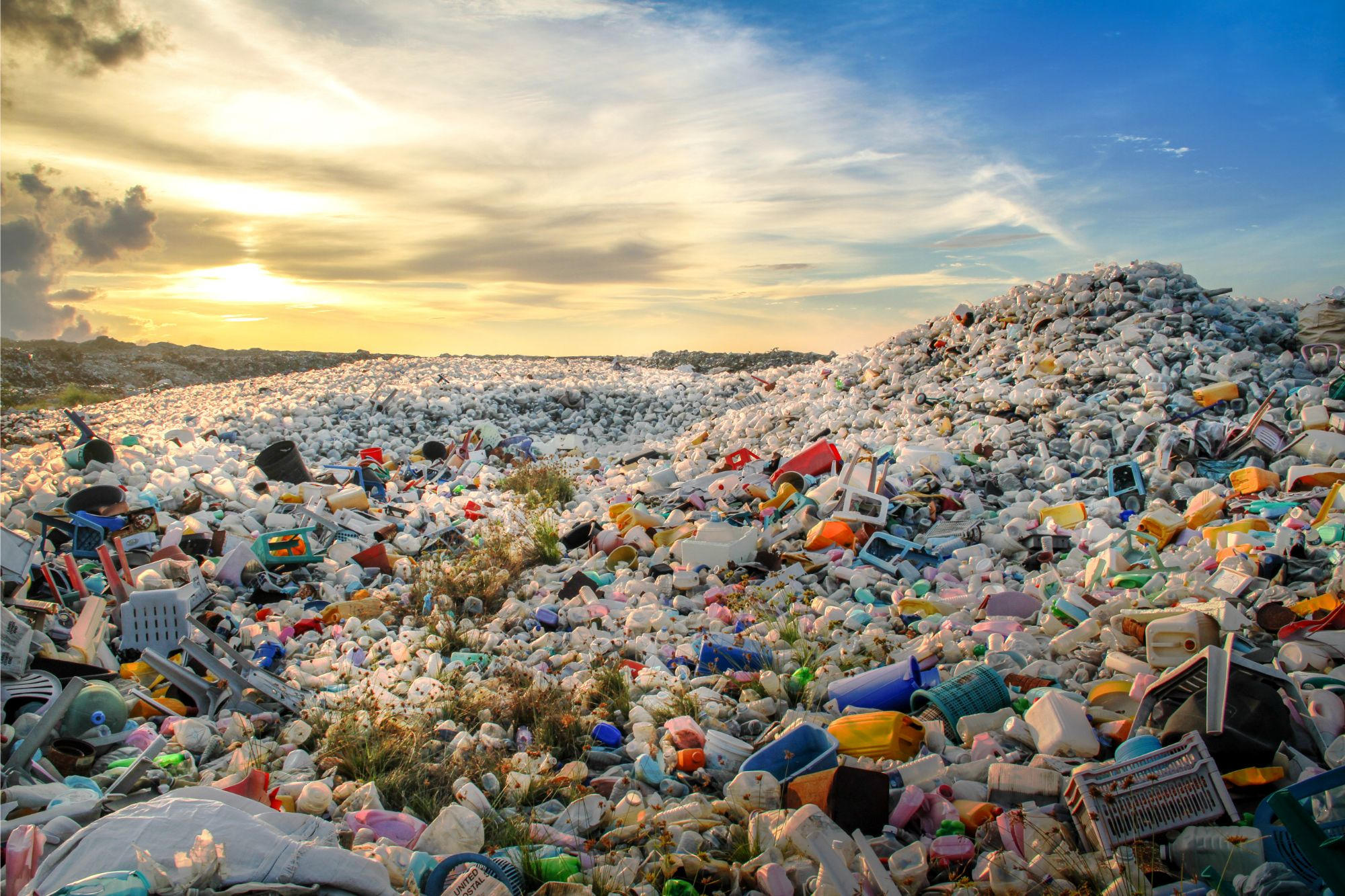
Common plastic waste could become fuel using heated salts instead of extreme temperatures.
Plastic bags, cutting boards, and many other everyday products are made from a plastic that is notoriously difficult to reuse once it becomes waste. Researchers at Oak Ridge National Laboratory have now found a way to break down this plastic and turn it into gasoline-like and diesel-like fuels using a relatively simple mixture of heated salts.
The plastic is polyethylene, one of the most widely used plastics in the world. In laboratory experiments, the new process converted it at temperatures below 200 degrees Celsius (392 degrees Fahrenheit), far cooler than many conventional methods, and produced a gasoline yield of about 60%.
The method also avoided several ingredients commonly needed to turn plastic into fuel. It did not require expensive precious metal catalysts, organic solvents, or an outside supply of hydrogen.
Molten salts replace harsher chemistry
At the heart of the process are molten salts containing aluminum chloride. Molten salts are simply salts heated until they form a liquid. In this case, the liquid salt mixture served both as the environment where the reaction took place and as the catalyst that helped drive it.
“We converted polymer waste to value-added fuels by using commercially available inorganic salts as the reaction media to provide the catalytic sites,” said Zhenzhen Yang, an ORNL staff scientist who was also a co-corresponding author of the paper. “Unlike traditional techniques for converting polymer to fuel, the new process did not require noble-metal catalysts, organic solvents or external hydrogen. This is the first time molten salts were used as media to produce high-value-added chemicals from waste without any catalytic initiator or solvent and at temperature below 200 degrees Celsius.”

The relatively low temperature is an important part of the approach. A common method called pyrolysis breaks plastics apart with intense heat, typically at about 450 to 500 degrees Celsius (842 to 932 degrees Fahrenheit).
“We developed an efficient and selective polyethylene-to-gasoline conversion,” said Liqi Qiu, a postdoctoral researcher at the University of Tennessee, Knoxville, who performed most of the study’s experiments in the ORNL laboratory of Sheng Dai, of ORNL and UTK. Dai, an ORNL Corporate Fellow and section head for separations and polymer chemistry, is a co-corresponding author of the paper.
Aluminum sites break plastic chains apart
The researchers also wanted to understand why the molten salts worked.
Polyethylene is made from long chains of carbon and hydrogen atoms. The team found that aluminum sites in the molten salt become strongly acidic and can trigger reactions that break those long chains into smaller hydrocarbon molecules, the kinds of compounds found in fuels.
One key step involves the formation of a positively charged carbon atom. To follow what happened during that reaction, the researchers used deuterium, a heavier form of hydrogen, as a chemical marker.
They then turned to neutron scattering at ORNL’s Spallation Neutron Source, which is especially useful for tracking hydrogen and its isotopes.
“The polymer contains a lot of hydrogen,” Dai said. “Neutrons are ideal at discerning light elements including hydrogen and its isotopes, such as deuterium.”
Those measurements helped explain why different forms of polyethylene produced different kinds of fuel. Simpler polymer chains tended to produce gasoline-like compounds, while more complex chains generated diesel-like products.
The researchers also examined what happened to the aluminum catalyst itself during the reaction. At Lawrence Berkeley National Laboratory’s Advanced Light Source, Yang worked with Min-Jae Kim and Jinhua Guo to use soft X-rays to study changes in the aluminum sites as they interacted with polyethylene.
“The aluminum edge shifted to the low-electron-density edge, which means some electron-rich intermediates formed,” Yang said. “We compared the findings with other techniques and confirmed an aromatic ring intermediate can coordinate with aluminum and cause a binding-energy change.”
The measurements provided evidence that the aluminum sites were actively driving the reaction. The team supported those findings with several additional techniques, including nuclear magnetic resonance, X-ray diffraction, gas chromatography-mass spectrometry, and computer simulations.
Decades of molten salt research find a new use
The work draws on decades of molten salt research at Oak Ridge. ORNL has studied these materials since at least the 1960s, when its Molten Salt Reactor Experiment demonstrated their potential for use in nuclear reactors. Dai later proposed applying molten salt chemistry to a very different challenge: converting discarded polymers into useful products.
Molten salts can remain stable under demanding chemical conditions, which could make them attractive for industrial processing if the new method can eventually be scaled up.
“The ORNL system solves two fundamental issues,” Dai said. “One, for a stable system, the process can be radically easier to scale up. Two, the previous system needed an initiator to kick off catalytic reactions. However, the ORNL system does not need one.”
Understanding the underlying chemistry could also help researchers apply the approach to other plastics or chemical processes.
“In this case we tackled polyethylene, a widely available commodity polymer, using molten salt,” said ORNL’s Tomonori Saito, who managed the project and contributed expertise in polymers. “We’re trying to understand fundamental science that will lead to discoveries and new economic opportunities.”
Water remains a barrier to scale-up
The method still has an important drawback. The aluminum-based molten salt readily absorbs water, which makes the system less stable. The researchers now hope to develop ways to better contain and protect the molten salts, potentially using halogens or carbon-based materials to improve separation and processing.
If those challenges can be overcome and the process can be scaled beyond the laboratory, discarded polyethylene could become a source of useful fuel-like chemicals rather than remaining difficult plastic waste. The team has applied for a patent on the method.
“Polymer source material is abundantly available from consumer waste, and our catalyst system, aluminum molten salts, is very cheap,” Qiu said. “This advance may be promising for industry.”
Reference: “Polyethylene Upcycling to Liquid Alkanes in Molten Salts under Neat and External Hydrogen Source-Free Conditions” by Liqi Qiu, Felipe Polo-Garzon, Luke L. Daemen, Min-Jae Kim, Jinghua Guo, Bobby G. Sumpter, Michael R. Koehler, Carlos Alberto Steren, Tao Wang, Logan T Kearney, Tomonori Saito, Zhenzhen Yang and Sheng Dai, 7 April 2025, Journal of the American Chemical Society.
DOI: 10.1021/jacs.5c01107
The DOE Office of Science (Materials Sciences and Engineering Division) primarily supported the research as well as the gas chromatography-mass spectrometry work (Chemical Sciences, Geosciences and Biosciences Division, Catalysis Science program).
Never miss a breakthrough: Join the SciTechDaily newsletter.
Follow us on Google and Google News.