
Close Menu
    Facebook X (Twitter) Instagram
    SciTechDaily
    • Biology
    • Chemistry
    • Earth
    • Health
    • Physics
    • Science
    • Space
    • Technology
    Facebook X (Twitter) Pinterest YouTube RSS
    SciTechDaily
    Home»Space»Once-in-a-Century Impact: NASA Just Found a Massive New Crater on the Moon
    Space

    Once-in-a-Century Impact: NASA Just Found a Massive New Crater on the Moon

    By Lonnie Shekhtman, NASASeptember 24, 2026No Comments10 Mins Read
    Facebook Twitter Pinterest Telegram LinkedIn WhatsApp Email Reddit
    Share
    Facebook Twitter LinkedIn Pinterest Telegram Email Reddit
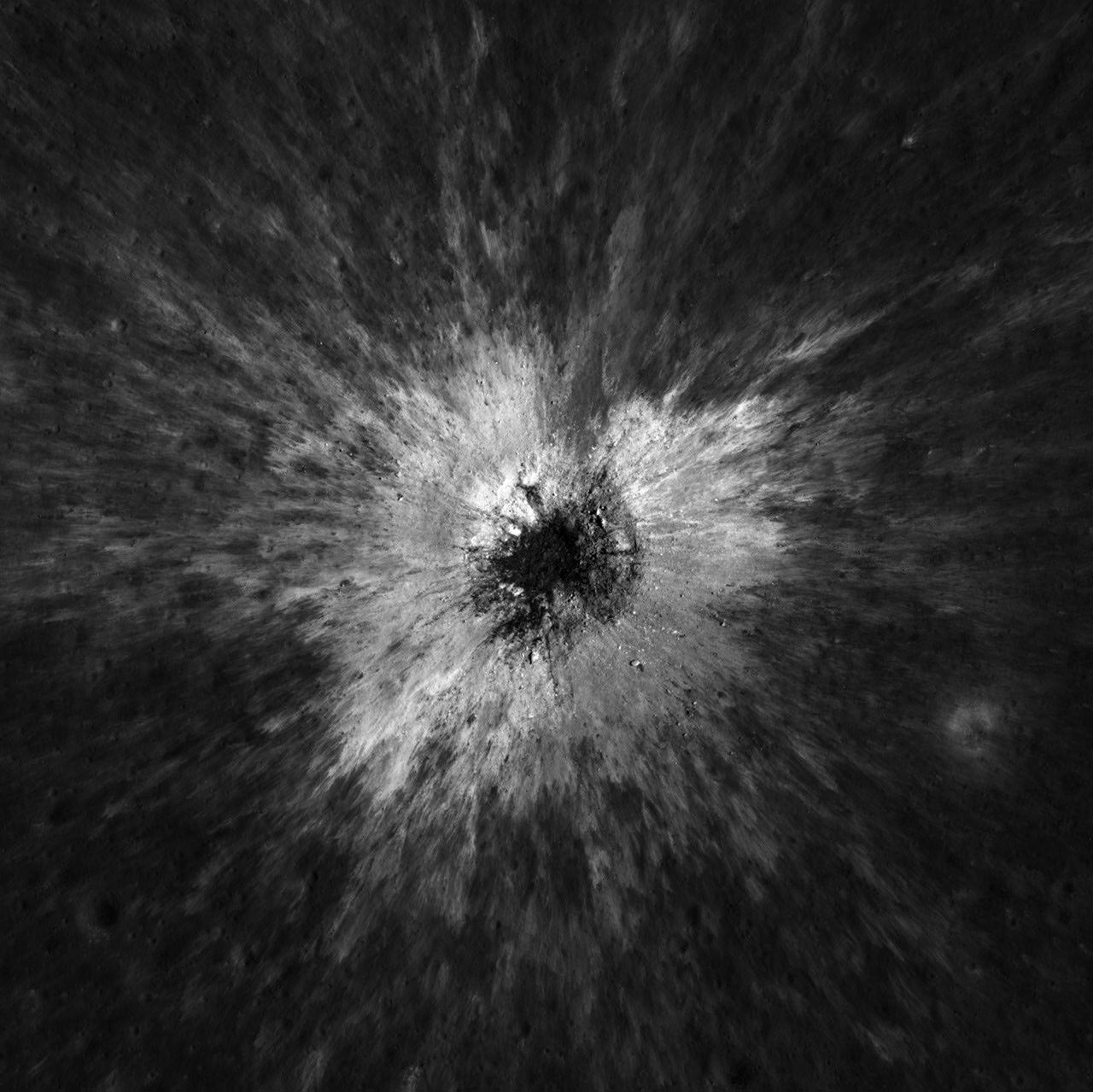
    McGetchin Crater Overhead View
    An overhead, close-up view of McGetchin crater that was taken on December 5, 2025, by NASA’s Lunar Reconnaissance Orbiter (LRO) Narrow-Angle Camera (NAC). After the crater was discovered on October 24, 2025, in global images from LRO’s Wide-Angle Camera, which captures broad views with pixels the size of American football fields, scientists turned to the NAC, which takes much sharper views at about 3 feet per pixel. The NAC images, taken as LRO flew over the impact site again, revealed the crater size, shape, and how the surrounding terrain was affected by the impact that carved McGetchin. The image covers an area that’s ¾ mile wide. Credit: NASA Goddard/Intuitive Machines

    NASA’s Lunar Reconnaissance Orbiter helped uncover a 728-foot-wide crater that formed on the Moon in 2024 after a rare, powerful impact.

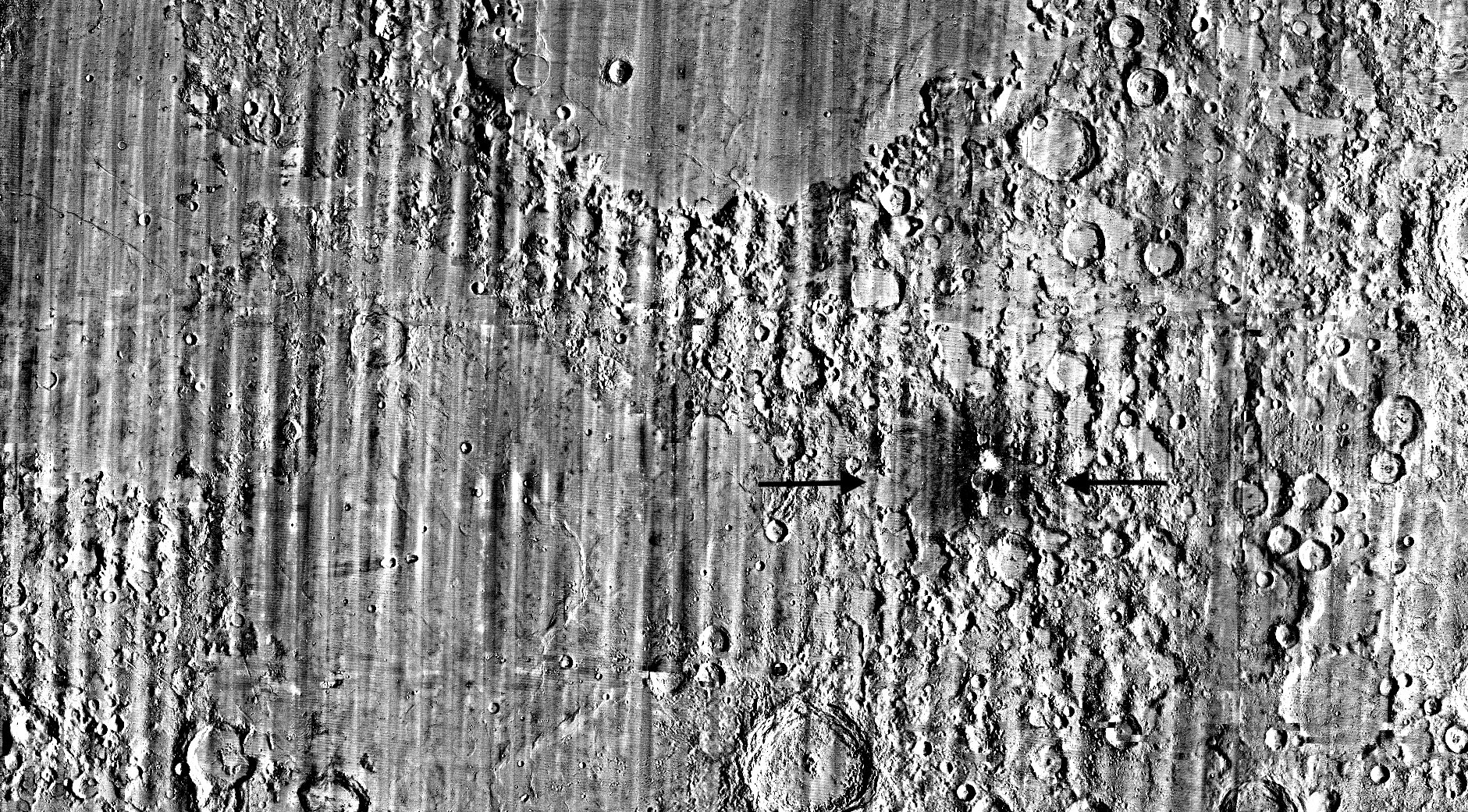
    What began as a routine check of lunar mapping data quickly turned into an unexpected discovery. Robert Wagner, a scientist working with NASA’s Lunar Reconnaissance Orbiter (LRO), was examining a large map of the Moon when one feature immediately stood out: an unusually bright patch surrounded by a dark halo.

    The pattern suggested that material on the lunar surface had recently been disturbed.

    “I just stopped, dropped everything, and started looking into what that spot was,” said Wagner, an image-processing specialist from Intuitive Machines who works with data from the Lunar Reconnaissance Orbiter Camera (LROC) system.

    When Wagner compared older images with newer ones, he realized the feature had not always been there. Scientists later determined that he had found the largest newly formed crater ever identified in the solar system, according to research published September 16 in Science Advances.

    The discovery demonstrates how NASA’s long-running observations of the Moon can reveal that its surface is still changing. That information is becoming increasingly important as NASA works toward a sustained human presence on the Moon alongside growing scientific and commercial activity.
    McGetchin Crater Discovery
    A zoomed-in view of the Moon, with debris around McGetchin crater visible as a white spot circled by a dark halo just right of center of the image (marked with black arrows). This is the view that Robert Wagner saw on October 24, 2025, during a routine data-quality check. Wagner is an image processing specialist for NASA’s Lunar Reconnaissance Orbiter Camera, a system of three cameras. Using images from the Wide-Angle Camera (WAC), which captures broad views with pixels the size of American football fields, he stacked hundreds of images captured by WAC over the last several years with software designed to highlight change. Anything that stayed the same is gray; anything that changed showed up as bright or dark patches. The stripes in the image are due to slight changes in lighting between the older and newer images. This image composite shows an area of the Moon approximately 900 miles across. Credit: NASA Goddard/Intuitive Machines/Robert Wagner

    A Rare Impact Leaves a Giant New Crater

    The crater is officially named McGetchin in honor of pioneering lunar scientist Tom McGetchin. It formed near the Moon’s eastern edge sometime between April 11 and May 22, 2024.

    Scientists estimate that the object responsible was a comet or asteroid roughly the size of a three- to six-story building.

    The collision excavated a crater 728 feet across, about the combined length of two football fields. It is also 141 feet deep, enough to hold three yellow school buses stacked vertically.

    Impacts this large are exceptionally uncommon. Researchers estimate that a collision of this scale strikes the Moon only about once every century, or possibly even less often.
    Moon Before and After McGetchin Crater Formed
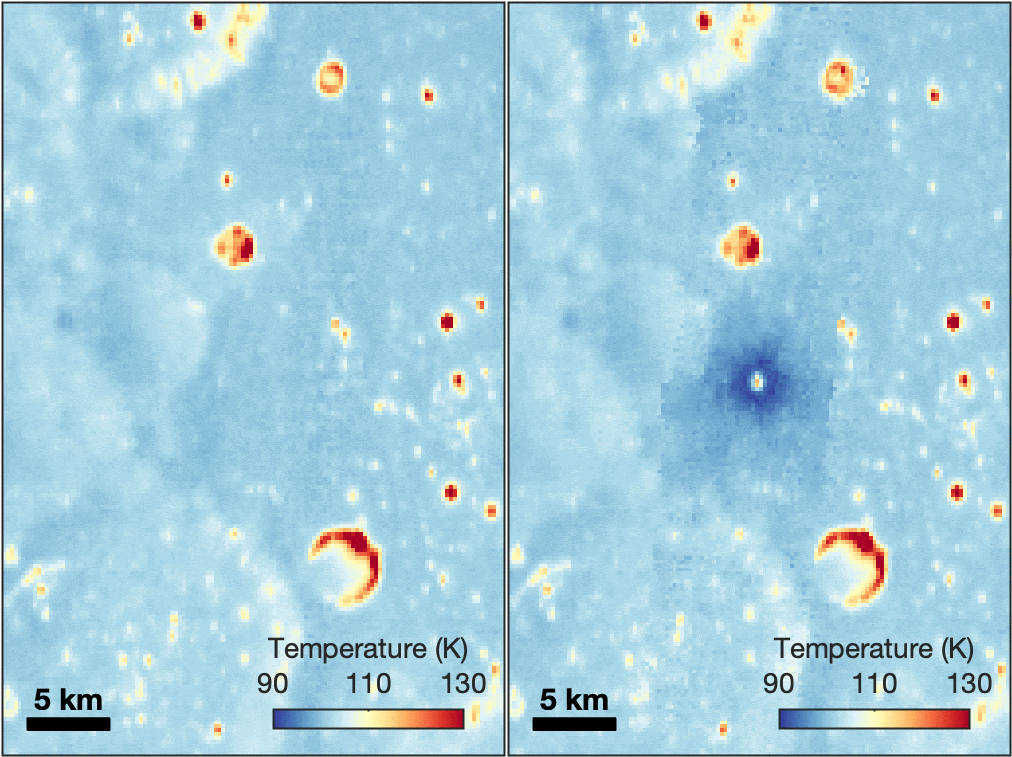
    This animated image set shows an area on the eastern limb of the Moon before and after McGetchin crater formed there sometime between April 11 and May 22, 2024. The post-impact image was constructed using data taken by NASA’s Lunar Reconnaissance Orbiter (LRO) thermal instrument, Diviner, between Nov. 15, 2025, and Feb. 18, 2026, after scientists discovered the crater in visible-light images taken by LRO’s Wide-Angle Camera. Pre-impact temperatures are from the Diviner Global High-Resolution Mosaics (GHRM). The crater formed on the Moon after a comet or asteroid, possibly the size of a six-story building, hit the surface in a rare, once-in-a-century collision. The dark blue strip that flashes into view reveals a 4-mile-wide “cold spot” around the crater that is about 16 degrees Fahrenheit cooler at night than its surroundings. This cooling happens because an impact fluffs up regolith around a crater, making it less dense and therefore less able to retain heat. Scientists on the Diviner team reported this finding in a paper published on Sept. 16, 2026, in Science Advances. The red and yellow spots indicate areas typically associated with rocks excavated by long-ago impacts which, though still at cryogenic temperatures like their surroundings, remain slightly warmer at night. Credit: NASA Goddard/UCLA/JHU APL

    The Moon Is Constantly Being Bombarded

    For more than 17 years, LRO has been circling the Moon while its seven instruments measure and map the lunar landscape. The spacecraft studies features including surface elevation, chemical composition, temperature, and the radiation environment.

    During the mission, scientists have identified at least 1,000 newly formed impact craters. They have also recorded about 100,000 additional surface changes caused either by objects striking the Moon or by debris thrown outward during those collisions.

    Unlike Earth, the Moon has no substantial atmosphere to slow incoming space rocks or cause them to burn up before reaching the ground. As a result, objects can strike the surface directly at enormous speeds.

    Most are much smaller than the body that created McGetchin.

    The smallest fresh craters that researchers can reliably identify in LRO images measure about 30 feet across, roughly the length of a three-story building laid on its side. These can be produced by rocks only about 43 inches wide, approximately the size of a monster-truck tire.

    Researchers estimate that impacts of this size create roughly 140 detectable craters across the Moon each year. Countless smaller projectiles also strike the surface, but most leave marks too tiny to be resolved from orbit.
    McGetchin Crater After and Before
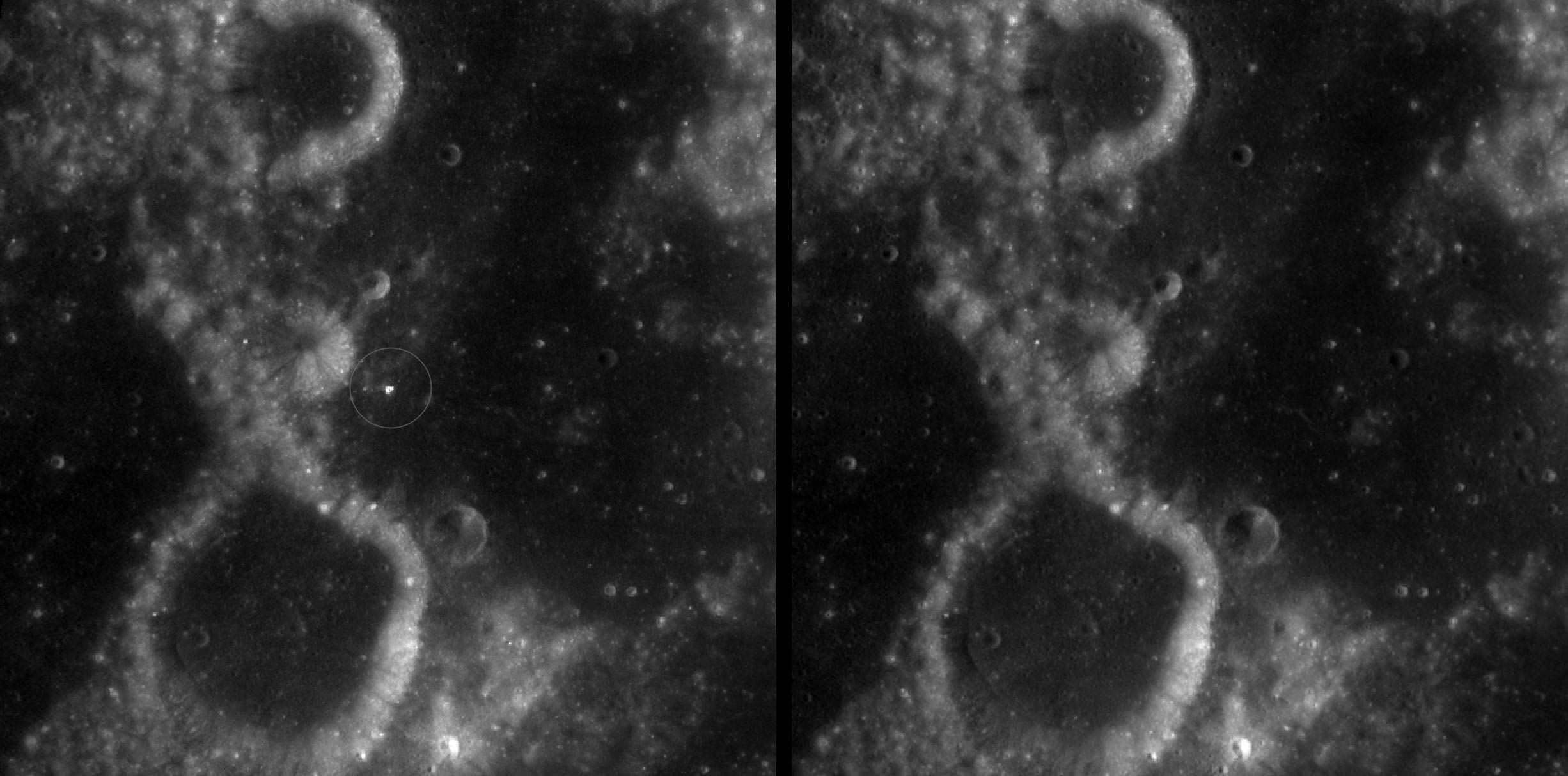
    A zoomed-in view of McGetchin crater, circled on the left, next to a “before” image on the right. The panel on the left is made from images captured by NASA’s Lunar Reconnaissance Orbiter Wide-Angle Camera in summer 2025; the right panel was made from images taken in spring 2011. The white spot is not the crater itself, but rather material flung out of the crater, which formed when a rock, possibly this size of a three- to six‑story building, crashed into the Moon between April 11 and May 22, 2024 – a once-in-a-century event, as scientists reported on September 15, 2026, in a pair of papers in Science Advances. The area shown in the images is 38 miles wide. Credit: NASA Goddard/Intuitive Machines/Robert Wagner

    A Four Mile Cold Spot Around the Crater

    LRO carries several instruments that can detect changes invisible in ordinary camera images. Once McGetchin had been identified, researchers used the spacecraft’s Diviner thermal instrument to examine temperatures around the impact site.

    They found something striking.

    A region extending about 4 miles around the crater was roughly 16 degrees Fahrenheit colder at night than the surrounding lunar terrain.

    In a second paper published September 16 in the same journal, researchers concluded that the temperature difference was caused by changes to the lunar regolith.

    Regolith is the loose layer of dust, broken rock, and debris covering the Moon. The impact churned and loosened this material, leaving it less densely packed. That altered surface does not hold heat as efficiently, so it cools more rapidly after sunset.

    The sheer size of this “cold spot” surprised researchers because it shows that the effects of an impact can extend far beyond the crater itself.

    Those changes may also have practical consequences. Looser regolith could, for example, influence how rover wheels grip and move across the lunar surface.
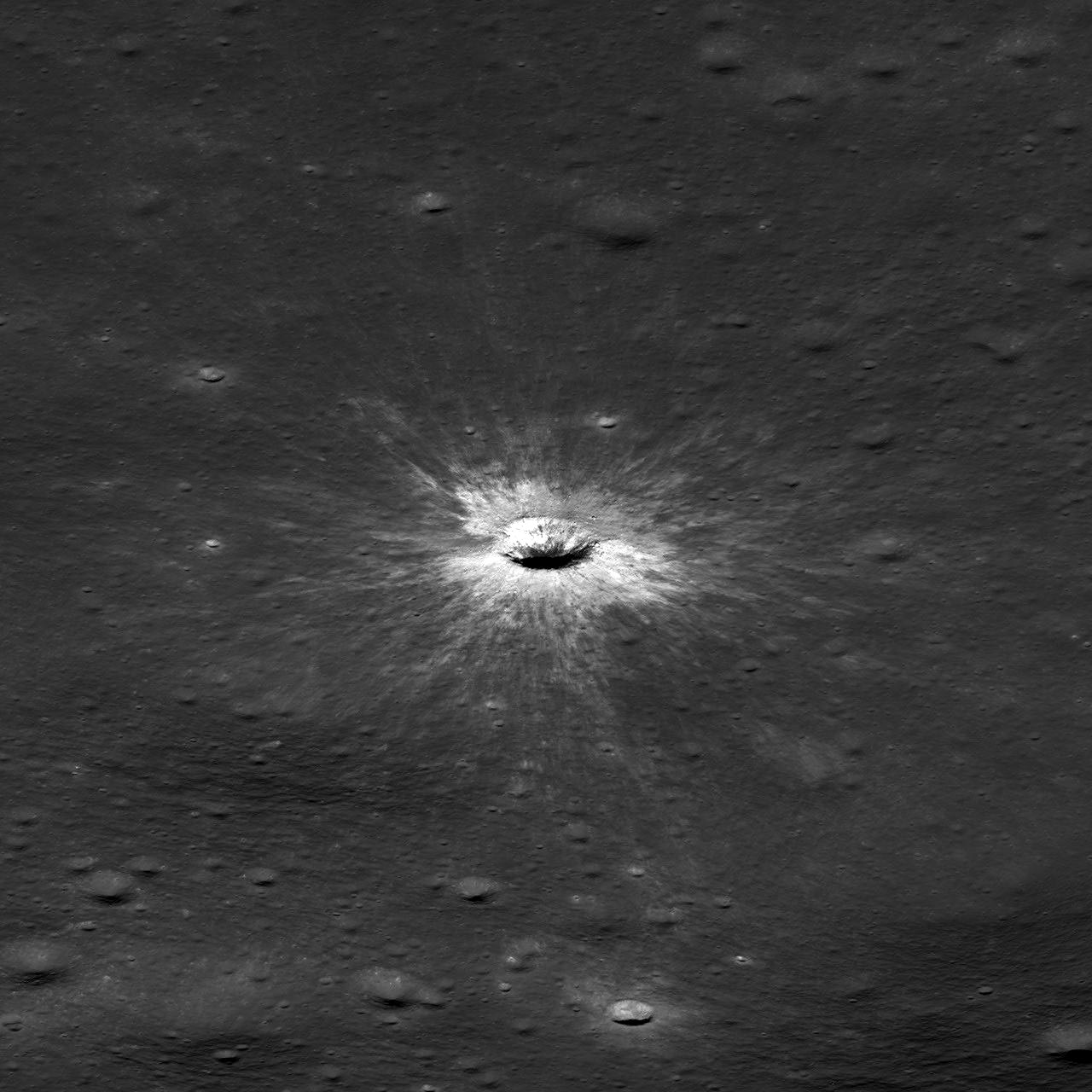
    McGetchin Crater Side View
    This view from the side (55° away from straight down) towards the east, covers an area of the Moon that’s about 1.5 miles wide. It was taken by NASA’s Lunar Reconnaissance Orbiter Narrow-Angle Camera on March 3, 2026. Credit: NASA Goddard/Intuitive Machines

    How NASA Found the Crater

    The LROC system photographs the Moon from an altitude of about 60 miles as LRO travels around the lunar poles. It includes two cameras that collect detailed black-and-white imagery along with another camera that records broader multispectral views.

    After thousands of orbital passes, scientists have assembled highly detailed maps capable of revealing far more than impact craters. LRO imagery has also been used to identify landslides, spacecraft landing sites, seismic faults, and possible signs of underground lava tubes.

    Scientists working with LROC routinely inspect detailed images from the Narrow-Angle Camera, searching for small changes that are often less than 30 feet wide.

    Every few years, however, the team carries out a different kind of search. Researchers construct global maps of the Moon and compare them with older maps to look for much larger changes (wider than 150 feet).

    Wagner was performing one of these comparisons on Oct. 24, 2025, when McGetchin caught his attention.

    Using images collected by LROC’s Wide-Angle Camera, which covers enormous areas of terrain with pixels about the size of football fields, Wagner combined hundreds of older and newer images using software designed to emphasize anything that had changed.

    Areas that remained unchanged appeared gray. Differences between the two sets of observations appeared as bright or dark patches.
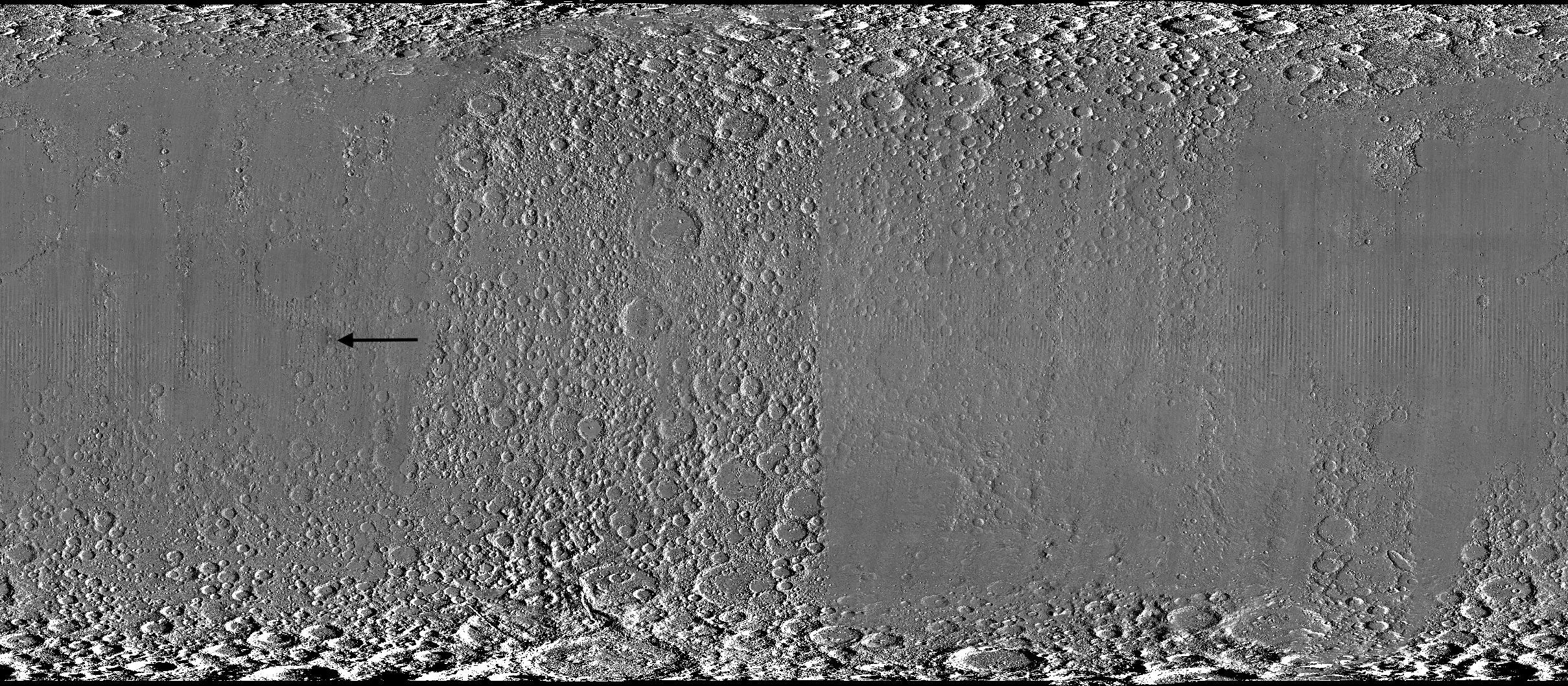
    McGetchin Crater Global Moon View
    A global view of the Moon made by stitching together hundreds of images from the Wide-Angle Camera aboard NASA’s Lunar Reconnaissance Orbiter (LRO). Robert Wagner, image processing specialist for LRO, made this map using two sets of mages taken several years apart. He used a software designed to highlight any changes between the two sets. Anything that stayed the same turned gray; anything different showed up as bright or dark patches. A black arrow just left of center points to McGetchin crater. Credit: NASA Goddard/Intuitive Machines/Robert Wagner

    One Signal Stood Out Immediately

    In practice, separating real surface changes from visual noise takes considerable effort. Slight differences in lighting and shadows can trigger the software, producing hundreds of false signals.

    Wagner therefore checks potential detections manually. He typically searches for small fuzzy halos around bright points only a pixel wide, a pattern that can indicate regolith thrown outward by a fresh impact.

    McGetchin was impossible to miss.

    Instead of appearing as a tiny signal, its debris pattern stretched across hundreds of pixels.

    “It was by far the most obvious impact debris pattern I’ve ever seen in one of these images,” Wagner said.

    After the discovery, researchers used LROC’s Narrow-Angle Camera for a much closer look. Its images can resolve details at roughly 3 feet per pixel.

    As LRO passed over the site again, these sharper observations revealed McGetchin’s dimensions, shape, and the extent of disruption in the surrounding landscape.

    The images also gave scientists information they could use to estimate the size of the incoming object and the force of the collision. Those calculations are expected to be presented in a future paper.

    References:

    “A new 222-m diameter lunar crater” by Mark S. Robinson, Aaron K. Boyd, Prasun Mahanti, Madeleine R. Manheim, Emerson J. Speyerer, Julie D. Stopar and Robert V. Wagner, 16 September 2026, Science Advances.
    DOI: 10.1126/sciadv.aeh7812

    “New lunar crater reveals extensive distal regolith modification” by Tyler M. Powell, Benjamin T. Greenhagen, Tyler Horvath, Jean-Pierre Williams, Elisha Jhoti, Emerson J. Speyerer, Catherine M. Elder and David A. Paige, 16 September 2026, Science Advances.
    DOI: 10.1126/sciadv.aeh9568

    Never miss a breakthrough: Join the SciTechDaily newsletter.
    Follow us on Google and Google News.

    Crater Moon NASA NASA's Lunar Reconnaissance Orbiter
    Share. Facebook Twitter Pinterest LinkedIn Email Reddit

    Related Articles

    A SpaceX Falcon 9 Rocket Hit the Moon and Blasted Open a 60-Foot Crater

    NASA Spots Fresh Lunar Impact From Crashed Moon Mission

    LRO Spacecraft Reveals Earth’s Moon Hit by Surprising Number of Meteoroids

    Lunar Reconnaissance Orbiter Moves Closer to the Lunar Surface

    LRO Spacecraft Captures Image of LADEE’s Lunar Impact Crater

    LRO Reveals Lunar Pits Could Support Human Activity on the Lunar Surface

    NASA’s Lunar Reconnaissance Orbiter Captures an Image of Earth from the Moon

    LRO Radar Data Indicates That the Walls of Shackleton Crater on the Moon May Hold Ice

    NASA LRO Spacecraft Reveals Geological Activity on the Moon’s Surface

    Leave A Reply Cancel Reply

    • Facebook
    • Twitter
    • Pinterest
    • YouTube

    Don't Miss a Discovery

    Subscribe for the Latest in Science & Tech!

    Trending News

    Natural Compound May Help Protect the Brain and Heart From Excess Salt

    240-Million-Year-Old Fossil Discovery Challenges the Story of the First Dinosaurs

    Knee Osteoarthritis Isn’t Inevitable: Simple Habits May Lower Your Risk

    Ancient DNA Rewrites the Story of the “American Cheetah”

    Einstein Called It “Spooky.” CERN Just Found It at Extreme Energies at the Large Hadron Collider

    A Long-Held Idea About Alzheimer’s Tau May Be Wrong

    Your Favorite Scented Cleaner Could Be Filling the Air With Invisible Pollution

    New Study Reveals a Major Shift Behind Rising ADHD and Autism Diagnoses

    Follow SciTechDaily
    • Facebook
    • Twitter
    • YouTube
    • Pinterest
    • Newsletter
    • RSS
    SciTech News
    • Biology News
    • Chemistry News
    • Earth News
    • Health News
    • Physics News
    • Science News
    • Space News
    • Technology News
    Recent Posts
    • Once-in-a-Century Impact: NASA Just Found a Massive New Crater on the Moon
    • Deep Beneath Australia, Hidden Caves Could Reveal Secrets of Alien Worlds
    • He Was Looking for a Campsite. He Found a Massive Impact Crater
    • Anak Krakatau Just Blasted Ash 50,000 Feet Into the Sky
    • Surprising Diabetes Study Finds Tighter Blood Sugar Control May Come With a Hidden Cost
    Copyright © 1998 - 2026 SciTechDaily. All Rights Reserved.
    • Science News
    • About
    • Contact
    • Editorial Board
    • Privacy Policy
    • Terms of Use

    Type above and press Enter to search. Press Esc to cancel.