
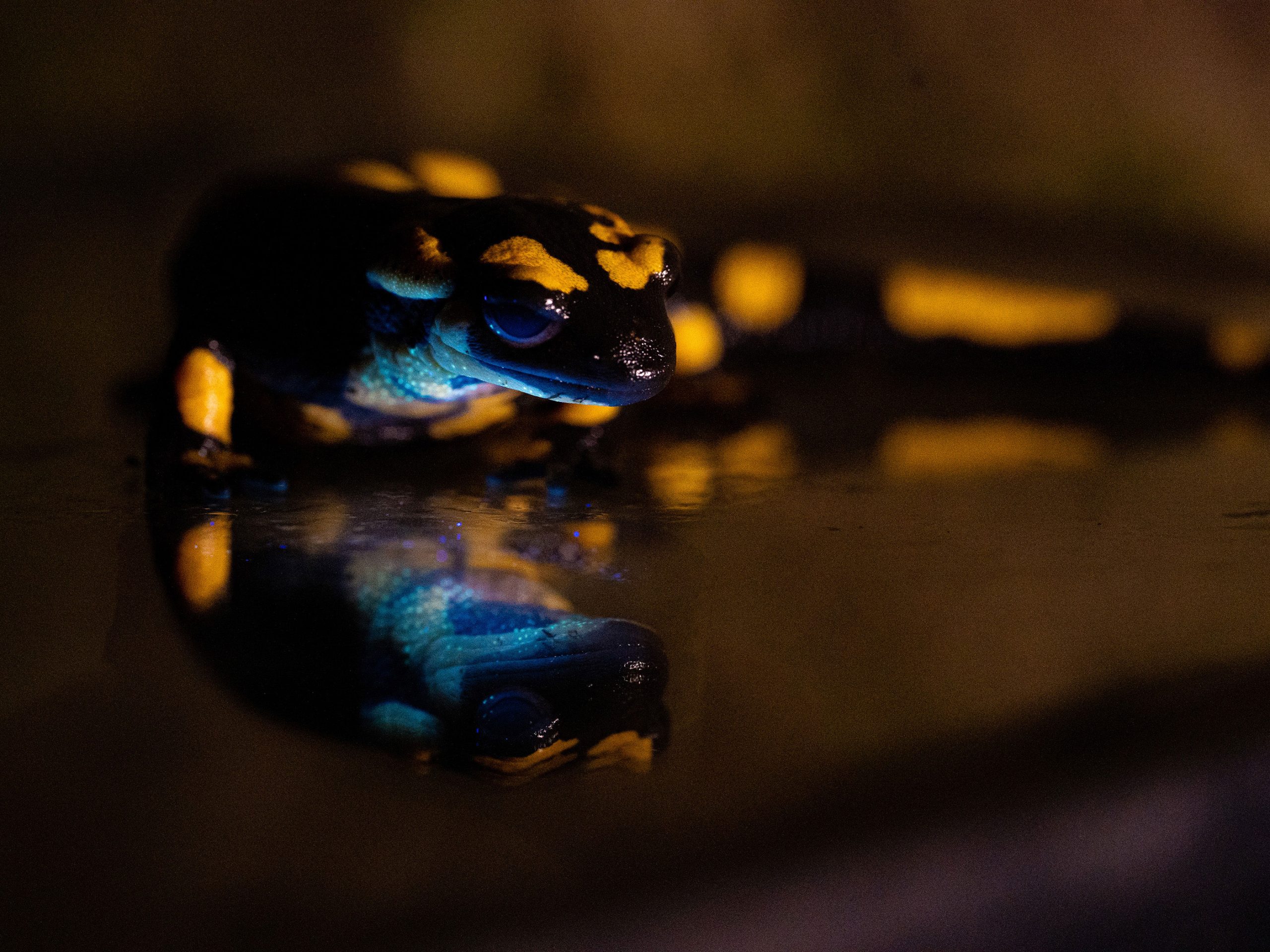
Researchers have discovered that fire salamanders can produce a striking cyan-green fluorescence when exposed to ultraviolet light.
Fire salamanders are famous for their vivid yellow and black warning colors, but part of their appearance remains invisible to human eyes. Researchers have found that when ultraviolet light strikes the animals, their skin and defensive secretions emit a cyan-green fluorescence that may persist for more than 24 hours after the secretions are released.
The fluorescence is strongest in the salamanders’ yellow underside and along the sides of the body. It originates mainly from skin glands and the substances they produce, suggesting that the phenomenon is closely connected to the same tissues involved in the animal’s chemical defenses.
A Hidden Glow in a Familiar Amphibian
“It is fascinating that such a well-studied species still harbors unknown phenomena like this. It reminds us that even the most familiar organisms can hide secrets that are only revealed when they are observed with new tools,” says Bernat Burriel, researcher at the Museum of Natural Sciences in Barcelona and first author of the work.
Biofluorescence occurs when a substance absorbs light at one wavelength and releases it at another. In the fire salamander, compounds in the skin absorb ultraviolet light, which humans cannot see, and reemit part of that energy as visible green and cyan light. Unlike bioluminescence, the process does not generate light independently. Bioluminescent animals such as fireflies produce their own light through chemical reactions, while fluorescent organisms require an outside light source.
Biofluorescence was once thought to be largely confined to marine organisms, apart from a few well-known terrestrial examples such as scorpions. Research over the past several years has expanded that picture, documenting fluorescence in terrestrial vertebrates including reptiles, birds, and amphibians.
What Could the Fluorescence Be Doing?
The function of the salamander’s fluorescence remains unknown. Researchers propose several possibilities, including communication between individuals, mate recognition, and strengthening the warning signals that advertise the animal’s toxicity. These ideas remain hypotheses rather than demonstrated functions.
“Fluorescence meets several criteria that suggest a communicative function. It could help salamanders detect each other in nocturnal or particularly dense environments, or act as an additional defense signal,” says Martin Kaltenpoth, the director of the Department of Insect Symbiosis at the Max Planck Institute for Chemical Ecology and co-author of the study. Because the fluorescence also occurs in toxic skin secretions, the researchers say it could potentially influence interactions with predators or other species.
Humans need ultraviolet illumination to see the effect clearly, but other animals may perceive it under much weaker natural light. Fire salamanders are active in dim forest environments, where moonlight and starlight can reach the ground. Full moonlight contains a relatively high proportion of ultraviolet and violet wavelengths compared with daylight, raising the possibility that fluorescence could make the salamanders more visible to one another by adding cyan-green signals to their yellow skin.
Fluorescence May Reinforce a Toxicity Warning
Fire salamanders already use conspicuous coloration as an aposematic signal, a visual warning that discourages predators from attacking toxic or otherwise dangerous prey. Their yellow and black pattern is associated with defensive skin secretions containing samandarines, a group of highly toxic steroidal alkaloids produced from cholesterol precursors.
Scientists linked salamander warning coloration with these toxic compounds more than a century ago, yet the fluorescent component of the secretions had apparently escaped notice. “The presence of this fluorescent compound was surprising because salamander skin secretions have been studied chemically for decades, and we were unaware of any published reports on fluorescence,” says Andrés Brunetti, a researcher at the Max Planck Institute for Chemical Ecology and co-first author of the study.
The chemical responsible for the glow has not yet been identified. “We still don’t know what the compound responsible for this fluorescence is, but everything indicates that it is a molecule unknown until now in this species. Identifying it will be key to understanding its origin and function,” adds Salvador Carranza, researcher at the IBE (CSIC-UPF) and also co-author of the study. The team is now chemically characterizing candidate compounds.
Fire salamanders are widespread and easily recognized across Europe, where they inhabit humid forests, streams, and mountain environments. The International Union for Conservation of Nature (IUCN) lists the species as “vulnerable” on its Red List of Threatened Species, with habitat degradation and fragmentation among the pressures affecting its populations.
Reference: “Glandular biofluorescence in fire salamanders (Salamandra salamandra): first evidence and ecological implications” by Bernat Burriel-Carranza, Andrés E. Brunetti, Margarita Skamnelou, Jorge Escudero, Maria Estarellas, Sergi Tulloch, Gabriel Riaño, Xavier Rivera, Maria-Dolors Piulachs, Tobias Engl, Benjamin Weiss, Martin Kaltenpoth and Salvador Carranza, 1 May 2026, Royal Society Open Science.
DOI: 10.1098/rsos.251991
Never miss a breakthrough: Join the SciTechDaily newsletter.
Follow us on Google and Google News.