
Close Menu
    Facebook X (Twitter) Instagram
    SciTechDaily
    • Biology
    • Chemistry
    • Earth
    • Health
    • Physics
    • Science
    • Space
    • Technology
    Facebook X (Twitter) Pinterest YouTube RSS
    SciTechDaily
    Home»Biology»Only About 1,000 Yangtze Finless Porpoises Remain
    Biology

    Only About 1,000 Yangtze Finless Porpoises Remain

    By SciTechDailyDecember 24, 2012No Comments3 Mins Read
    Facebook Twitter Pinterest Telegram LinkedIn WhatsApp Email Reddit
    Share
    Facebook Twitter LinkedIn Pinterest Telegram Email Reddit
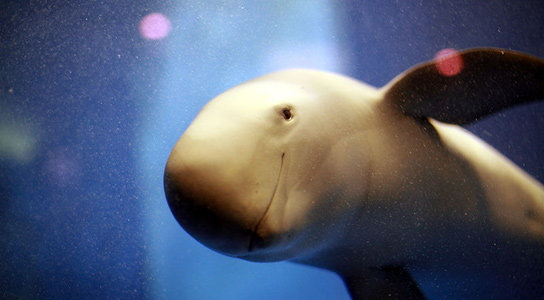
    Finless Porpoise
    Finless Porpoise at Miyajima Aquarium, Japan. Credit: ori2uru/Flickr

    A six-week survey of the Yangtze River’s middle and lower stretches by the Chinese Academy of Sciences’ Institute of Hydrobiology (IHB) in Wuhan and the conservation group WWF in China has concluded that the Yangtze finless porpoises (Neophocaena phocaenoides asiaeorientalis) are being driven to the brink of extinction by fishing, pollution, and other human activities.

    The final results will be announced in March, but the preliminary findings are worrisome to scientists. The survey team spotted fewer than half of the N. p. asiaeorientalis that were seen during a similar fact-finding expedition in 2006 that found 1,225 living in the river¹.

    N. p. asiaeorientalis is doing much worse than previously thought. N. p. asiaeorientalis is one of the few extant freshwater cetaceans and it is only found in the Yangtze, as well as two adjoining lakes, the Poyang and the Dongting. Scientists hope that the species can avoid the fate of the Yangtze River dolphin (Lipotes vexillifer), which was declared effectively extinct after the 2006 survey¹.

    There are 450 N. p. asiaeorientalis in Poyang Lake, and that population has been stable for the past six years. Only 90 remained in Dongting Lake, which is a decline of 40%. This means that there are only about 1,000 finless porpoises in the Yangtze River basin.

    Intense human activity is to blame, states Lei Gang, director of the WWF China’s freshwater program. Overfishing has caused a big decline in the porpoises’ natural food source. The animals are also vulnerable to unregulated fishing methods, like electro-fishing, which sends electrical currents into the water to stun fish before they are caught.

    The Yangtze supports 40% of China’s population, and most of its banks are lined with large cities, factories and power plants. This causes 20 billion tonnes of waste to be discharged into the Yangtze every year. This estimate doesn’t even include diffuse pollution from agriculture or pollution caused by ships.

    N. p. asiaeorientalis uses sonar for navigation, ranging and foraging. The high density of ships along the Yangtze creates high levels of acoustic pollution, which interferes with the animals’ sonar. This affects their feeding and many are also wounded and die because of collisions with ships.

    The new estimate will probably make N. p. asiaeorientalis join the critically endangered list of the IUCN. They were already endangered. Within 15 years, they might be completely extinct.

    Reference: “Abundance and conservation status of the Yangtze finless porpoise in the Yangtze River, China” by Xiujiang Zhao, Jay Barlow, Barbara L. Taylor, Robert L. Pitman, Kexiong Wang, Zhuo Wei, Brent S. Stewart, Samuel T. Turvey, Tomonari Akamatsu, Randall R. Reeves and Ding Wang, 21 October 2008, Biological Conservation.
    DOI: 10.1016/j.biocon.2008.09.005

    Never miss a breakthrough: Join the SciTechDaily newsletter.
    Follow us on Google and Google News.

    Cetology Conservation Wildlife
    Share. Facebook Twitter Pinterest LinkedIn Email Reddit

    Related Articles

    New Zealand’s Endangered Birds Find Refuge in Ancient Moa Habitats

    New Global Study Confirms: Conservation Actually Works

    Footprint Forensics: How DNA From Polar Bears’ Snow Tracks Aids Conservation

    Cryo Conservation – A Cool Solution to Saving Species From Extinction

    Unexpected Dietary Habits of Elephants: Surprising Variation in Meals, Similar to Humans

    Are Bats to Blame for the Coronavirus Crisis? Q&A With Wildlife Biologist

    Elephants Are More Likely to Die at the Hands of Humans Than From Natural Causes

    US Ichthyologists Claim Political Interference

    Hunters Kill Yellowstone Park Research Wolves

    Leave A Reply Cancel Reply

    • Facebook
    • Twitter
    • Pinterest
    • YouTube

    Don't Miss a Discovery

    Subscribe for the Latest in Science & Tech!

    Trending News

    Millions Take These IBS Drugs, But a New Study Finds Serious Risks

    Scientists Unlock Hidden Secrets of 2,300-Year-Old Mummies Using Cutting-Edge CT Scanner

    Bread Might Be Making You Gain Weight Even Without Eating More Calories

    Scientists Discover Massive Magma Reservoir Beneath Tuscany

    Europe’s Most Active Volcano Just Got Stranger – Here’s Why Scientists Are Rethinking It

    Alzheimer’s Symptoms May Start Outside the Brain, Study Finds

    Millions Take This Popular Supplement – Scientists Discover a Concerning Link to Heart Failure

    The Universe Is Expanding Too Fast and Scientists Can’t Explain Why

    Follow SciTechDaily
    • Facebook
    • Twitter
    • YouTube
    • Pinterest
    • Newsletter
    • RSS
    SciTech News
    • Biology News
    • Chemistry News
    • Earth News
    • Health News
    • Physics News
    • Science News
    • Space News
    • Technology News
    Recent Posts
    • Doctors Surprised by the Power of a Simple Drug Against Colon Cancer
    • Why Popular Diabetes Drugs Like Ozempic Don’t Work for Everyone: The “Genetic Glitch”
    • Scientists Create Improved Insulin Cells That Reverse Diabetes in Mice
    • Scientists Stunned After Finding Plant Thought Extinct for 60 Years
    • A Common Diabetes Drug May Hold the Key to Stopping HIV From Coming Back
    Copyright © 1998 - 2026 SciTechDaily. All Rights Reserved.
    • Science News
    • About
    • Contact
    • Editorial Board
    • Privacy Policy
    • Terms of Use

    Type above and press Enter to search. Press Esc to cancel.