
Close Menu
    Facebook X (Twitter) Instagram
    SciTechDaily
    • Biology
    • Chemistry
    • Earth
    • Health
    • Physics
    • Science
    • Space
    • Technology
    Facebook X (Twitter) Pinterest YouTube RSS
    SciTechDaily
    Home»Science»7 Million Years Old – New Secrets of the Oldest Representative of Humanity Revealed
    Science

    7 Million Years Old – New Secrets of the Oldest Representative of Humanity Revealed

    By CNRSSeptember 10, 2022No Comments5 Mins Read
    Facebook Twitter Pinterest Telegram LinkedIn WhatsApp Email Reddit
    Share
    Facebook Twitter LinkedIn Pinterest Telegram Email Reddit
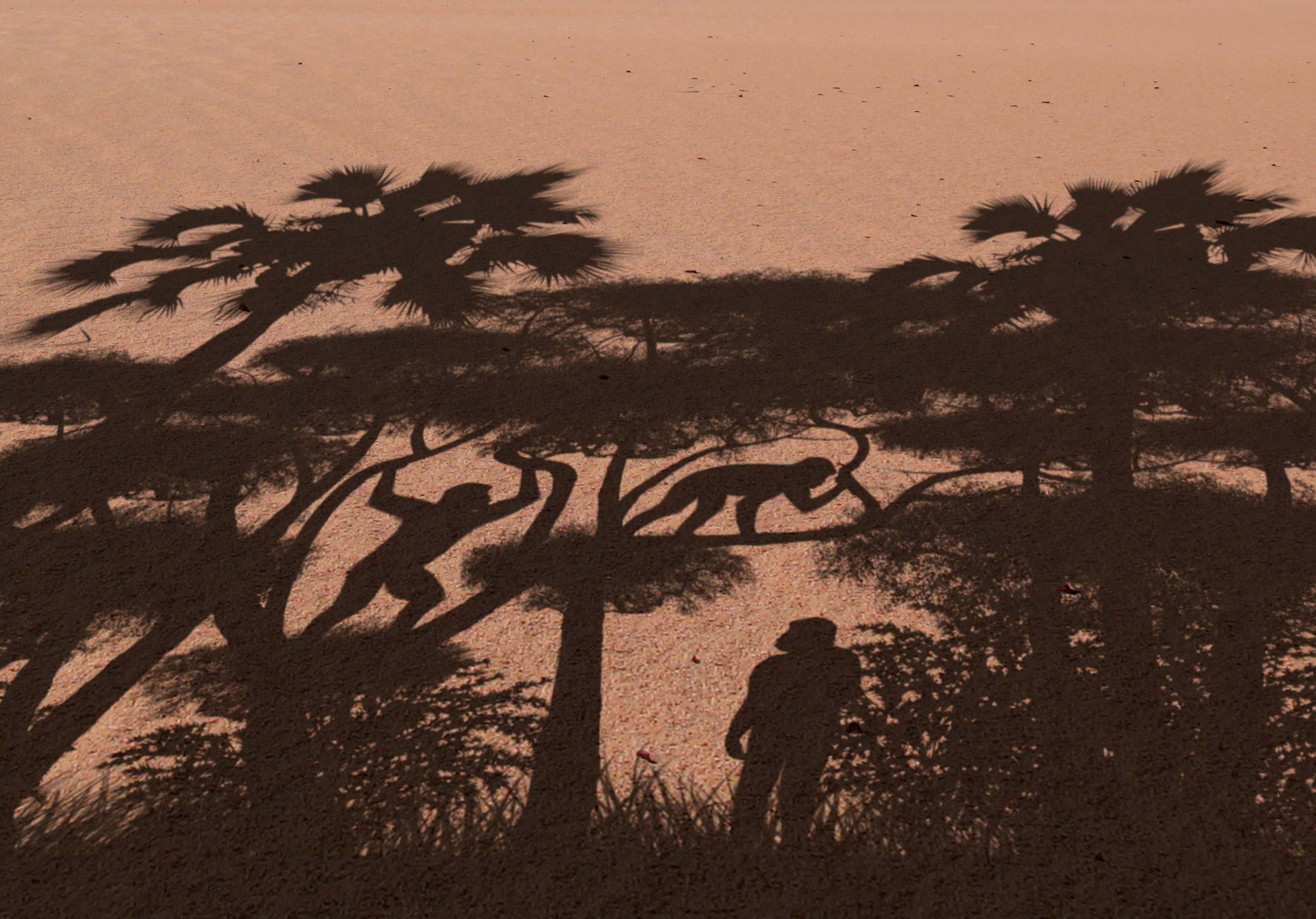
    Representation of the Modes of Locomotion Practiced by Sahelanthropus
    Representation of the modes of locomotion practiced by Sahelanthropus. Bipedalism was common among the earliest known representatives of humankind, probably on the ground but also in trees. It coexisted with other types of movement in a tree environment, including quadrupedal movement using firm hand grips, clearly differing from that of gorillas and chimpanzees who use the back of their phalanges for support (“knuckle-walking”). Credit: Sabine Riffaut, Guillaume Daver, Franck Guy / PALEVOPRIM / CNRS – University of Poitiers

    A new study reveals that Sahelanthropus tchadensis, the oldest representative species of humanity, was bipedal.

    It is believed that the development of bipedalism was a turning point in human evolution. However, there is disagreement over its modalities and age, notably due to the fact there are no fossilized remains. Researchers from the University of Poitiers, the French National Centre for Scientific Research (CNRS), and its Chadian partners analyzed three limb bones from Sahelanthropus tchadensis, the earliest known representative of the human genus. The study, which was recently published in the journal Nature, supports the hypothesis that bipedalism was developed extremely early in human history, at a time still associated with the ability to move on four limbs in trees.
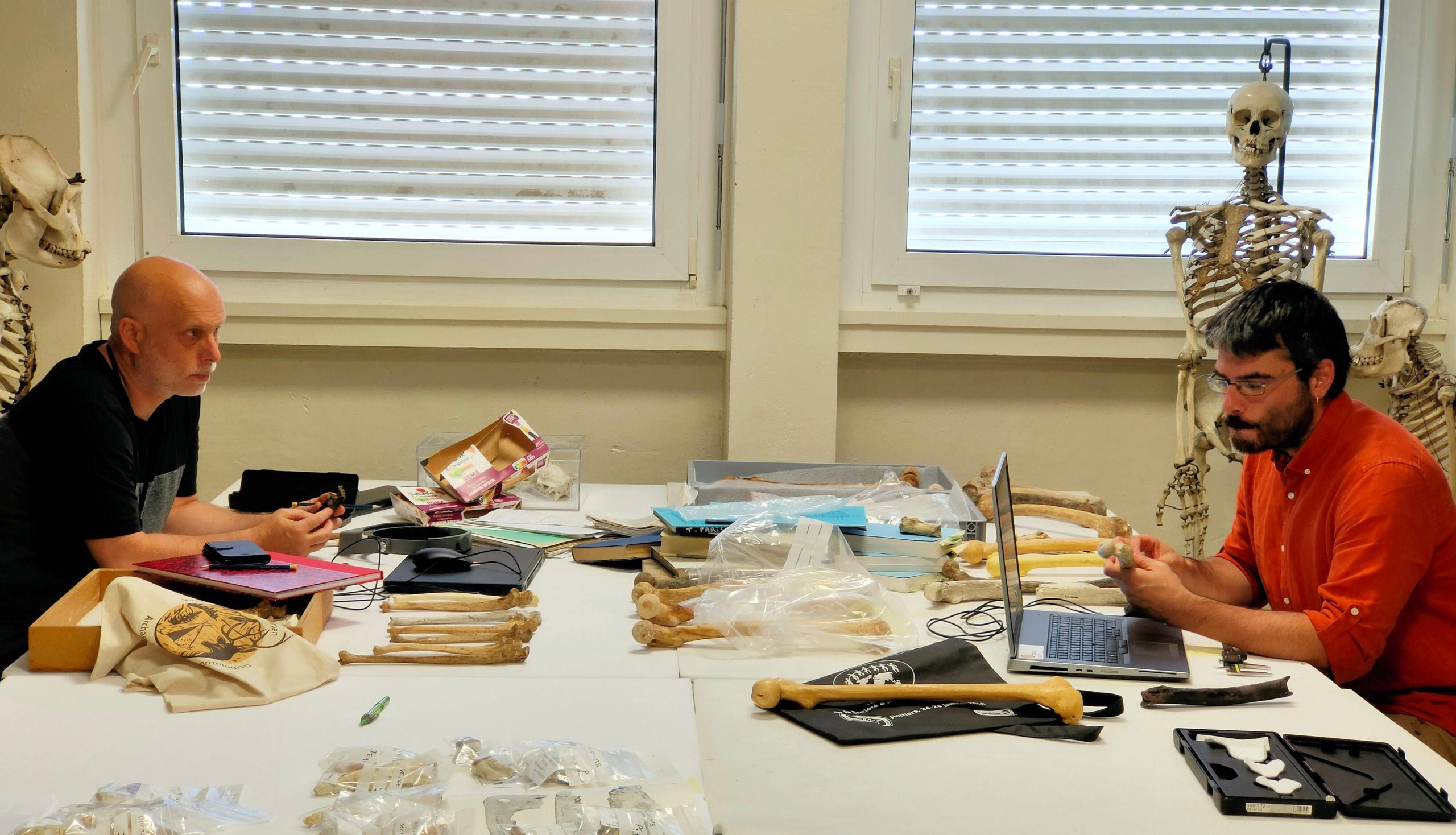
    Franck Guy and Guillaume Daver
    Collection working session between Franck Guy (left) and Guillaume Daver (right), at the PALEVOPRIM laboratory, Poitiers (CNRS/University of Poitiers). Credit: Franck Guy / PALEVOPRIM / CNRS – University of Poitiers

    Sahelanthropus tchadensis is considered the earliest representative species of humans, dating back 7 million years. Its description goes back to 2001 when the Franco-Chadian Paleoanthropological Mission (MPFT) uncovered the bones of three people at Toros-Menalla in the Djurab Desert (Chad), including a particularly well-preserved cranium. This cranium, particularly the orientation and anterior location of the occipital foramen where the spinal column is inserted, reveals a form of locomotion on two legs, implying that it was capable of bipedalism.

    In addition to the cranium, nicknamed Toumaï, and fragments of jaws and teeth that have already been published, the locality of Toros-Menalla 266 (TM 266) yielded two ulnae (forearm bone) and a femur (thigh bone). These bones were also attributed to Sahelanthropus because no other large primate was found at the site; however, it is impossible to know if they belong to the same individual as the cranium. Paleontologists from the University of Poitiers, the CNRS, the University of N’Djamena, and the National Centre of Research for Development (CNRD, Chad) recently published their complete analysis in Nature.
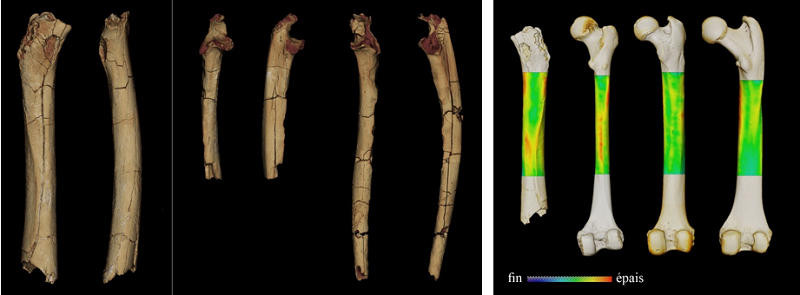
    3D Models Sahelanthropus Tchadensis
    Left: 3D models of the postcranial material of Sahelanthropus tchadensis. From left to right: the femur, in posterior and medial view; the right and left ulnae, in anterior and lateral view. Right: Example of analysis performed to interpret the locomotor mode of Sahelanthropus tchadensis. 3D cortical thickness variation map for the femurs of (from left to right) Sahelanthropus, an extant human, a chimpanzee, and a gorilla (in posterior view). This analysis enables us to understand the variations of mechanical constraints on the femur and to interpret these constraints in terms of locomotor mode. Credit: Franck Guy / PALEVOPRIM / CNRS – University of Poitiers

    The femur and ulnae were subjected to a battery of measurements and analyses, concerning both their external morphology and their internal structures using microtomography imaging: biometric measurements, geometric morphometrics, biomechanical indicators, etc. These data were compared to those of a relatively large sample of extant and fossil apes: chimpanzees, gorillas, orangutans, Miocene apes, and members of the human group (Orrorin, Ardipithecus, australopithecines, ancient Homo, Homo sapiens).

    The structure of the femur indicates that Sahelanthropus was usually bipedal on the ground, but probably also in trees. According to results from the ulnae, this bipedalism coexisted in arboreal environments with a form of quadrupedalism, that is arboreal clambering enabled by firm hand grips, clearly differing from that of gorillas and chimpanzees who lean on the back of their phalanges.
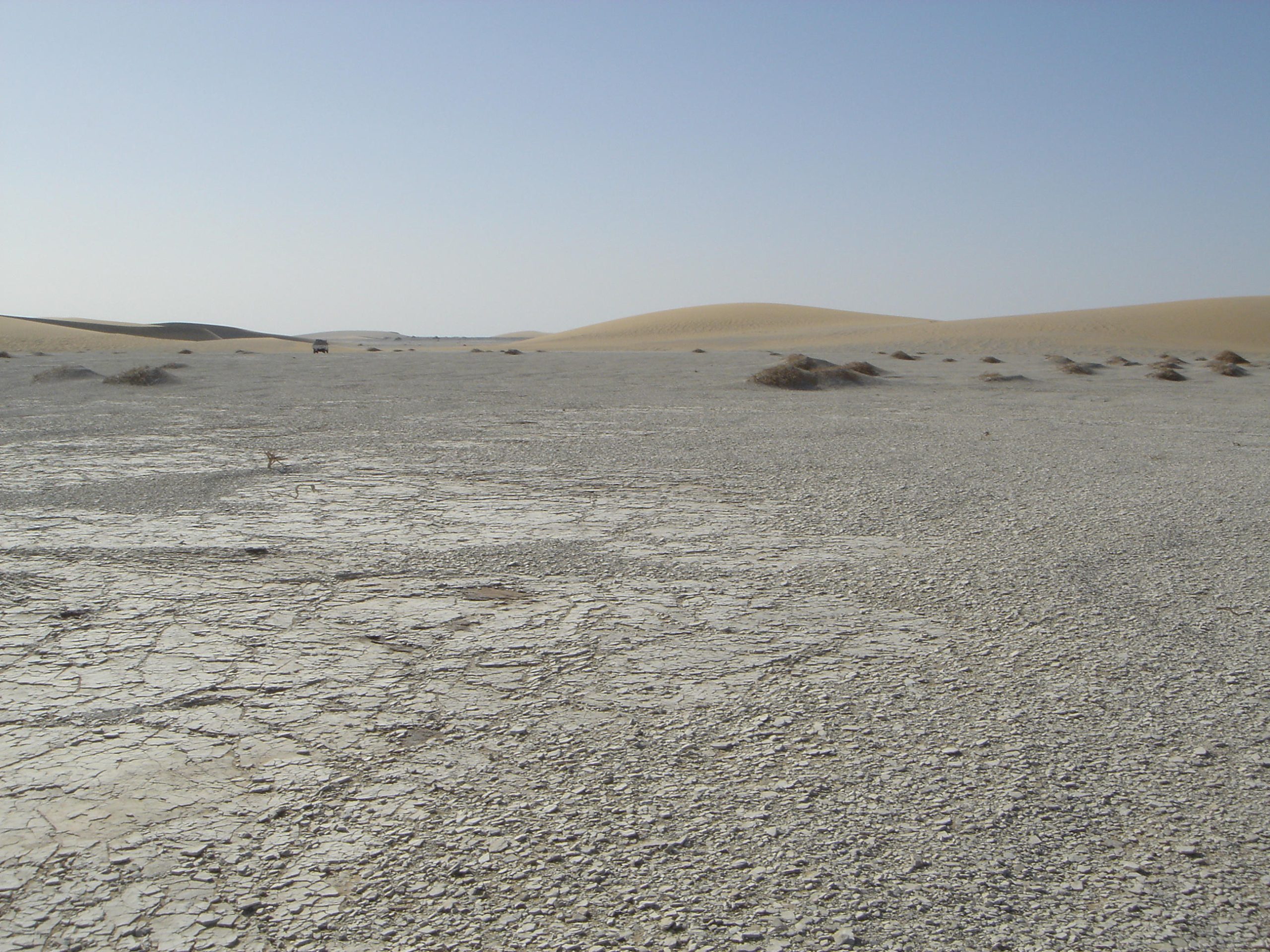
    Djurab Desert
    The Djurab Desert, where the fossil sites that yielded the postcranial remains of Sahelanthropus tchadensis are located. Credit: MPFT, PALEVOPRIM / CNRS – University of Poitiers

    The conclusions of this study, including the identification of habitual bipedalism, are based on the observation and comparison of more than twenty characteristics of the femur and ulnae. They are, by far, the most parsimonious interpretation of the combination of these traits. All these data reinforce the concept of very early bipedal locomotion in human history, even if at this stage other modes of locomotion were also practiced.

    This work was supported by the French Ministry for Europe and Foreign Affairs, the Chadian Government, the French National Research Agency (ANR), the Nouvelle-Aquitaine Region, the CNRS, the University of Poitiers and the French representation in Chad. It is dedicated to the memory of the late Yves Coppens, precursor and inspirer of the MPFT’s work in the Djourab Desert.

    Reference: “Postcranial evidence of late Miocene hominin bipedalism in Chad” by G. Daver, F. Guy, H. T. Mackaye, A. Likius, J. -R. Boisserie, A. Moussa, L. Pallas, P. Vignaud and N. D. Clarisse, 24 August 2022, Nature.
    DOI: 10.1038/s41586-022-04901-z

    The study was funded by the Région Nouvelle-Aquitaine, Université de Poitiers, and the Centre National de la Recherche Scientifique.

    Never miss a breakthrough: Join the SciTechDaily newsletter.
    Follow us on Google and Google News.

    CNRS Evolution Humans Paleoanthropology Popular
    Share. Facebook Twitter Pinterest LinkedIn Email Reddit

    Related Articles

    41,000-Year-Old Bones Reveal Chilling Pattern of Neanderthal Cannibalism

    1.77-Million-Year-Old Fossil Challenges Human Big Brain Theory

    Who Were the First Modern Humans To Settle in Europe? Scientists Shed New Light

    The Most Dynamic and Impactful – How the Last 12,000 Years Have Shaped What Humans Are Today

    New Study Uncovers Surprising Connection Between Evolution and Discrimination

    Accurate Hominin Data: Getting the Fossil Record Right on Human Evolution

    Early Humans Used Bone Tools To Produce Clothing in Morocco 120,000 Years Ago

    Stickleback Fish Used Pre-Existing Genes to Go from Saltwater to Freshwater Environments

    Humans Implicated in Africa’s Deforestation 3,000 Years Ago

    Leave A Reply Cancel Reply

    • Facebook
    • Twitter
    • Pinterest
    • YouTube

    Don't Miss a Discovery

    Subscribe for the Latest in Science & Tech!

    Trending News

    Scientists May Have Found the Key to Jupiter and Saturn’s Moon Mystery

    Scientists Uncover Brain Changes That Link Pain to Depression

    Saunas May Do More Than Raise Body Temperature – They Activate Your Immune System

    Exercise in a Pill? Metformin Shows Surprising Effects in Cancer Patients

    Hidden Oceans of Magma Could Be Protecting Alien Life

    New Study Challenges Alzheimer’s Theories: It’s Not Just About Plaques

    Artificial Sweeteners May Harm Future Generations, Study Suggests

    Splashdown! NASA Artemis II Returns From Record-Breaking Moon Mission

    Follow SciTechDaily
    • Facebook
    • Twitter
    • YouTube
    • Pinterest
    • Newsletter
    • RSS
    SciTech News
    • Biology News
    • Chemistry News
    • Earth News
    • Health News
    • Physics News
    • Science News
    • Space News
    • Technology News
    Recent Posts
    • As Cities Invade the Amazon, Yellow Fever Makes a Dangerous Comeback
    • “Asian Flush” May Be a Hidden Trigger for Deadly Heart Damage
    • AI Could Detect Early Signs of Alzheimer’s in Under a Minute – Far Before Traditional Tests
    • What if Dark Matter Has Two Forms? Bold New Hypothesis Could Explain a Cosmic Mystery
    • Researchers Expose Hidden Chemistry of “Ore-Forming” Elements in Biology
    Copyright © 1998 - 2026 SciTechDaily. All Rights Reserved.
    • Science News
    • About
    • Contact
    • Editorial Board
    • Privacy Policy
    • Terms of Use

    Type above and press Enter to search. Press Esc to cancel.