
Nazi Germany’s final nuclear reactor was nowhere near ready, lacking roughly half the uranium and heavy water it needed to work.
When American forces dismantled Nazi Germany’s final experimental nuclear reactor in 1945, they found a machine that its scientific leader, Werner Heisenberg, would later describe as tantalizingly close to working. Known as the B8 pile, the reactor relied on natural uranium and heavy water to sustain the neutron reactions needed to reach criticality. Yet new analysis suggests that no amount of last-minute engineering could have pushed the design across that threshold. Germany simply lacked enough of the essential materials.
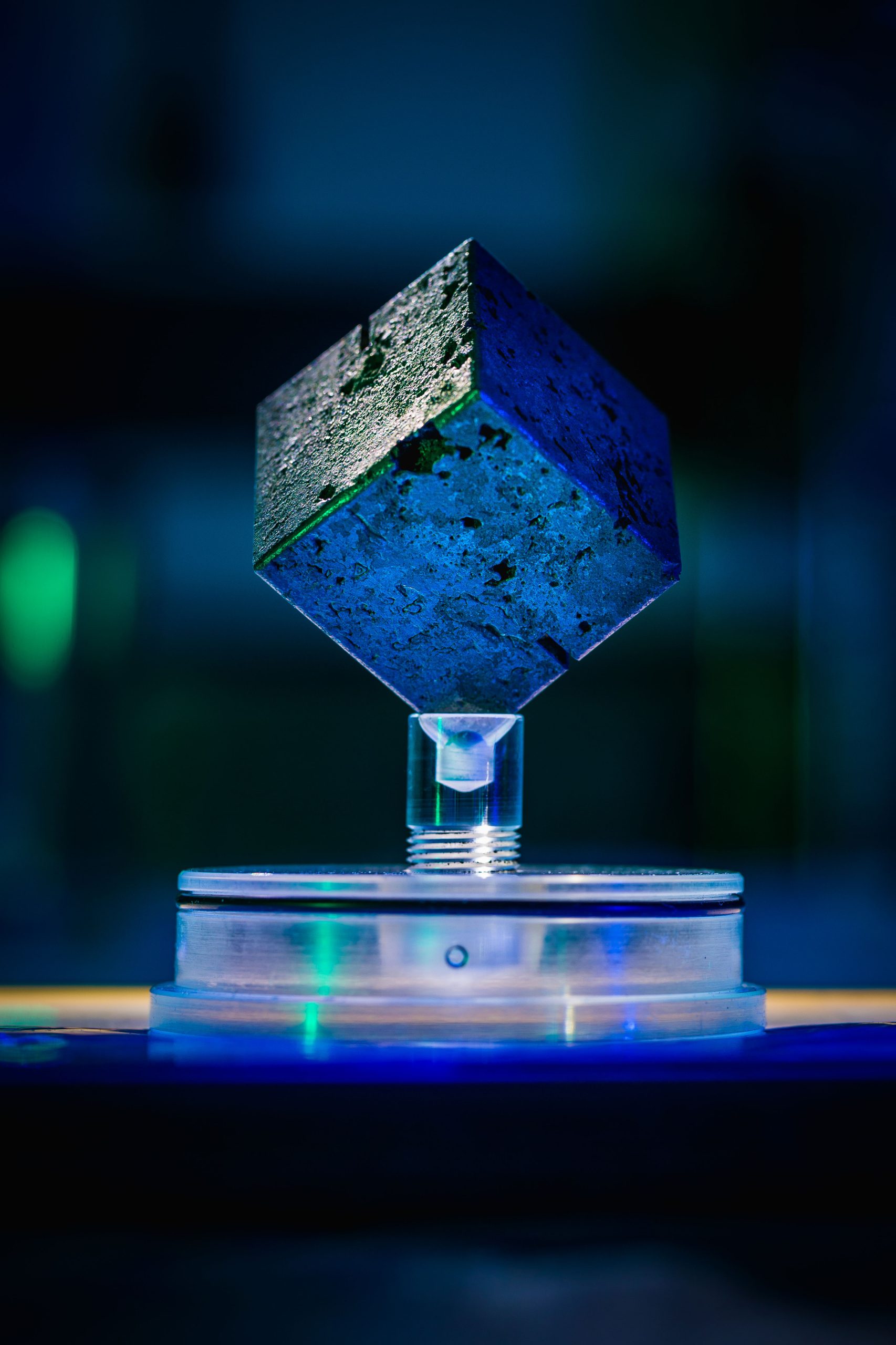
Reconstructing the B8 pile decades later, Timothy Koeth and his colleagues analyzed two surviving cubes of natural uranium from Germany’s wartime nuclear program alongside historical records, technical reports, correspondence, and other archival material. Their goal was to test Heisenberg’s claim against the physical requirements of the reactor itself.
Heavy water became a fatal constraint
For a reactor to become critical, neutrons released by splitting uranium atoms must trigger enough additional fissions to sustain a chain reaction. Some of those neutrons move too quickly to efficiently continue the process, so a reactor uses a moderator to slow them down. German scientists chose heavy water, a form of water containing the heavier hydrogen isotope deuterium, for that job.
Supplying that heavy water created a severe bottleneck. Germany had access to only one source, the Norsk Hydro plant at Vemork, Norway, which came under German control in April 1940. Allied efforts repeatedly targeted the facility and its production, and bombing destroyed the plant in November 1944, cutting off a material that the German reactor design depended on.
The material shortfall was enormous
Calculating what the B8 pile would actually have needed, Koeth and his colleagues found a gap far larger than Heisenberg’s account implied. Reaching criticality would have required about twice as much uranium as the reactor contained. Even more importantly, the design would have needed roughly twice as much heavy water as Norsk Hydro produced during the entire war.
The researchers say, “The gap … may appear small numerically, but the material cost of closing it would have far exceeded Germany’s total production capacity.”
Replacing the missing heavy water with graphite would not have solved the problem. Although graphite can serve as a neutron moderator in some reactor designs, the graphite available in German-controlled territory was not suitable for the job, according to the researchers. That left the project tied to a scarce material Germany could not obtain in anything close to the necessary quantity.
Germany was far from criticality
Those shortages change the historical picture of the wartime nuclear race. The Manhattan Project was driven in part by the fear that Nazi Germany might build a nuclear weapon first, and one possible route to bomb material involved operating a reactor capable of producing fissile material. Yet the German program’s final reactor was not merely one adjustment away from success. Its basic design demanded quantities of uranium and heavy water that Germany did not possess.
By the time American forces reached the B8 pile in 1945, the reactor may have looked like the remains of a nuclear program approaching a dangerous milestone. The surviving uranium cubes and wartime records tell a different story. Even if the machine had remained intact, the materials needed to make it work were still far beyond Germany’s reach.
Reference: “Nuclear archaeology reassesses Heisenberg’s last reactor experiment” by Patrick J Park, Brittany Robertson, Miriam E Hiebert, Jason Zhao, Ciara B Sivels and Timothy W Koeth, 29 September 2026, PNAS Nexus.
DOI: 10.1093/pnasnexus/pgag282
Never miss a breakthrough: Join the SciTechDaily newsletter.
Follow us on Google and Google News.