
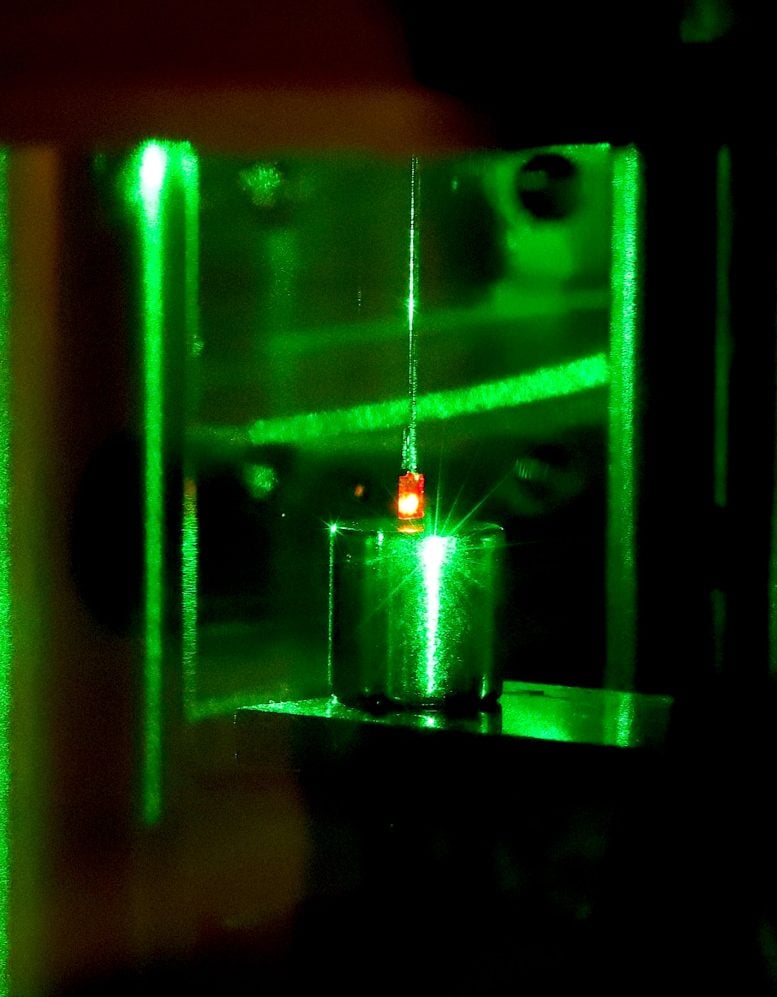
Electrons inside a diamond have given a floating, centimeter-sized device a quantum nudge, opening a new path toward testing how quantum physics and gravity fit together.
Researchers at the Okinawa Institute of Science and Technology (OIST) have used electron spin inside a diamond to drive the motion of a centimeter-scale (roughly 0.4-inch-scale) levitating device. Published in Science Advances, the experiment offers a new way to explore quantum effects in objects massive enough to matter in future investigations of gravity.
Quantum mechanics already makes lasers, MRI scanners, semiconductors, and quantum computers possible. But testing its stranger predictions in larger objects is difficult because heat, vibration, and other environmental disturbances can overwhelm delicate quantum behavior.
A Quantum Push on a Larger Scale
“There have been many efforts to test whether quantum mechanics holds for anything larger than a few tens of nanometers, so far without success. Now, we have observed a classical mechanical response to a quantum force on an object that is eight to nine orders of magnitude more massive than the current state-of-the-art spin-mechanical experiments,” said Professor Jason Twamley of OIST’s Quantum Machines Unit.
The device is roughly 100 million to a billion times more massive than the objects used in the spin-mechanical experiments Twamley describes.
The team’s long-term goal is to test whether gravity follows quantum rules by placing a sufficiently massive object in a superposition of different locations. So far, positional superposition has only been demonstrated in microscopic systems, whose gravitational effects are extremely weak.
“To test the quantum nature of gravity, we ultimately need to put objects with large enough masses into quantum superposition. And these objects need to be levitated in a vacuum to minimize the influence of environmental noise,” said first author Anshuman Nayak, a PhD student in the unit.
Starting Big Instead Of Scaling Up
Many researchers approach the problem by levitating tiny objects and attempting to increase their size. The OIST team is working from the other direction, using magnetic levitation to support a larger device before developing finer quantum control.
“The typical approach has been to start with extremely small, levitated objects and gradually increase their mass until the effects of gravity become relevant. But levitating macroscale objects using conventional techniques, such as optical traps, has proven extremely challenging. That’s why we’re in the opposite camp — going from large to small. Just as diamagnetic levitation can lift maglev trains, it can also be used to levitate centimeter-wide objects holding diamonds, where the effect of gravity can be extremely strong, but quantum effects have not been observed,” Nayak said.
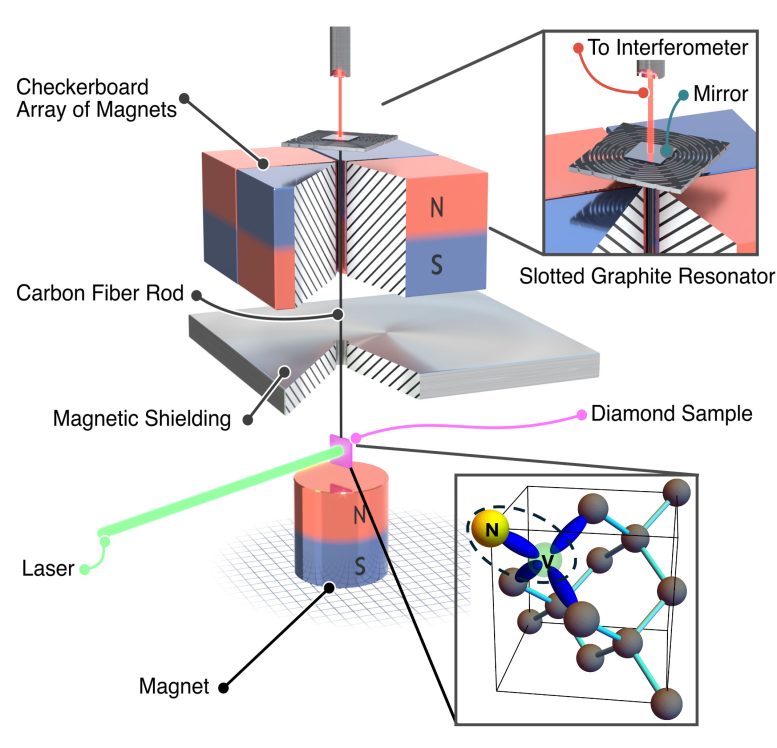
The apparatus combined components the group had previously developed. A diamagnetically levitated graphite plate held a small mirror and supported a diamond through a carbon rod. The rod passed through magnetic shielding, with the diamond hanging above a magnet.
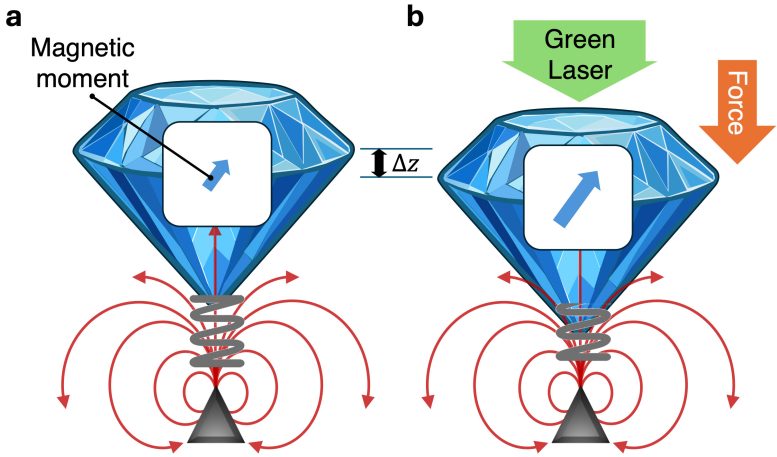
The diamond contained billions of nitrogen-vacancy (NV) centers, defects that hold unpaired electrons. Their quantum property called spin allows these centers to act as tiny magnets whose behavior the researchers can control.
Laser Pulses Turn Spin Into Motion
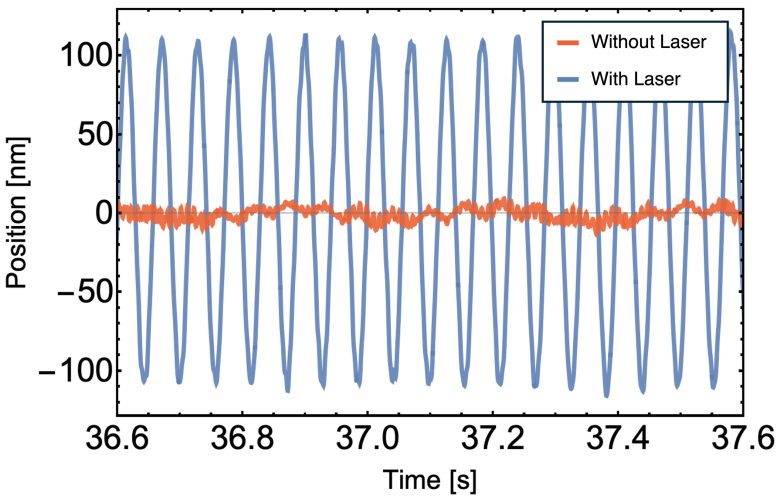
Green laser pulses prepared the NV centers in a selected spin state. This altered the diamond’s magnetic response, generating a small downward force that moved the suspended device.
A separate laser reflected off the mirror on the graphite plate into an interferometer. This instrument measured changes in position with picometer precision, a scale corresponding to trillionths of a meter.
“NV diamonds are well understood and easy to control. That, and the fact that NV centers have some of the longest known coherence times, allowing them to maintain quantum superposition at room temperature much longer than other systems, makes them particularly attractive for generating macroscopic superposition of the motion or object in future research,” said co-author Daehee Kim, a PhD student in the unit.
Diamond’s durable quantum states could give researchers a way to control motion at much larger scales. The next challenge is to extend that control from producing ordinary motion to preparing genuinely quantum states of the device’s motion.
Toward Quantum Gravity And Sharper Sensors
Einstein wrestled with the foundations of quantum mechanics late in his life, and its relationship with gravity remains unresolved. Questions about gravity’s quantum nature, information in black holes, dark matter, and dark energy continue to expose gaps in our understanding of the universe.
Exploring those gaps requires experiments that can put theoretical predictions to the test. The new apparatus could help researchers develop such tests while also paving the way for exceptionally precise sensors to search for dark matter, gravitational waves, and other elusive phenomena.
“We’ve shown a large classical response from a small quantum effect. It’s no longer a question of whether such technology is possible, but of how we can refine experimental conditions to achieve quantum superposition within the regime of Einstein’s general relativity. And on the way, we’re developing a new class of extremely precise sensors. We’re pushing the bar from nanometers to centimeters. All we need is another order of magnitude, and we can finally observe Schrödinger’s cat in real life,” Twamley said.
Reference: “Spin force from a nitrogen-vacancy ensemble drives a 100-mg levitated resonator” by Anshuman Nayak, Daehee Kim, Shilu Tian and Jason Twamley, 7 October 2026, Science Advances.
DOI: 10.1126/sciadv.aeh0566
This study was funded by Okinawa Institute of Science and Technology Graduate University, Japan Science and Technology Agency.
Never miss a breakthrough: Join the SciTechDaily newsletter.
Follow us on Google and Google News.