
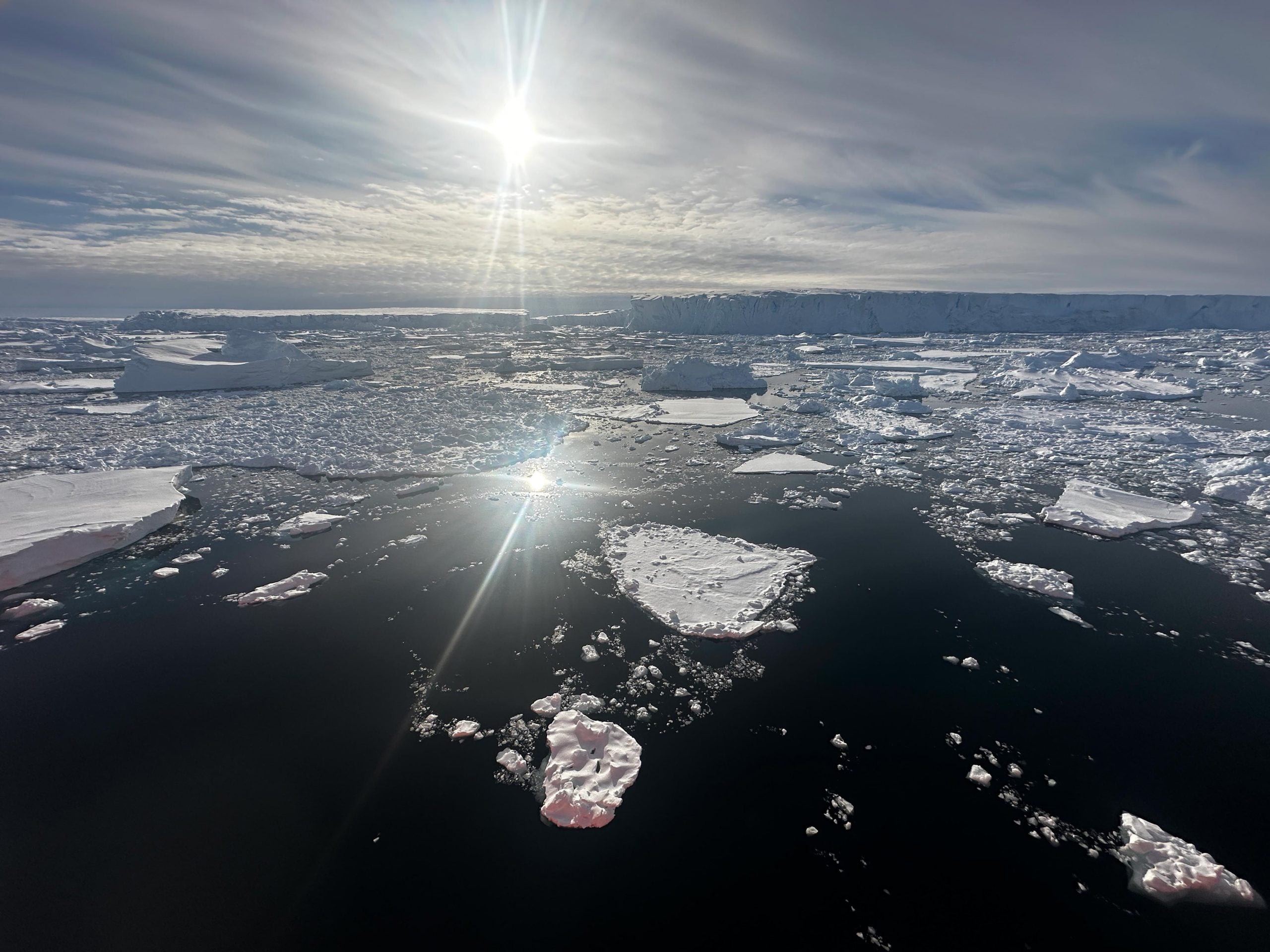
Even without further warming, Thwaites Glacier could contribute twice as much to sea level rise by 2100 as previously estimated, according to a revised ice sheet model.
Thwaites Glacier in West Antarctica has been retreating and thinning rapidly, while satellites show substantial acceleration in its ice flow. Traditional ice sheet models have depicted slower movement, leaving scientists struggling to reconcile their simulations with the observations. The glacier lies in the Amundsen Sea Embayment, a sector responsible for roughly one-third of the Antarctic Ice Sheet’s mass loss.
A new ice sheet model developed by glaciologists at the University of California, Irvine and NASA’s Jet Propulsion Laboratory projects that melting at Thwaites could contribute up to 30 millimeters, or about 1.2 inches, to sea level rise by 2100. That is twice previous estimates, even without additional climate warming. The study was published in Nature Communications.
Warm seawater reaches beneath grounded ice
“Glaciologists have long based their assumptions of ice sheet dynamics on the ‘grounding line,’ a discreet, narrow and mostly stable demarcation where ice leaves the land and begins floating on water,” said lead author Mattia Poinelli, who was a UC Irvine postdoctoral scholar in Earth system science when the study was conducted. “We have come to acknowledge a different arrangement beneath Earth’s major ocean-terminating glaciers. Satellite observations demonstrate the existence of a ‘grounding zone,’ sometimes kilometers wide, where warm ocean water is reaching deep underneath the ice sheets and causing vigorous melting.”
Synthetic aperture radar readings from the Finnish ICEYE satellite constellation allowed the researchers to detect kilometer-scale fluctuations in this zone along the main trunk of Thwaites. The data indicate that seawater penetrates several kilometers beneath grounded ice and lifts it during tidal cycles. This flushes the underside of the ice with pressurized, warm seawater, which currents altered by climate change push toward the Antarctic coastline.
That contact with the ocean affects how firmly the glacier remains anchored to ridges on the seafloor. According to Poinelli, a NASA JPL research affiliate who is now a project scientist at UCLA, the study showed that grounding zone processes accelerate the glacier’s detachment from these stabilizing features, allowing faster ice flow and deterioration.
“The Thwaites main trunk is being temporarily stabilized by the Mouginot Ridge,” he said. “Once that ridge is unpinned, the glacier will continually retreat across a predominantly retrograde seafloor toward its next topographic high, the South Ridge.”
A retrograde seafloor slopes downward farther inland, so retreat would carry the glacier into deeper water before it reaches the next rise in the terrain.
A 60 percent chance of detachment
The researchers calibrated their model against more than 20 years of observations. By including a grounding zone instead of a grounding line, they reconstructed changes in the glacier from the 1990s to the present that were four times as pronounced as those represented in traditional models.
Simulations incorporating a grounding zone 4 to 6 kilometers wide, or about 2.5 to 3.7 miles, predict a 60 percent probability that the glacier will lose its anchoring contact with Mouginot Ridge by the end of the century, Poinelli said. “When you factor in key physical processes and calibrate against historical observations, you gain a reliable pathway for narrowing uncertainty in projections,” he said.
“We have documented and quantified the impacts of climate change on our planet’s sensitive ice sheets for decades, but a mounting realization gained in recent years of what is happening on the undersides of glaciers like Thwaites is leading to an even greater sense of alarm,” said co-author Eric Rignot, UC Irvine professor of Earth system science. “Most projections up-to-present have struggled to match the rapidity of the mass loss because of missing physics; our new model with more complete physics is able to match the record and then produces projections that are twice larger than before. These results predict greater risk of and exposure for coastal flooding than anticipated in the coming decades.”
Reference: “Sea-level contribution from Thwaites Glacier doubles in an observation-constrained ice-sheet model” by Mattia Poinelli, Eric Rignot, Hélène Seroussi, Joshua Cuzzone, Tyler Pelle and Eric Larour, 12 October 2026, Nature Communications.
DOI: 10.1038/s41467-026-77976-1
Never miss a breakthrough: Join the SciTechDaily newsletter.
Follow us on Google and Google News.