
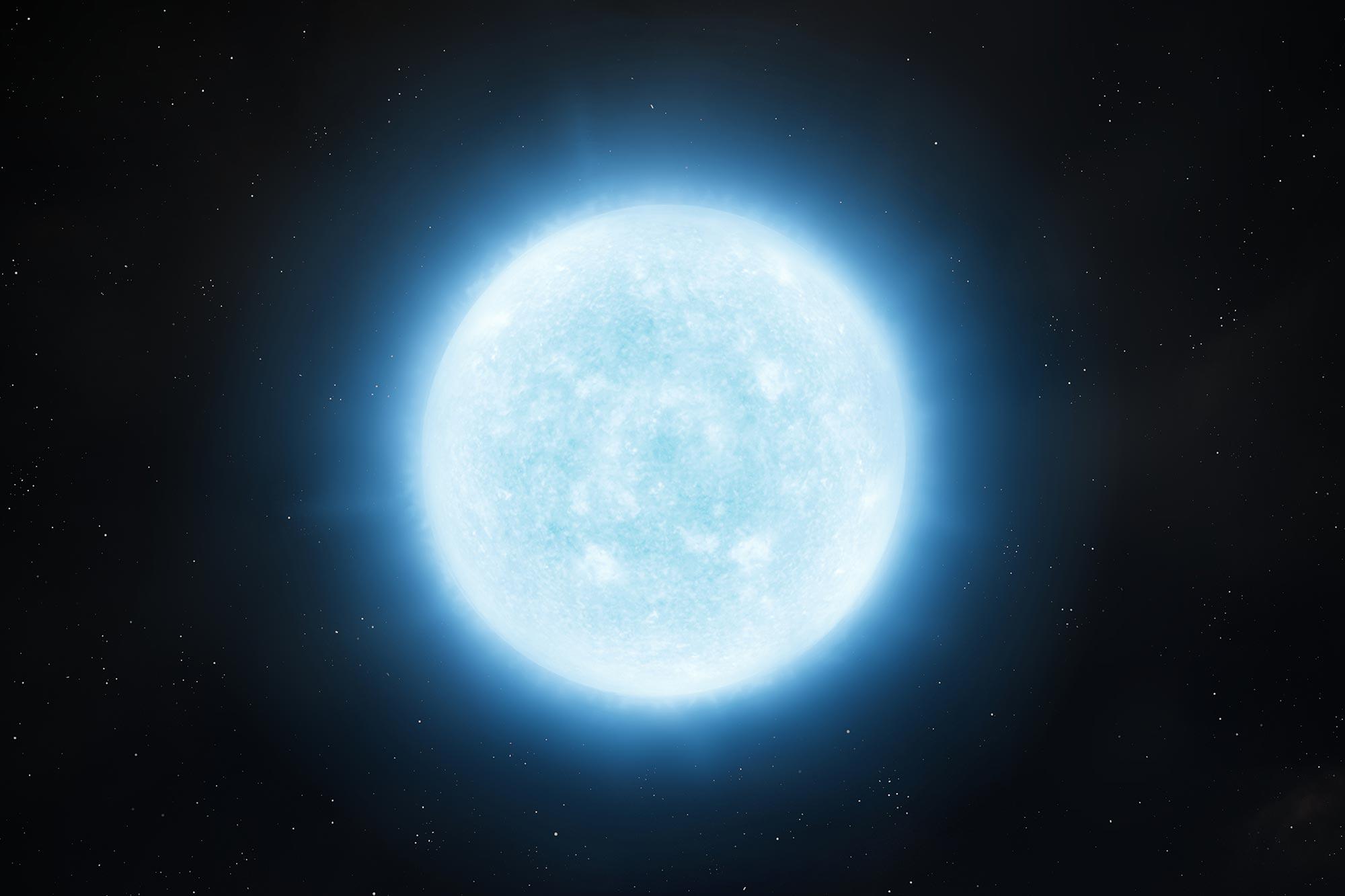
New simulations suggest that powerful internal magnetic fields could allow some white dwarfs to grow far beyond a long-established stellar mass limit.
New research suggests that some white dwarfs, the incredibly dense remnants of dead stars, could grow far heavier than a fundamental limit in astrophysics predicts. Computer simulations show that powerful internal magnetic fields may allow these objects to reach about 2.4 times the Sun’s mass, well beyond the conventional limit of roughly 1.4 solar masses.
The findings, published in The Astrophysical Journal Letters, offer a possible explanation for unusually bright stellar explosions and could have implications for how astronomers measure the expansion of the universe. They also demonstrate a potential evolutionary path through which these exceptionally massive stars could form.
How Magnetic Fields Could Overcome a Stellar Mass Limit
White dwarfs form when stars exhaust their nuclear fuel and lose their outer layers, leaving behind compact cores typically about the size of Earth. Despite their small dimensions, these remnants can contain a substantial fraction of the Sun’s mass. For white dwarfs without strong magnetic fields or rapid rotation, the maximum stable mass is approximately 1.4 solar masses, a threshold known as the Chandrasekhar limit.
Researchers at the Department of Physics, Indian Institute of Science (IISc), and their collaborators found that strong magnetic fields could change this restriction. As a white dwarf draws material from a companion star, its increasing mass causes it to become denser and contract. This compression strengthens its internal magnetic field, generating additional pressure that helps counteract gravity and allows the star to support more mass than conventional models predict.
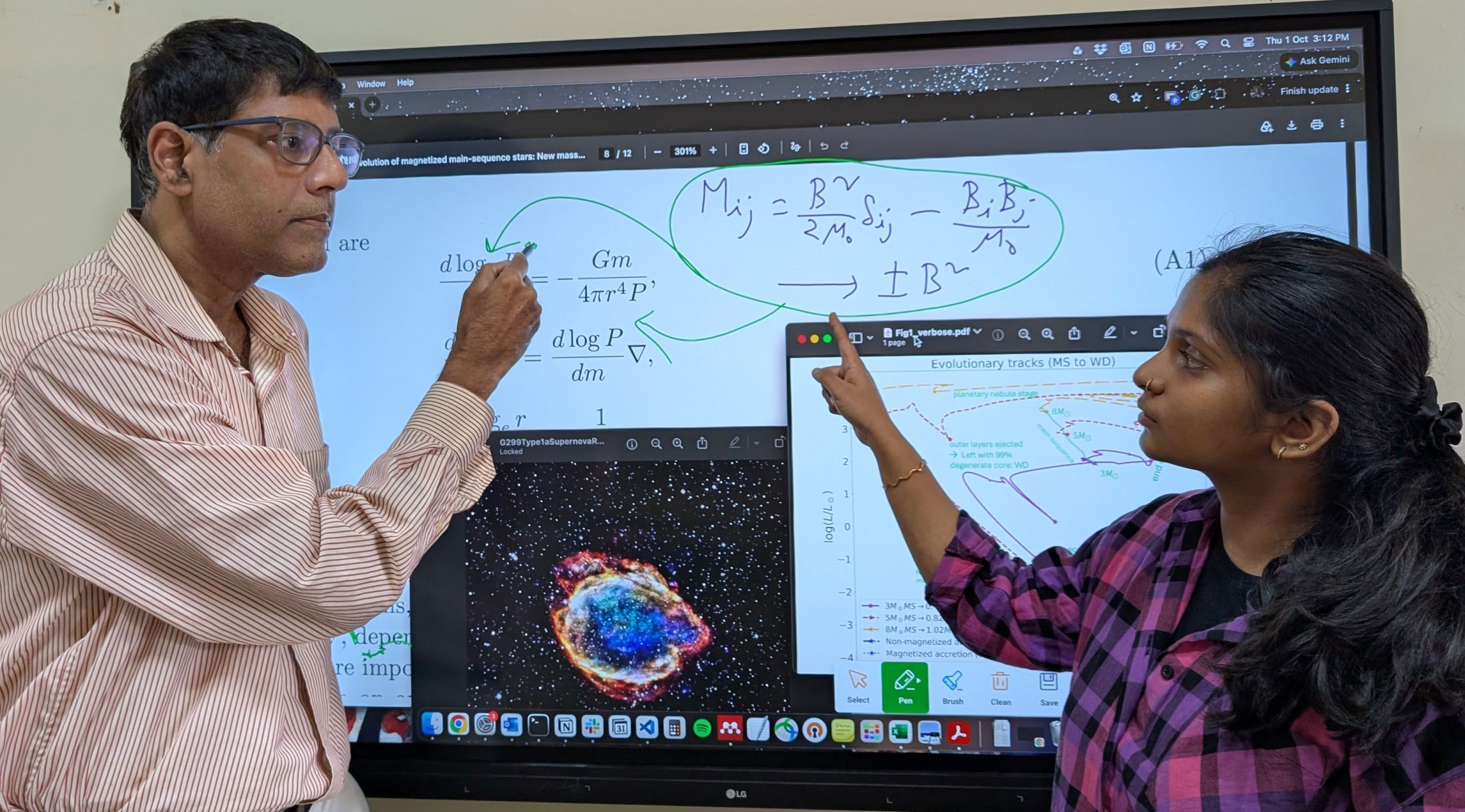
The simulations also suggest that magnetic fields can alter the relationship between a white dwarf’s mass and radius. This effect could help explain observations of certain low-mass white dwarfs that appear larger than expected.
Simulating the Evolution of an Exceptionally Massive White Dwarf
To investigate whether such objects could actually develop through stellar evolution, the scientists modified STARS, a computer program developed at the University of Cambridge. They incorporated the effects of magnetic fields and white dwarf cooling, allowing them to follow a star from its main-sequence phase, when hydrogen fusion powers its core, through its transformation into a white dwarf. They then modeled how the remnant would evolve as it accumulated material from a companion star.
In one simulation, a star initially eight times the Sun’s mass produced a carbon-oxygen white dwarf weighing approximately 1.02 solar masses. When the remnant gained material at a rate of 10⁻⁹ solar masses per year, its magnetic field strengthened enough to support a modeled mass limit of approximately 2.4 solar masses. Under comparable conditions without magnetic effects, the limit remained near 1.4 solar masses.
“The important question was not simply whether a super-Chandrasekhar white dwarf is possible, but whether a star can actually evolve into one,” says Zenia Zuraiq, first author of the study and PhD student at the Department of Physics. “Our simulations allowed us to follow that evolutionary pathway from the main-sequence star to the white dwarf, and show that under certain conditions, such a pathway is possible.”
A Longstanding Theory Gains Support From Simulations
The possibility of white dwarfs exceeding the Chandrasekhar limit has been explored theoretically for decades. Astronomers have also observed unusually luminous Type Ia supernovae, raising the possibility that some originate from white dwarfs substantially more massive than expected. Previous interpretations have suggested progenitor masses, and possible upper limits, approaching 2.8 times the Sun’s mass.
The new study builds on an investigation that began more than a decade ago. “The idea started in 2011, when a summer student came to me and I gave him a problem quite casually: to check whether the Chandrasekhar limit can be violated by a magnetic field,” explains Banibrata Mukhopadhyay, Professor at the Department of Physics and corresponding author of the study published in The Astrophysical Journal Letters.
Unlike calculations that examine whether an unusually massive white dwarf could remain stable, the new simulations follow the process by which such a remnant might develop. The results support the theoretical possibility of magnetically sustained white dwarfs, although they do not establish how commonly these objects occur in nature.
Possible Implications for Measuring the Expanding Universe
Type Ia supernovae can occur when carbon-oxygen white dwarfs undergo runaway thermonuclear burning. As a white dwarf approaches the Chandrasekhar limit, conditions in its interior can become extreme enough to ignite carbon and potentially trigger a catastrophic explosion.
Astronomers use Type Ia supernovae as standardizable candles to estimate distances across the universe. Although their intrinsic brightness varies, relationships between their luminosity and how their light changes over time allow scientists to calibrate these explosions. Such measurements have played a central role in understanding cosmic expansion.
If some Type Ia supernovae originate from unusually massive, strongly magnetized white dwarfs, differences in their progenitors could influence the properties and brightness of their explosions. Understanding those effects may help astronomers interpret exceptionally luminous supernovae and improve the physical models underlying cosmic distance measurements.
Reference: “Super-Chandrasekhar White Dwarfs by the Evolution of Magnetized Main-sequence Stars: New Mass Limits from STARS Simulation” by Zenia Zuraiq, Banibrata Mukhopadhyay, Achal Kumar, Arnab Sarkar, Alexander J. Hackett, Projjwal Banerjee and Christopher A. Tout, 8 October 2026, The Astrophysical Journal Letters.
DOI: 10.3847/2041-8213/aea97e
Never miss a breakthrough: Join the SciTechDaily newsletter.
Follow us on Google and Google News.