
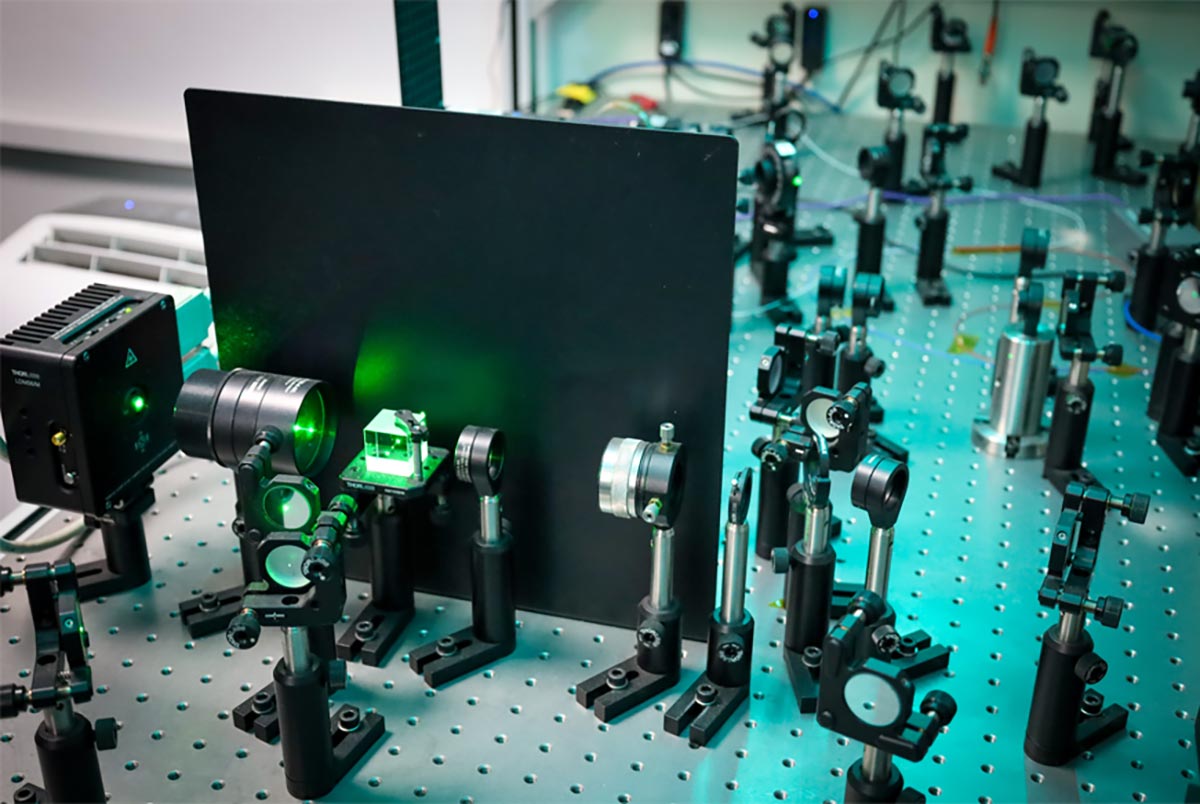
Monitoring electricity in buried cables could one day become easier thanks to an overlooked magnetic effect in optical fibers, although researchers still need to overcome a major sensitivity challenge.
For decades, engineers have used optical fibers to measure magnetic fields around electrical cables, but these sensors generally need to wrap around the conductor to work. Now, researchers in South Africa have discovered that a magnetic field can also affect light when it points sideways across a fiber, challenging an assumption that has guided optical engineering for more than 50 years.
The finding, published in Optics Letters, could eventually lead to sensors that sit alongside electrical cables rather than surrounding them. It may also offer a new way to control light for optical computing.
MSc student Mohammed Raiyan Sharif and Professor Mitchell Cox at the University of the Witwatersrand (Wits University) in Johannesburg demonstrated the previously overlooked interaction, known as the transverse Faraday effect. Their research was conducted at the Wits Optical Communication (OC) Lab in the university’s School of Electrical and Information Engineering.
Optical fibers carry internet signals through thin strands of glass, but they can also detect magnetic fields. This sensing ability relies on the Faraday effect, first observed by Michael Faraday in glass in 1845. When a magnetic field points along the direction light travels, it slightly rotates the light’s polarization, or the direction in which its electric field oscillates. Measuring that rotation can reveal the strength of the magnetic field and the electrical current producing it.
Sideways magnets reshape light patterns
A sideways magnetic field was not expected to produce the same effect. To investigate, Sharif and Cox placed strong magnets beside a stationary multimode optical fiber without touching it, then watched the light emerging from the other end.
Multimode fibers have relatively wide glass cores that allow light to travel along many different paths, repeatedly reflecting off the core’s mirror-like boundary. At the output, the overlapping waves create a pattern of bright and dark spots called speckle, similar to the shifting patterns inside a kaleidoscope.
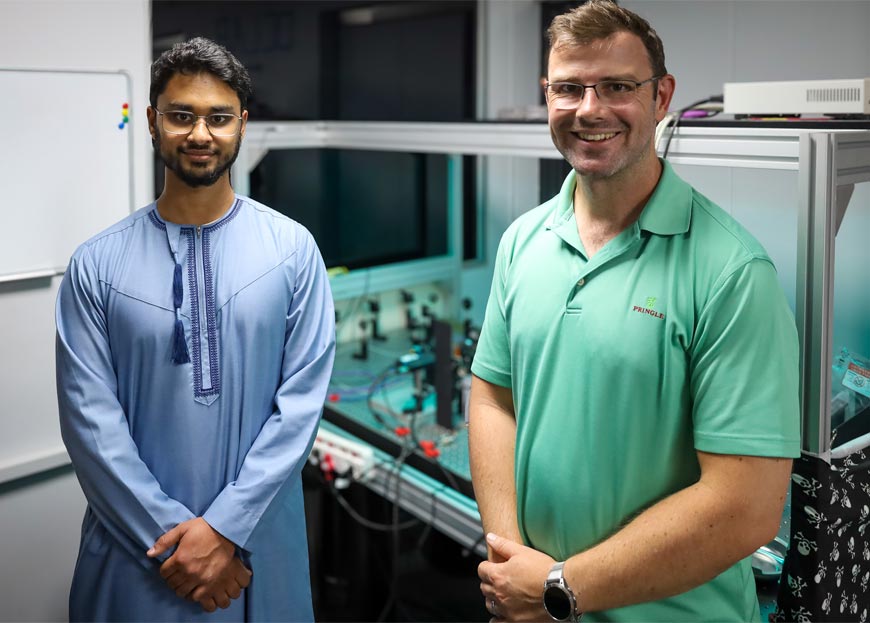
As the researchers rearranged the magnets, a camera recorded changes in that pattern. The sideways magnetic field was somehow altering the light’s behavior inside the fiber.
“It wasn’t hard to 3D print a rig to test our intuition. Working out the theory for what we were seeing was the challenging part,” says Sharif. “The key was to return to the underlying equations and question assumptions that are usually taken for granted in fiber optics.”
The overlooked direction of light’s oscillation
The explanation involved a small part of the light wave that a widely used mathematical shortcut ignores. Known as the weak-guidance approximation, this approach assumes that light’s electric field oscillates almost entirely across the fiber, leaving out a tiny component that oscillates along its length.
The approximation works extremely well when the fiber’s core and surrounding glass have similar refractive indices, which describe how strongly a material slows light. However, Sharif and Cox tested step-index fibers, where the refractive index changes abruptly at the core’s boundary rather than gradually, as it does in graded-index fibers.
When that difference is large, the normally neglected longitudinal component becomes significant near the core’s edge. By including it in their equations, the researchers showed that a sideways magnetic field transfers some of the light’s transverse oscillation into the longitudinal component. This changes how light reflects inside the fiber and, ultimately, the speckle pattern it produces.
Tests distinguish two magnetic effects
The team also distinguished the new interaction from the Cotton-Mouton effect, another response to sideways magnetic fields. The Cotton-Mouton effect increases with the square of the magnetic field’s strength, while the transverse Faraday effect increases in direct proportion to it.
Their measurements confirmed four predictions. The effect disappeared without a sufficiently strong step in refractive index, became stronger when light entered at steeper angles, occurred for only one polarization relative to the magnetic field, and varied with wavelength in the same way as the conventional Faraday effect.
With a magnetic field of 0.24 tesla, roughly the strength found close to a powerful neodymium magnet, light polarized across the field produced a speckle pattern only about 84% similar to the original.
“What is surprising is finding an overlooked, useful interaction in such a familiar technology,” says Cox. “It’s quite exciting that there is always something new to learn or discover, and often these things are right under our noses, hidden in the assumptions we have made for decades.”
Fibers could sense currents or control light
One possible application is monitoring electrical currents with fibers laid alongside cables, including those buried in trenches. However, magnetic fields near most cables are much weaker than those used in the experiment, so the sensitivity of a practical sensor remains uncertain.
The researchers also envision replacing permanent magnets with electrical coils, allowing currents to control the patterns of light traveling through a fiber.
“Besides sensing, I think that being able to control different modes (patterns of light) inside the fiber electrically could unlock a new way to do optical computing,” says Cox. “We can model the way light gets distorted when it propagates through fibers, frosted glass windows, or even the atmosphere. If we change our perspective on those models, we can actually use light to do mathematical computations for us, for free.”
Reference: “Transverse Faraday effect in multimode fibers” by Mohammed R. Sharif and Mitchell A. Cox, 30 September 2026, Optics Letters.
DOI: 10.1364/OL.611078
The research was supported by the South African Council for Scientific and Industrial Research (CSIR) and the National Research Foundation (NRF).
Never miss a breakthrough: Join the SciTechDaily newsletter.
Follow us on Google and Google News.