
X-ray experiments have revealed a surprising way water molecules break apart in just a few femtoseconds.
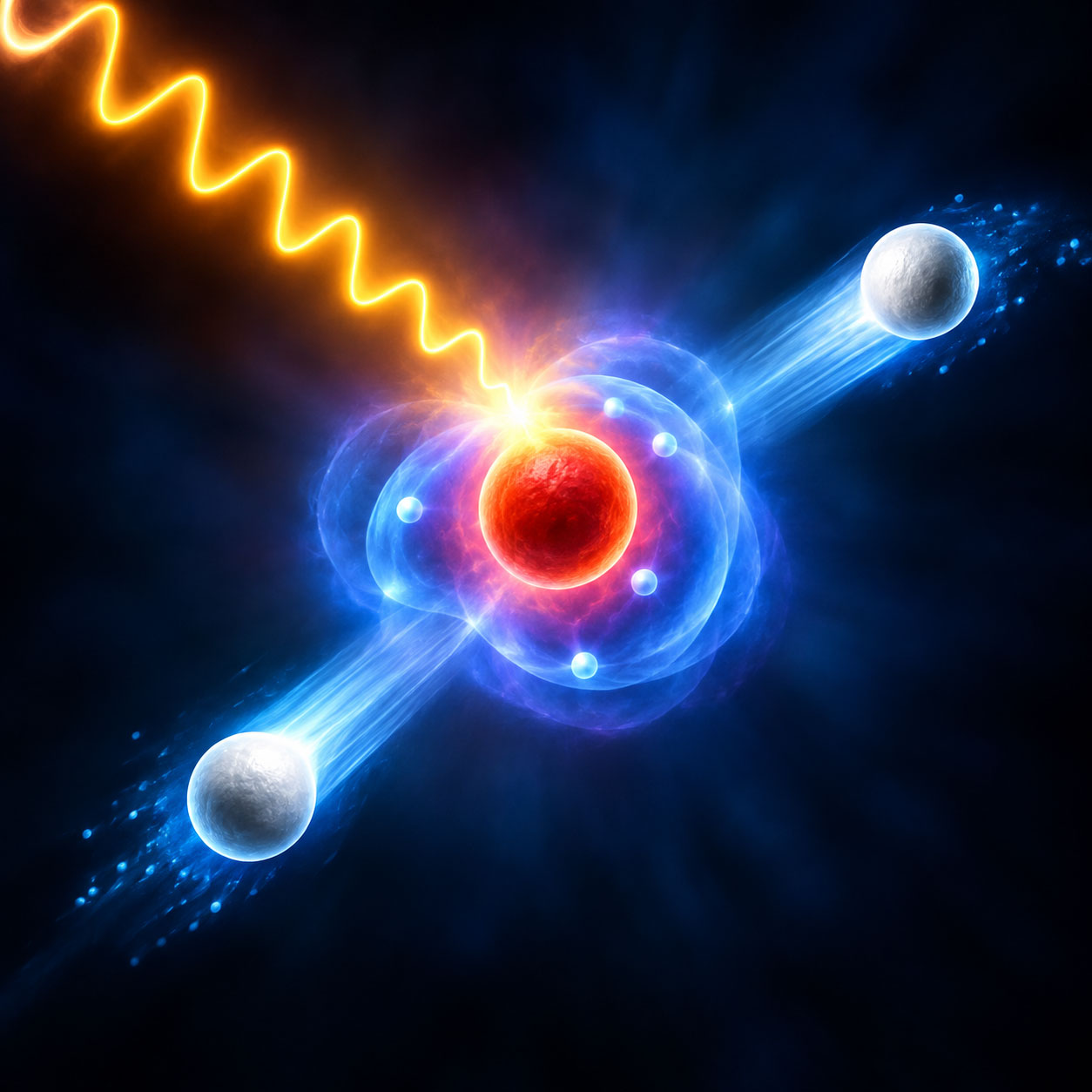
When X-rays strike a water molecule, the molecule can break apart faster than its electrons can complete a fundamental relaxation process. Scientists have discovered that both bonds holding hydrogen to oxygen can rupture within just a few femtoseconds, leaving behind an excited, electrically neutral oxygen atom.
The discovery challenges established interpretations of how water responds to X-ray radiation. It also identifies a previously overlooked source of highly reactive atomic oxygen, which can participate in further chemical reactions.
Water Molecules Break Apart Before Their Electrons Relax
When a water molecule absorbs a sufficiently energetic X-ray photon, an electron can be ejected from an inner shell of its oxygen atom. The resulting vacancy normally triggers Auger decay, a rapid process in which another electron fills the vacancy and transfers enough energy to eject a second electron.
However, the researchers found that the molecular structure can change even faster. The particular electronic state produced by X-ray absorption creates strong repulsive forces, allowing both oxygen-hydrogen bonds to break before Auger decay occurs.
“What makes this result particularly exciting is that we see the molecule break apart before the electronic relaxation has even finished. Both O–H bonds rupture within the lifetime of the oxygen core hole, so the nuclear motion is essentially winning the race against the electrons,” explained Florian Trinter of FHI in Berlin.
Two X-ray Facilities Reveal the Same Atomic Signature
The team examined isolated water molecules in the gas phase using high-resolution electron spectroscopy at two synchrotron facilities: PETRA III at DESY in Hamburg, Germany, and the FlexPES beamline at MAX IV in Lund, Sweden.
Both experiments detected unusually sharp peaks at specific electron energies. These features could not be explained by the electronic decay of intact water molecules or the molecular fragments typically expected after X-ray absorption.
“Seeing the characteristic signal also at MAX IV was an important part of establishing this as a genuine molecular fragmentation pathway. The measurements at the two facilities give us a very consistent picture of what happens to the water molecule after X-ray excitation,” said Gunnar Öhrwall of MAX IV in Lund.
Calculations Identify the Unexpected Oxygen Product
To determine what produced the unusual electron signals, the researchers performed detailed molecular and atomic calculations. The predicted electron energies matched the decay of excited neutral oxygen atoms rather than hydroxyl (OH) fragments.
This distinction matters because the energies of emitted electrons depend on the electronic structure of the atom or molecule producing them. The exceptionally narrow spectral features provided a recognizable signature of oxygen that had already separated from the original water molecule.
“The energy of the emitted electrons provides a kind of fingerprint of the state that is formed. Our calculations show that the observed features are consistent with the decay of an excited neutral oxygen atom that has already separated from the water molecule,” explained Ludger Inhester of CFEL at DESY in Hamburg.
What the Discovery Means for Radiation Chemistry
The results offer a new explanation for high-energy electron features observed in earlier water experiments. Signals previously associated with hydroxyl fragments may instead originate from excited neutral oxygen atoms produced through extremely rapid molecular fragmentation.
Because neutral atomic oxygen is highly reactive, understanding how it forms could improve models of chemical processes initiated by X-ray radiation. The findings also provide a more precise basis for interpreting electron spectra from water and related molecular systems.
Reference: “Ultrafast Dissociation of Water Producing Atomic Oxygen following Excitation above the O 1s Threshold” by Florian Trinter, Stephan Thürmer, Qi Zhou (周琪), Uwe Hergenhahn, Bernd Winter, Olle Björneholm, Maxim Tchaplyguine, Ludger Inhester and Gunnar Öhrwall, 5 November 2026, Physical Review Letters.
DOI: 10.1103/c1hm-82p2
Never miss a breakthrough: Join the SciTechDaily newsletter.
Follow us on Google and Google News.