
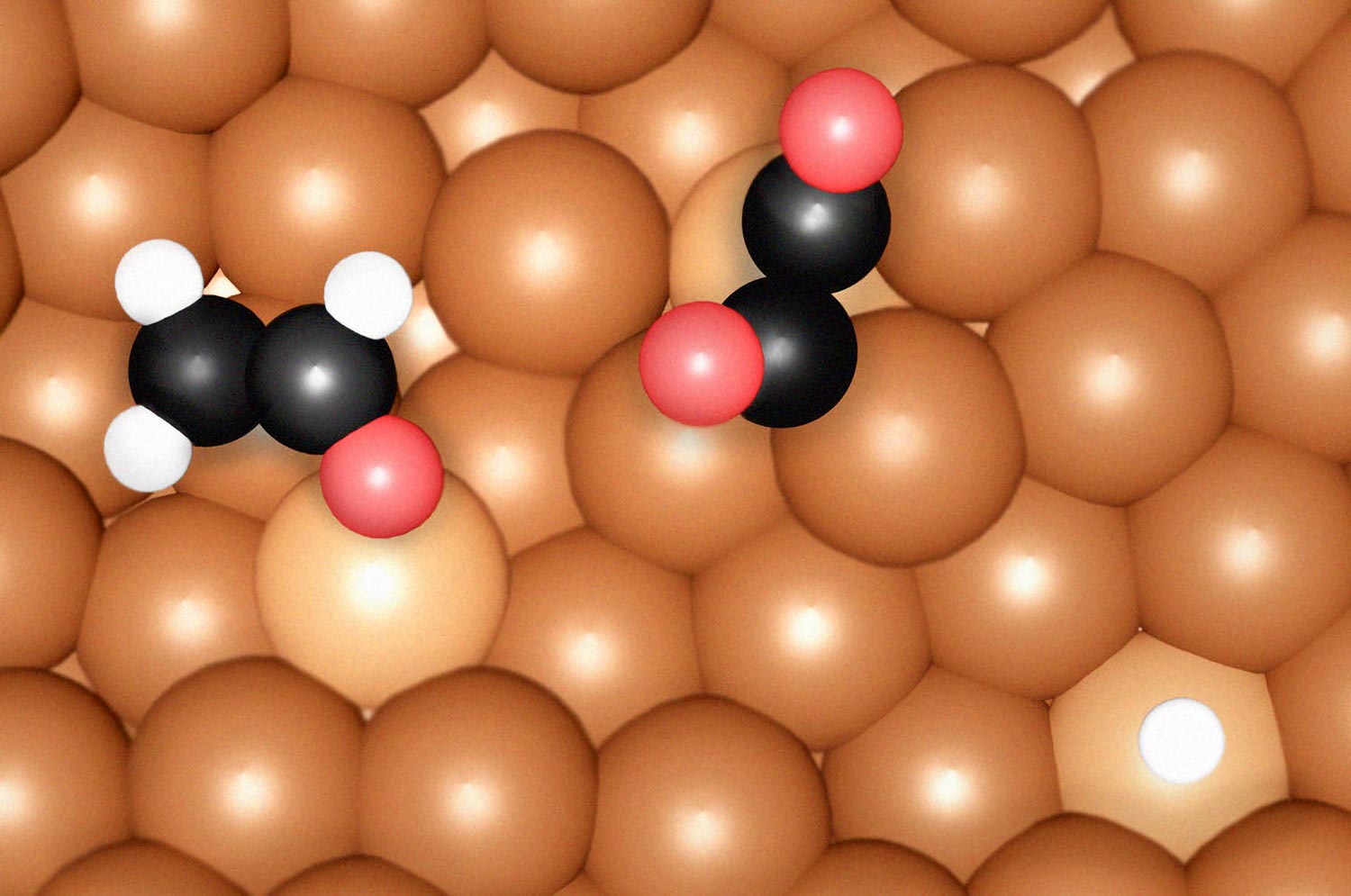
Researchers have made significant advancements in CO2 electroreduction technology, identifying specific catalyst sites and mechanisms for converting CO2 into ethylene and ethanol, crucial for sustainable fuel and plastic production.
A groundbreaking study takes advantage of advanced spectroscopic methods and theory to shed light on the intricate processes involved in converting carbon dioxide (CO2) into valuable chemicals. This research could significantly enhance sustainable practices in the chemical industry by advancing the development of efficient and sustainable catalysts.
CO2 Reduction: A Pathway to Valuable Chemicals
The electrochemical reduction of CO2 (CO2RR) is a promising technology that uses renewable electricity to convert CO2 into high-value chemicals, effectively closing the carbon cycle. Ethylene and ethanol, the focus of this study, are crucial for producing environmentally friendly plastics and fuels, respectively.
However, the exact mechanisms and intermediate steps involved in this conversion have remained elusive until now. The mechanistic understanding is crucial in order to rationally design the active sites, which we show here are not only present in the synthesized pre-catalyst, but can also be formed and evolve in the course of the reaction through the interaction with reactants and reaction intermediates.
Key Findings: Spectroscopic Insights and Theoretical Support
The research team led by group leader Dr. Arno Bergmann, Prof. Dr. Beatriz Roldán Cuenya, and Prof. Dr. Núria López employed in-situ surface-enhanced Raman spectroscopy (SERS) and density functional theory (DFT) to investigate the molecular species on copper (Cu) electrocatalysts and thereby, gain insights into the reaction mechanism.
Their findings reveal that the formation of ethylene occurs when specific intermediates, known as *OC-CO(H) dimers, form on undercoordinated Cu sites. Conversely, the production of ethanol requires highly compressed and distorted coordination environment of the Cu sites, with the key intermediate *OCHCH2.
Understanding the Role of Surface Morphology
One of the critical discoveries is the role of surface morphology in the reaction process. The team found that the undercoordinated Cu sites strengthen the binding of CO, a crucial step in the reduction process. These Cu sites, characterized by atomic-level irregularities, likely form under reaction conditions and make the catalytic surface more effective, leading to better performance in producing ethylene and ethanol.
Implications for the Chemical Industry
These findings can have significant implications for the chemical industry, particularly in the production of plastics and fuels. By understanding the specific conditions and intermediates required for the selective production of ethylene and ethanol, researchers can design more efficient and sustainable catalysts. This could lead to more effective ways to utilize CO2, reducing the carbon footprint of chemical manufacturing processes.
Collaborative Effort
The study was a collaborative effort, with theoretical support from a research group in Spain. This partnership allowed for a comprehensive investigation, combining experimental and theoretical approaches to provide a detailed understanding of the CO2 reduction process.
Conclusion
The research conducted by the Interface Science Department at the Fritz Haber Institute and Institute of Chemical Research of Catalonia represents a significant step forward in the field of CO2 reduction. By unveiling the key intermediates and active sites involved in the production of ethylene and ethanol, this study provides a foundation for developing more efficient and sustainable catalytic processes.
The findings not only advance scientific knowledge but also offer practical solutions for reducing CO2 emissions and promoting sustainable chemical production.
Reference: “Key intermediates and Cu active sites for CO2 electroreduction to ethylene and ethanol” by Chao Zhan, Federico Dattila, Clara Rettenmaier, Antonia Herzog, Matias Herran, Timon Wagner, Fabian Scholten, Arno Bergmann, Núria López and Beatriz Roldan Cuenya, 11 September 2024, Nature Energy.
DOI: 10.1038/s41560-024-01633-4
Never miss a breakthrough: Join the SciTechDaily newsletter.
Follow us on Google and Google News.
3 Comments
Look at the quality of the fit to the Cu AES region. They are fitting a Cu metal feature that is smaller than the noise level while ignoring a gap in the fit at slightly higher energy that is also bigger than the fitted Cu metal peak. The data fitting is laughable as myself and several colleagues have found out
Metal complex with CO2 which gives ßpecific IR are reported which on reduction with strong reducing agent gives methanol .
Chemically reduction of CO2 to methanol is possible it is obtained as side product.
N2Cl and CO2 could form four membered Lactone carbondioxide can be stored . Nitrogen carrying positive charge CO2 can be trapped using such chemistry examples are reported published report we can say observation such complex are formed can be use to reduced carbon dioxide footprint.
In general, research to improve the efficiency of common industrial chemical reactions is good. However, the reader should not expect any sudden breakthroughs that revolutionize our chemical industries and economy. There is no such thing as a ‘Perpetual Motion’ machine. There are always losses in chemical systems and the best that one can hope for is to minimize those.